
Yoga for Flexibility: A 20-Minute Home Routine for Stiff Beginners
Flexibility is not about touching your toes on the first day. It is about moving a little more freely than you did last month — reaching the top shelf without a stretch of effort, sitting cross-legged without your hips complaining, bending to tie your shoes without a groan. For beginners who feel stiff everywhere, yoga is one of the most practical ways to get there, because it combines stretching, strength, and breathing in a single quiet session.
This routine takes twenty minutes, needs only a mat or a rug, and is designed for people who have never done yoga before. Every pose has a simple, forgiving version. Hold each pose for three to five slow breaths, move gently between them, and never force a position. Flexibility improves through regular, gentle practice — not through one heroic session.

Before You Begin: The Rules for Stiff Beginners
Warm up first. Stretching cold muscles is less effective and less comfortable. March in place for two minutes, roll your shoulders, and swing your arms gently before starting the routine. A warm body stretches more easily.
Breathe through every pose. Slow breathing — in through the nose, out through the nose or mouth — helps the muscles relax into a stretch. If you are holding your breath, you are pushing too hard.
Find the edge, not the pain. A stretch should feel like a gentle pull, about a four or five out of ten. Sharp pain, pinching, or numbness means you have gone too far. Back off until the sensation is mild, then breathe there.
Both sides, every time. The body is rarely symmetrical. Always stretch both sides, and spend a little longer on the side that feels tighter.
The 20-Minute Routine
1. Easy seated pose with side stretches (2 minutes). Sit cross-legged on your mat, or on a cushion if your hips are tight. Sit tall, raise your right arm overhead, and lean gently to the left. Hold for four breaths, then switch sides. This opens the sides of the torso and wakes up the spine.
2. Tabletop cat-cow (2 minutes). Come onto hands and knees, wrists under shoulders, knees under hips. As you inhale, arch your back gently and lift your head and tailbone. As you exhale, round your spine and tuck your chin. Move slowly between the two shapes for six breaths. This is the best first movement for a stiff spine.
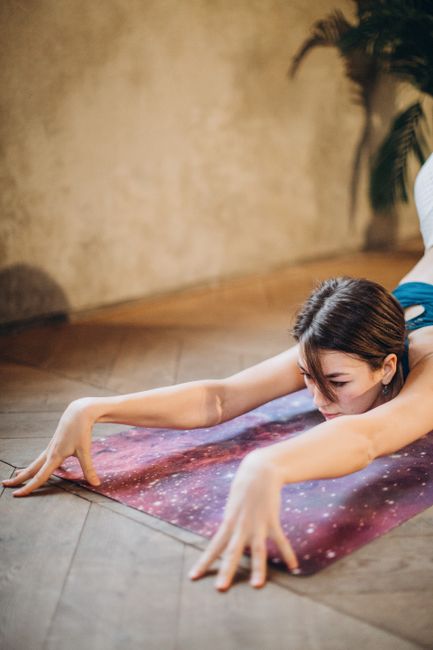
3. Child's pose (2 minutes). From tabletop, sit your hips back toward your heels and stretch your arms forward along the floor, forehead resting on the mat. Breathe slowly. Child's pose stretches the hips, thighs, and lower back, and it is a restful place to return to whenever you need a break.
4. Downward-facing dog, with bent knees (2 minutes). From tabletop, tuck your toes, lift your hips up and back, and straighten your legs as much as is comfortable. Keep your knees generously bent if your hamstrings are tight — straight legs are not the goal. Pedal your feet gently, bending one knee and then the other. Hold for four slow breaths. This pose stretches the whole back of the body.
5. Low lunge (2 minutes per side). Step your right foot forward between your hands and lower your left knee to the floor. Place your hands on your front knee or on blocks or books beside you. Sink your hips gently forward until you feel a stretch at the front of the left hip. Hold for four breaths, then switch sides. Tight hip flexors are one of the most common causes of stiffness in people who sit all day, and the low lunge is the direct fix.
6. Standing forward fold (2 minutes). Stand with feet hip-width apart, bend your knees generously, and fold forward, letting your head and arms hang. Sway gently from side to side. Hold for four breaths, then roll up slowly, one vertebra at a time. Keep the knees bent — this is a hamstring and back stretch, not a test of straight legs.
7. Seated forward fold (2 minutes). Sit with your legs extended in front of you and a cushion under your hips if your lower back rounds. Bend your knees slightly, reach your arms forward, and fold gently toward your legs. Hold for four breaths. You should feel a stretch along the backs of the legs, not strain in the lower back.
8. Supine figure-four stretch (2 minutes per side). Lie on your back, cross your right ankle over your left knee, and draw the left knee toward your chest. Hold for four breaths, then switch sides. This is one of the most effective hip stretches there is, and because you are lying down, it is easy to relax into it.
9. Reclined twist (2 minutes per side). Lie on your back, hug your knees to your chest, then drop both knees to the right while opening your arms wide. Hold for four breaths, feeling a gentle twist through the spine, then switch sides.
10. Final rest (2 minutes). Lie flat on your back, arms relaxed at your sides, palms up. Close your eyes and breathe slowly. This short rest lets your body absorb the work and is part of the practice, not a luxury.
How Often Should You Practise?
Three to four times a week is ideal for a beginner. Daily practice is wonderful if you enjoy it, but three sessions a week still produces steady improvement. Flexibility changes slowly — most people notice a real difference after three to four weeks of regular practice, not after three days. That is normal. The body adapts to consistent, gentle stress over time.
If twenty minutes feels like too much on a busy day, do the first five poses only. A ten-minute session you actually do is worth more than a twenty-minute session you keep postponing. Short sessions also keep the habit alive during busy weeks.
Mistakes That Slow Your Progress
- Bouncing in stretches. Bouncing triggers the muscles to tighten protectively, which is the opposite of what you want. Move into a stretch slowly, hold it still, and breathe.
- Comparing yourself with others. Flexibility varies enormously between people and depends on body shape, age, and history. Your only useful comparison is with yourself last month.
- Only stretching what is already flexible. It is tempting to spend time on the stretches that feel easy and avoid the tight spots. Spend extra time on the stiff areas — hips, hamstrings, and shoulders for most people.
- Skipping the warm-up. Cold muscles resist stretching. Two minutes of marching and arm swings makes the whole routine more comfortable and more effective.
- Practising once a week and expecting fast results. Flexibility is a use-it-or-lose-it quality. Short, frequent sessions beat rare long ones.
Frequently Asked Questions
How long does it take to become flexible? It depends on your starting point, but most beginners feel noticeably looser within three to four weeks of practising three times a week. Deeper changes — a comfortable cross-legged sit, an easier forward fold — typically take two to three months. There is no finish line; flexibility is a practice, not a destination.
Can I do yoga if I am not flexible at all? Yes — stiffness is the reason to start yoga, not a reason to avoid it. Every pose in this routine has a beginner version, and props like cushions and books make poses accessible at any level of flexibility.
Is yoga enough exercise on its own? Yoga is excellent for flexibility, balance, and stress relief. For complete fitness, combine it with some strength training and cardio during the week — even two short strength sessions and a few walks make a balanced routine.
Should stretching hurt? No. A stretch should feel like a mild, pleasant pull. Sharp pain, joint pain, or tingling means you should back off or skip that pose. If pain persists, speak to a health professional.
Conclusion
Flexibility is not a talent you are born with — it is a quality you build, a few minutes at a time. This twenty-minute routine gives you a simple, repeatable practice: warm up, move through ten gentle poses, breathe slowly, and rest at the end. Do it three times a week for a month and notice what changes. Your hips will open, your spine will move more freely, and everyday movements — sitting, bending, reaching — will start to feel easier. That is what yoga for flexibility is really for: not impressive poses, but a body that moves well through an ordinary day.


