I have bought the resistance bands, the adjustable dumbbells, and, in a moment of late-night optimism, a pull-up bar that is still in its box behind the bedroom door. None of them made me fit. What finally did was a twenty-minute bodyweight routine in my living room, done four mornings a week, with no equipment at all except a yoga mat I already owned. It is not glamorous. It is not the routine I would post online to impress anyone. It is the first routine I have actually stuck to for more than three months, and that, I have learned, matters more than any perfect plan.
The first time I tried home workouts went wrong because I copied a gym routine into my living room. Forty-five minutes, twelve exercises, burpees at 6 in the morning, and a warm-up that was longer than my patience. I lasted nine days. Day ten, I looked at the list, felt tired just reading it, and went back to bed. The problem wasn't laziness, although I called it that at the time. The problem was that the routine was designed for someone with an hour, a gym floor, and a level of fitness I did not have. I needed something I could start half-asleep and finish before my coffee got cold.
The twenty minutes that actually happen
Here is the routine, exactly as I do it. Five exercises, four rounds, forty seconds of work and twenty seconds of rest for each one. That is five minutes per round, four rounds, twenty minutes total, including the rest between rounds. I set a free interval timer on my phone, put it on the floor where I can see it, and I don't touch it again until the timer ends. No decisions mid-workout, no skipping the hard exercise because I feel like it. The timer decides.
The five moves are squats, push-ups, reverse lunges, plank shoulder taps, and glute bridges. I picked them because together they cover legs, chest, back, core, and glutes, and none of them need space beyond a mat's width. Squats are bodyweight only, feet shoulder-width apart, sitting back like I am aiming for a low chair. Push-ups are from the knees on days when my shoulders are tired, full push-ups when they are not, and I stopped feeling guilty about the knee version months ago. It still builds strength, and it keeps my form honest.
Reverse lunges replaced forward lunges after my knees complained for a week. Stepping backward is gentler on the knees and easier to balance in a small room. I alternate legs each rep, keep my chest tall, and touch my back knee lightly to the mat without slamming it down. Plank shoulder taps are my core move, and they are harder than they look: hold a plank, tap one hand to the opposite shoulder, try not to rock your hips. If my hips swing like a boat, I widen my feet. Glute bridges finish the round, lying on my back, feet flat, lifting my hips and squeezing at the top for a second. Boring? Yes. Effective? My lower back, which used to ache after sitting all day, has not complained in two months.
How I built up without burning out
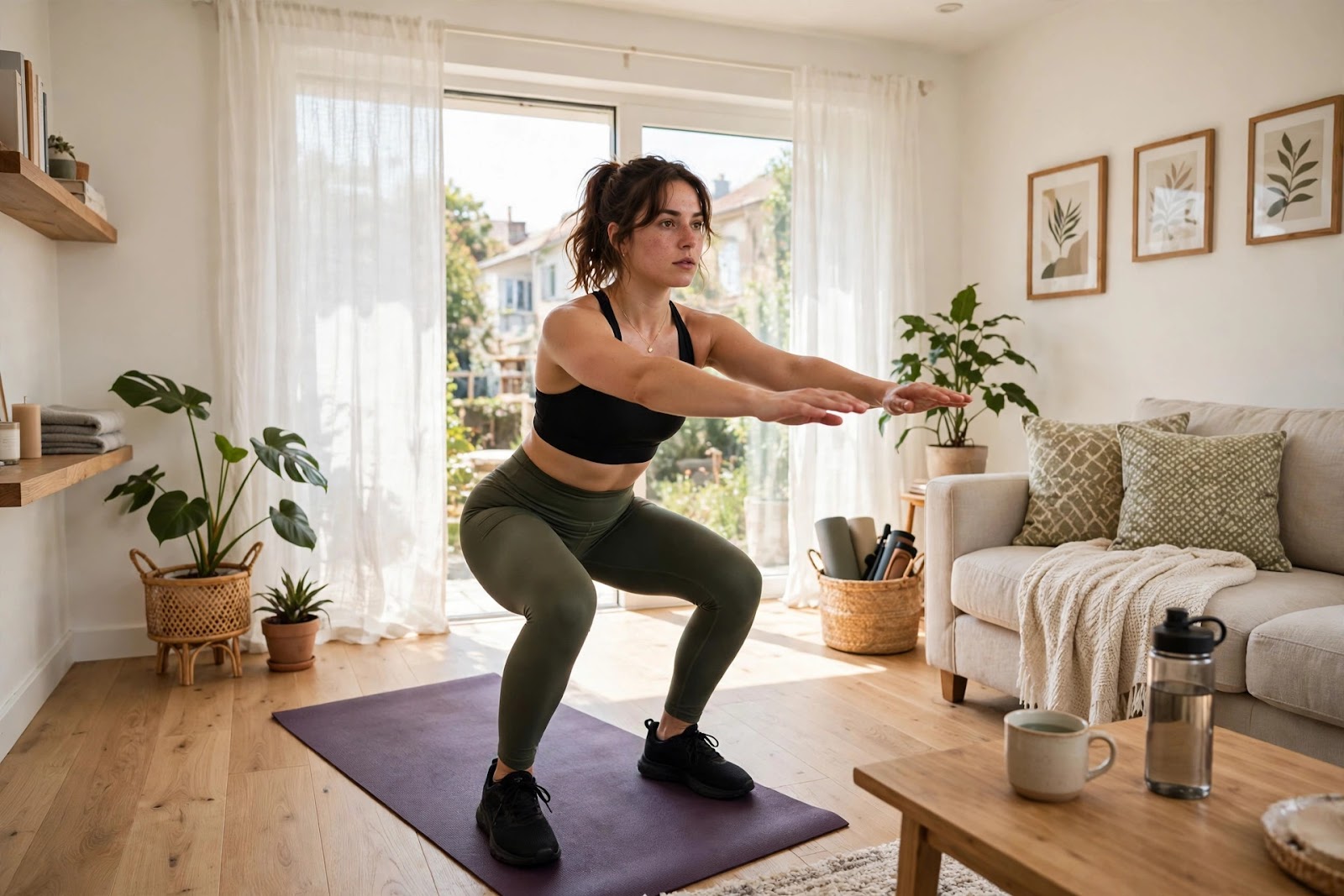
I did not start with four rounds. I started with two rounds, ten minutes, three mornings a week, and I stayed there for two full weeks. It felt too easy, and that was the point. Easy is repeatable. When ten minutes felt like a habit instead of a chore, I added a third round. Two weeks later, a fourth. When forty seconds of push-ups became manageable, I didn't add a sixth exercise. I slowed the push-ups down, three seconds lowering, one second up, which made the same forty seconds much harder without adding time.
Progression at home is mostly about tempo and range, not new equipment. Squats became slower squats, then squats with a three-second pause at the bottom. Lunges became lunges with a longer step back. Planks became shoulder taps with feet closer together. I keep a small notebook by the mat and write one line after each session: date, rounds, and one note, like "push-ups full, 12 per round" or "knees sore, used knee push-ups." That notebook is how I know I am improving, because memory lies and says nothing has changed. The notebook says I went from six knee push-ups per round to fourteen full ones in ten weeks.
Warm-up is two minutes, not ten. I do thirty seconds each of marching in place, arm circles, hip circles, and slow squats, and then I start. Cooling down is one minute of stretching: hamstrings, chest, and hip flexors, the three places that tighten from sitting. I used to skip both and wonder why my shoulders felt stiff. Two minutes at the start and one at the end is three minutes I can defend, and it means the whole session, warm-up to stretch, is still under twenty-five minutes door to door.
The part nobody posts about
The hardest part was not the exercises. It was the mornings I woke up tired, or it rained, or I had a bad night's sleep, and the mat looked like an accusation. My rule for those mornings is the two-minute rule: I only have to start. Put the mat down, do the warm-up, do one round. If I still want to stop after one round, I am allowed to stop, no guilt. I have used that escape clause maybe four times in three months. Every other time, one round turned into four, because starting was the hard part, not continuing.
I also stopped working out in my bedroom, where the bed was three steps away and extremely persuasive. The living room, with the curtains open and the mat facing the window, works better. I lay the mat out the night before, so the morning decision is already made. If the mat is rolled up in a cupboard, I will find a reason not to unroll it. If it is already on the floor, I step on it while the kettle boils and the workout starts almost by accident. Environment beats willpower, every single time.

One honest warning: bodyweight training has a ceiling if you never change anything. After three months, my squats stopped feeling challenging, and my progress stalled for two weeks. I didn't buy weights. I switched to single-leg variations: split squats with my back foot on the sofa, and single-leg glute bridges. Same twenty minutes, same living room, harder stimulus. If you reach that point, change the leverage before you change the equipment. A backpack with a few books in it also works as a weighted vest for squats, and it costs nothing.
Results, since people always ask: I can do fourteen full push-ups in a row now, up from three. I can hold a plank for ninety seconds without my hips sagging. My resting heart rate dropped from 78 to 68 over three months, measured on the same cheap fitness watch every morning. I have not lost dramatic weight, about three kilos, because I did not change my eating much, and I am not going to pretend otherwise. What changed most is that I no longer get out of breath climbing the three flights to my flat, and my back doesn't ache at my desk by 4 in the afternoon.
What I track, and what I ignore
I track only three things: sessions done, rounds completed, and one form note. I do not track calories burned, because my watch's estimate swings wildly and chasing it made me overeat on workout days. I do not photograph progress weekly, because lighting changes fool me more than the mirror does. The notebook line is enough, and it takes ten seconds. If a system needs an app, a spreadsheet, and a weekly review, I will abandon it. A notebook by the mat survives.
I also ignore the urge to train every day. Four mornings a week, Monday, Wednesday, Friday, and Saturday, leaves three rest days, and those rest days are when the strength actually builds. Early on I tried six days a week and felt weaker by week three, not stronger. Rest is not laziness. It is part of the programme, and treating it that way stopped the guilt spiral that used to end my routines.
If you have tried home workouts before and quit, don't buy anything new and don't download a new app. Pick five moves you can do in your living room, set a timer for twenty minutes, and do two rounds, three mornings this week. Write it in a notebook. Let it feel too easy for two weeks. The routine you actually do, four times a week for three months, will beat the perfect routine you quit on day nine, and I know that because I have been both people.


