I used to lie awake for an hour every night, replaying the day and planning tomorrow, while my body refused to switch off. My mind was tired. My muscles were not. That mismatch, I eventually realized, was a big part of why I could not sleep.
I did not set out to fix my sleep with stretching. I set out to fix my stiff neck. I spent most days at a desk, shoulders creeping up toward my ears, and by evening my upper back felt like a single knotted rope. A friend suggested ten minutes of gentle stretching before bed. I tried it mostly to stop complaining about my neck.
The sleep improvement showed up first, and it showed up fast. Within the first week, I was falling asleep noticeably quicker. By the end of the month, my whole evening felt different. This is what I actually did, what helped, what did not, and what I would change if I started again.
The routine I actually followed
Ten minutes, every night, in my bedroom, on a thin mat I already owned. No app, no video, no special clothes. I did it in the T-shirt and joggers I was already wearing, usually around 10:30, about half an hour before I wanted to be asleep.
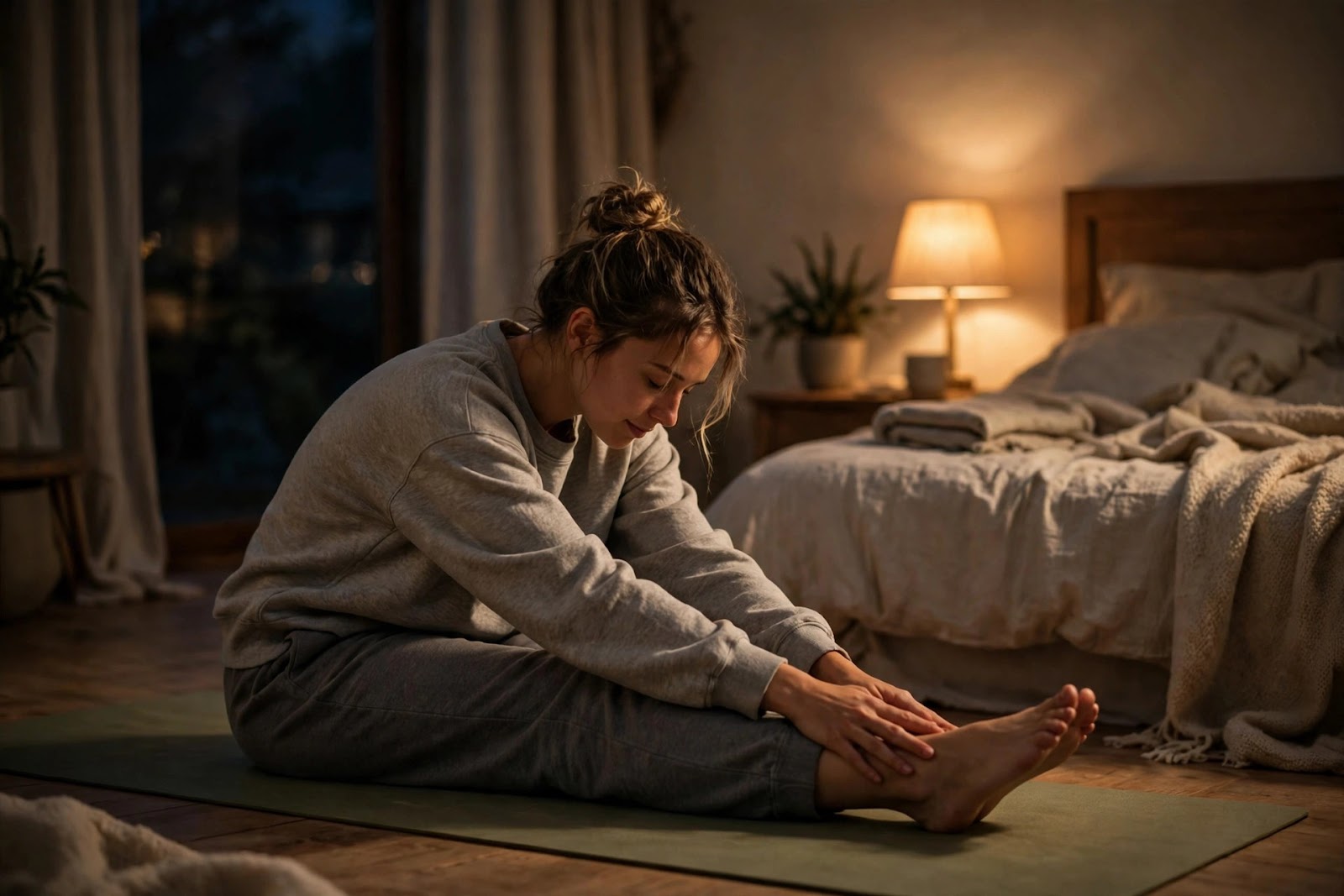
The order never changed, and I think that mattered. Neck rolls first, then shoulder rolls, then a seated forward fold, then a gentle spinal twist each side, then a hip stretch, then child's pose to finish. Six moves, roughly ninety seconds each, with slow breathing throughout. I was not chasing flexibility records. I was winding down.
I kept the lights low. Not candlelit-romantic low, just the bedside lamp instead of the bright ceiling light. My phone went on silent and face-down on the dresser before I started. That rule was harder than any stretch, honestly. The first three nights I caught myself reaching for it mid-routine out of pure habit.
Why ten minutes, and why at night
Ten minutes is short enough that I could not talk myself out of it. Twenty minutes would have felt like a commitment. Thirty would have needed scheduling. Ten minutes is the gap between "I should brush my teeth" and "I am actually in bed," and it fit there without displacing anything else.
Doing it at night, rather than in the morning, changed what the stretching was for. Morning stretching wakes you up. Evening stretching, done slowly, tells your nervous system the day is over. I stopped thinking of it as exercise and started thinking of it as a closing ritual, like locking the front door or turning the house lights off one by one.
That framing helped on nights when I was exhausted and tempted to skip it. I told myself I was not working out, I was closing up shop. Some nights the stretches were barely stretches at all, just slow movements and breathing. Those nights still counted, and I think they still helped, because the ritual itself was part of the effect.
Week one: the surprise was speed
Night one, I fell asleep in about forty minutes instead of my usual hour-plus. I noticed because I was still awake enough to be annoyed at being awake, but less annoyed than usual. Night three, it was closer to half an hour. By night six, I was asleep within twenty minutes twice in a row, which had not happened in months.
I want to be careful here, because I am not claiming stretching cured insomnia or anything dramatic. I did not have a medical sleep problem. I had a busy-brain, stiff-body problem, and the stretching addressed exactly the physical half of it. My shoulders dropped. My jaw unclenched. My breathing slowed down without me forcing it.
One thing I did wrong in week one: I stretched too hard. Old habits from school PE kicked in, and I pushed into each stretch like I was trying to win something. My hamstrings protested the next morning. Gentle is the whole point here. A stretch at night should feel like a sigh, not a test. Once I backed off to about seventy percent effort, the morning stiffness vanished.
Weeks two and three: the deeper changes
In week two, I started waking up less during the night. Before, I would wake at 3 a.m., check the clock, and lie there doing mental maths about how many hours were left. That 3 a.m. wake-up did not vanish completely, but it got rarer, and when it happened I fell back asleep faster instead of spiraling.
My morning stiffness improved too, which I had not expected to care about as much as I did. Getting out of bed used to involve a slow, creaky sit-up and a minute of standing still while my back decided whether it was cooperating. After two weeks of nightly stretching, that first minute of the day felt normal. Not athletic, just normal.
Week three brought the most useful discovery: the routine started working even on stressful days. I had a genuinely bad day in week three, a work deadline slipping and a bill I had not budgeted for, and I fully expected a terrible night. I did the stretches anyway, half-heartedly, and still fell asleep in about twenty-five minutes. The routine had become a buffer between a bad day and a bad night.
That is when I stopped thinking of it as an experiment and started thinking of it as a permanent part of my evening. Experiments end. This one had earned its place, not because it was impressive, but because it quietly made bad days less costly.
The six moves, in plain language
People keep asking me exactly what I did, so here it is without jargon. Neck: slowly roll your head in a wide circle, five times each way, stopping if anything pinches. Shoulders: big slow rolls, forward then back, letting your arms hang loose.
Seated forward fold: sit with legs straight out, reach gently toward your toes, and stop where you feel a mild pull. You do not need to touch your toes. I still cannot, after a month, and it does not matter. Hold, breathe, come back up slowly.
Spinal twist: sit tall, twist gently to one side, hold for a few breaths, then the other side. No forcing, no cracking your back on purpose. Hip stretch: lie on your back, cross one ankle over the opposite knee, and draw the bottom leg gently toward you until the outer hip feels stretched.
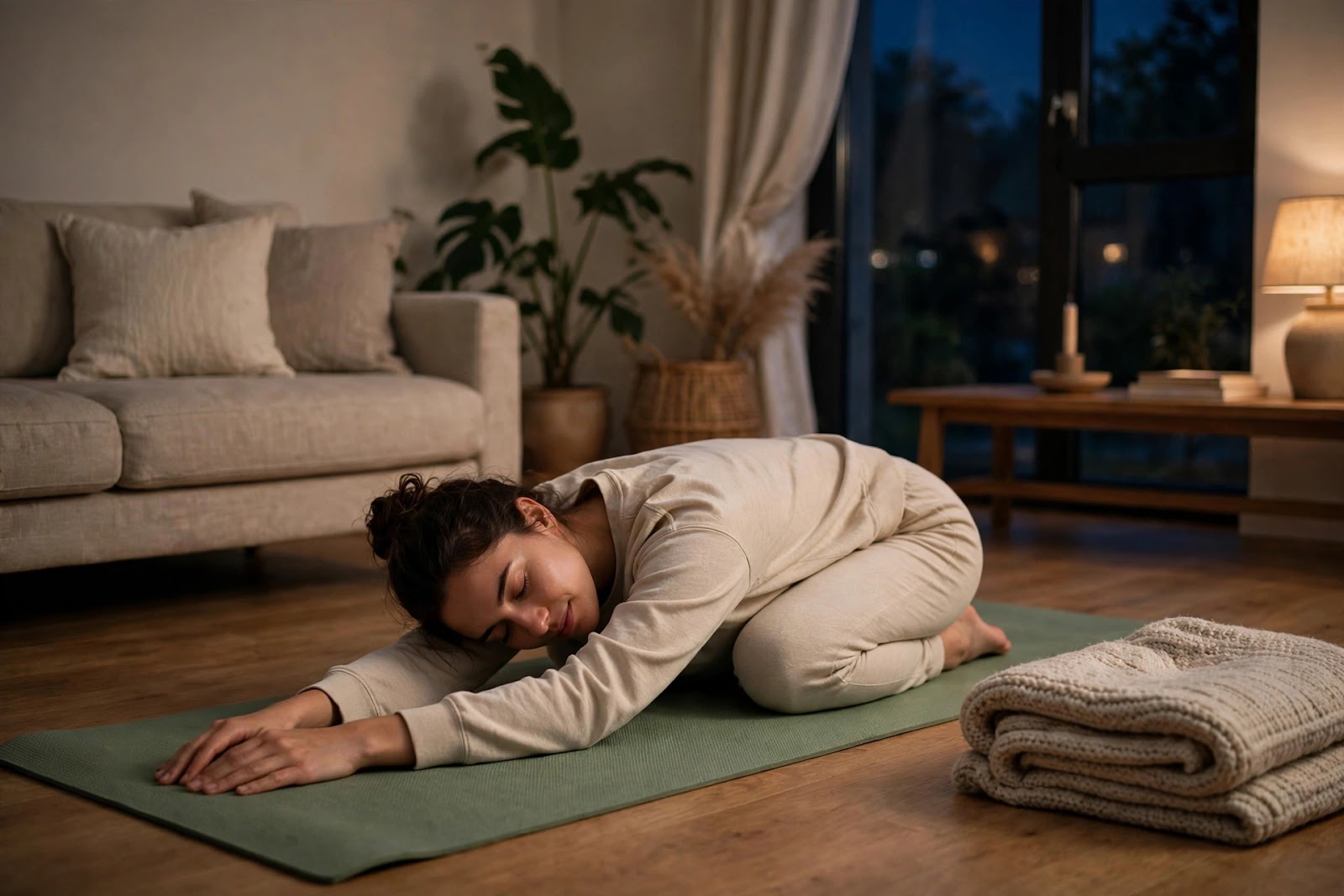
Child's pose to finish: knees wide, sit back toward your heels, arms stretched forward on the mat, forehead resting down. Stay there for the last ninety seconds and just breathe. This is the move that most feels like switching off. If you only have two minutes one night, do this one and the neck rolls, and call it done.
What did not help, and what I dropped
I tried adding a foam roller in week two because I owned one and felt guilty about ignoring it. Bad idea at night. Rolling is intense, it woke my muscles up instead of calming them, and it added five minutes of faffing about on the floor. The roller went back in the cupboard, where it belongs until morning workouts.
I also tried stretching in front of the television once, thinking I could combine it with winding down in front of a show. It did not work. Half my attention was on the screen, my breathing stayed shallow, and I finished feeling neither stretched nor rested. The no-screens rule during those ten minutes is not optional, in my experience.
Music, on the other hand, helped a little. Not a playlist I had to manage, just a single long, quiet instrumental track I played from a speaker every night. After a week, hearing the first notes of that track made my shoulders drop before I had even started stretching. That is a conditioned cue, and I will happily take it.
Week four: what a month actually gave me
By the end of the month, my average time to fall asleep had dropped from over an hour to roughly twenty to thirty minutes. I tracked it loosely, just noting the time when I got into bed and roughly when I drifted off, not with any gadget. Some nights were still bad. Two nights in week four were still over forty minutes. But the average had moved, and the average is what your life feels like.
I also woke up feeling less groggy, which I think came from fewer night wakings rather than more total sleep. I was still getting about seven hours, roughly the same as before. The difference was that the seven hours were less broken. I stopped needing a second alarm, which is a small thing that improved my mornings more than I expected.
My neck and shoulders, the original reason I started, were genuinely better. The knot between my shoulder blades that used to need a weekly massage from my wife had softened to something I could manage myself. She was pleased, for obvious reasons. My posture at my desk improved slightly too, though I suspect that was just because I was more aware of my shoulders after stretching them every night.
The nights it failed, honestly
Not every night worked. One night I came home late, skipped the routine, and lay awake for ninety minutes. That was useful data, actually: skipping it cost me more than doing it badly. A rushed, half-hearted two-minute version still beat nothing, and I learned to do the short version rather than skip entirely.
Another night, after too much coffee at 7 p.m., no amount of stretching could override the caffeine. I lay there, loose and relaxed, wide awake. Stretching is not magic. It cannot cancel a late coffee, a stressful argument right before bed, or a room that is too hot. It just lowers the physical noise so the rest of your sleep system has a chance.
There were also two nights where my mind simply would not stop, even though my body was calm. On those nights, I added slow breathing in bed: in for four counts, out for six, for about five minutes. That combination, stretch first then breathing, worked better than either alone. I now use the breathing on restless nights without thinking about it.
How to start tonight, without overthinking it
Do not buy anything. Do not download an app. Do not watch a forty-minute video to learn a ten-minute routine. Put your phone face-down, dim the lights, and do six gentle moves for ten minutes before bed. That is the whole starter plan.
Keep the effort gentle, about the level where you can still breathe normally and even smile. If a stretch hurts, back off immediately. Sharp pain is not a badge of honor, it is information. And keep the same order every night for at least a week, because the sameness is what turns it into a cue your body recognizes.
Track it loosely if that helps you stick with it. I kept a one-line note each morning: time to sleep, roughly, and how I felt. Seeing "20 min, good" repeated down the page was more motivating than any streak app. If you miss a night, do not restart the count from zero. Just do it the next night. A missed night is a comma, not a full stop.
So my practical takeaway is simple, and it is the same one I would give a friend who complained about lying awake. Tonight, give your body ten slow minutes to finish the day before you ask it to sleep. Stretch gently, breathe slowly, and let your shoulders drop. My sleep did not transform overnight, but over a month it quietly shifted from an hour of tossing to twenty minutes of drifting, and that difference has been worth every one of those ten-minute evenings.


