My stairs used to be the enemy. Not in a dramatic way — just in the quiet, everyday way where I'd get to the bottom of them carrying laundry and think "ugh," the way you'd think about a chore you can't delegate. Two flights, fourteen steps each, and by the top I'd be breathing through my mouth like I'd run for a bus. I'm thirty-four, I walk a fair amount, I'm not unfit exactly — but stairs had my number.
Then one Tuesday in March, waiting for the kettle to boil, I did something on a whim. I stepped up onto the bottom stair with my right foot, brought the left up, stepped back down. Then again. Left foot leading this time. It felt... fine. Easy, even. Boring, honestly. So I kept going until the kettle clicked — maybe three minutes — and my thighs were warm in a way they hadn't been in ages. That was the whole origin story. No programme, no app, no epiphany. Just a kettle and a staircase.
Four weeks later, stairs felt different. Noticeably, undeniably different. I want to tell you exactly what I did, because it's the simplest bit of home fitness I've ever stuck with, and it's the only "programme" I've done that survived contact with my actual life — the job, the kids' schedules, the days when motivation is a rumour.
Why stairs, of all things
I'd tried the usual home workout routes before. I owned a set of resistance bands that lived, tangled, in a drawer. I'd done a month of a popular bodyweight app and quit when the burpees started (I'm not ashamed; burpees are a young person's game and I knew it at the time). I'd even bought a second-hand exercise bike that became, within six weeks, the world's most expensive clothes horse. Every one of those attempts failed for the same reason: they needed me to carve out special time, in special clothes, in a special headspace. My life doesn't have special time. It has the gaps between things.
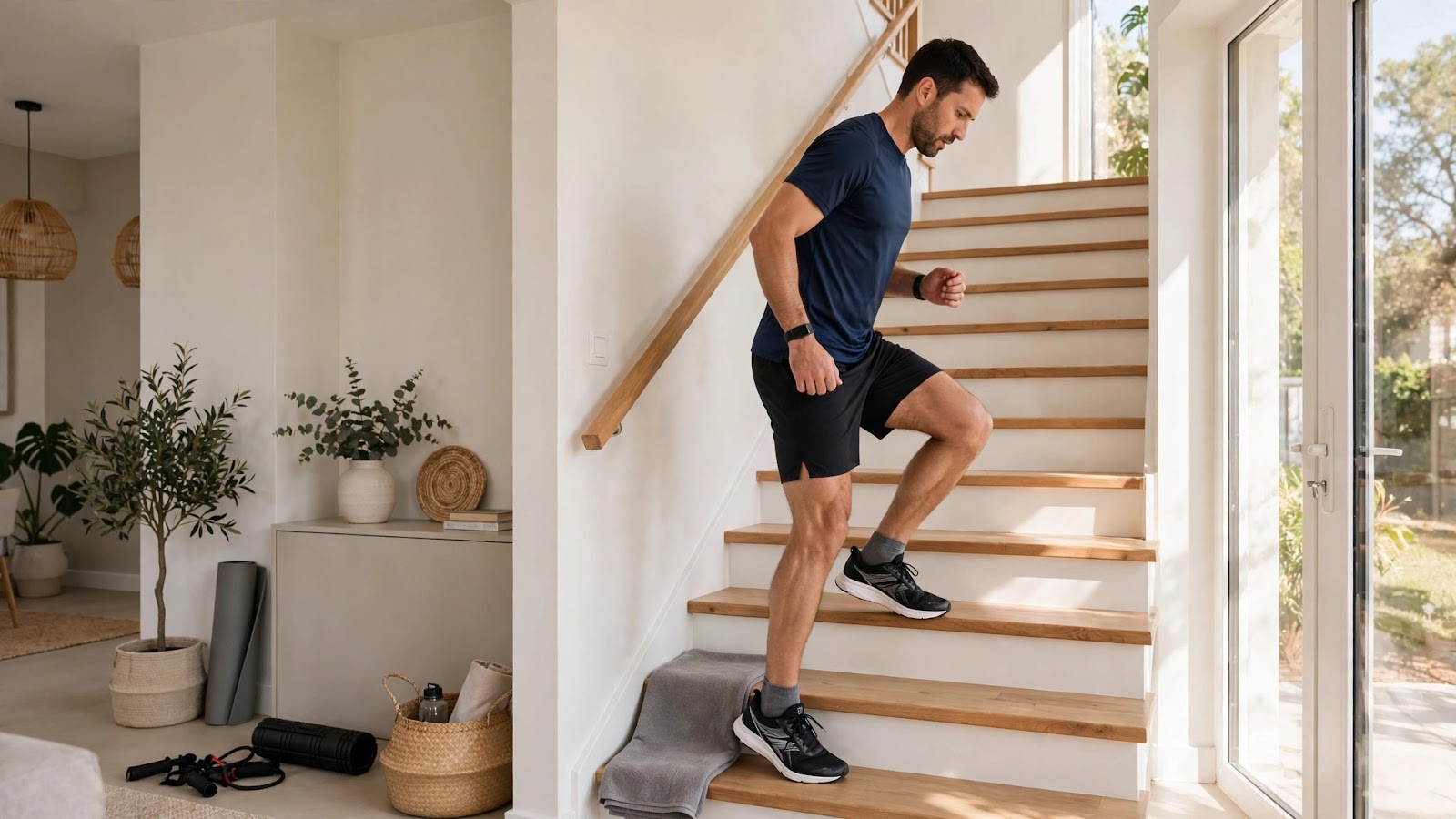
Stairs needed nothing. No equipment, no changing, no clearing the living room. My staircase was just there, fourteen steps of it, doing nothing all day. The step-up — one foot on a step, drive up, other foot joins, step back down — is about as unglamorous as exercise gets. But unglamorous was exactly what I needed, because unglamorous is what I actually do.
There's also the specificity of it. My complaint wasn't abstract fitness; it was stairs. Training the exact movement I was bad at — stepping up, repeatedly, under control — turned out to be more useful than any amount of general exercise had been. By week three, I caught myself taking the stairs two at a time without thinking about it, and I stood at the top grinning like an idiot.
The form rules I set for myself
Before I get into the routine, the form, because doing step-ups badly is easy and pointless. I worked this out through trial and a fair amount of wobbling. Rule one: the whole foot goes on the step. Not the toes, not half the foot hanging off — the entire foot, heel to toe, planted flat. Half-foot step-ups turn into calf raises with extra steps, and that's not what I was after.
Rule two: drive through the heel of the working leg. When you push up, think about pressing the step down through your heel rather than pulling yourself up with the other leg. The trailing leg is just along for the ride — it should touch down lightly on the step, not push. I spent the first week basically doing assisted hops with my back leg, and my thighs felt nothing. Once I made the back leg lazy on purpose, everything changed. The working leg does the work. That's the whole exercise.
Rule three: control the way down. Don't just drop off the step. Lower yourself slowly — two full seconds on the way down — because the lowering phase is where a lot of the benefit lives, or so every trainer I've ever read seems to agree. Slow lowering also stopped the jarring in my knees that I got when I was plopping down carelessly.
Rule four: stand tall. Chest up, shoulders back, no leaning forward over the working knee. I do mine in front of the hallway mirror (the stairs are right there), and I check my posture in the reflection. Leaning forward is the body's cheat code — it shifts the work off the thigh and onto momentum. Upright is harder. Upright is the point.
Rule five, and this one is about safety: use the handrail if you need it. I used it for the first ten days, one fingertip trailing along it for balance. There's no prize for wobbling. My stairs have a solid wooden rail on the right side going up, and I kept a light touch on it until my balance caught up with my legs.
The first shaky week
I'm not going to pretend week one was graceful. My plan was simple: every morning, while the kettle boiled for my tea, I'd do step-ups on the bottom step. Three minutes, alternating the leading leg every ten reps. The first morning, I managed about four minutes before my thighs were burning and I was breathing harder than the effort seemed to warrant. My left leg — the non-dominant one — wobbled visibly on the way down. I had to put my full hand on the rail for the last minute.
Day three, I woke up with that deep, satisfying ache in my thighs and glutes — the kind that makes stairs themselves a challenge, which felt cosmically unfair given stairs were the whole project. I nearly skipped. I didn't, but I cut the session to two minutes and went gently, and I'm glad I did, because day four the ache had eased and I felt springier than before.
By the end of week one, I could do five minutes without stopping, alternating legs every minute. The wobble in the left leg was still there but smaller. And something I didn't expect: my knees felt... quieter. Going down stairs — which had always involved a faint, crunchy awareness of my knees — felt smoother. I'm not making any big claims here; I just noticed it, and I noticed I noticed it, if that makes sense.
How I progressed it
Week two, I added structure. The kettle-boil session became a proper little routine: five minutes of step-ups, alternating the lead leg every minute, on the bottom step. Then, in the evening while dinner was in the oven, I'd do a second session — this time on the second step up, which is a slightly bigger step (our stairs have a deeper tread on the lower steps, about 28cm deep and 18cm high, fairly standard). The higher step-up was noticeably harder. My glutes joined the conversation properly for the first time.
Week three, I introduced the slow count. Three seconds up, two-second pause standing tall on the step, three seconds down. This is brutally effective and I hated every minute of it, which is usually a sign something's working. Five minutes of slow step-ups left my legs trembling in a way the regular pace never had. I dropped back to one session a day during the slow-count week because two sessions plus slow tempo was too much — my legs were tired going up the actual stairs, which defeated the purpose.
Week four, I combined: morning session at normal pace for five minutes, evening session slow-tempo for three minutes. And I started doing the last minute of each session leading exclusively with my left leg, because the imbalance between my legs was still visible in the mirror — right leg smooth, left leg slightly jerky on the descent. Giving the left leg extra solo time evened it out faster than I expected.
Total time investment by week four: about eight minutes a day, split across two sessions I'd have spent standing around waiting for appliances anyway. That's the part I'm proudest of. Not the stronger legs — the fact that it fit.
What changed, honestly
Let me be specific about what I actually noticed after four weeks, because vague "I feel great!" claims help nobody. One: stairs stopped being an event. I go up and down our two flights maybe fifteen times a day — laundry, kids' rooms, the office — and somewhere in week three I realised I'd stopped noticing. The little pre-stair sigh was gone. The mouth-breathing at the top was gone.
Two: my knees felt steadier on descents. I used to take stairs down one at a time, slightly sideways, especially when carrying things — the classic careful-descent. Now I walk down normally. This is purely my own experience, and I'm not suggesting anything about anyone else's knees, but for me the change was real and welcome.
Three: single-leg balance improved. I noticed it putting on socks standing up — I could do it without grabbing the bedframe. Small thing, but it made me grin.
Four, and this surprised me: my lower back felt better on long sitting days. I work from home three days a week, and by 4pm my lower back usually aches. In week four, I realised the ache was milder. I think — and this is just my theory — that stronger glutes and thighs meant I was fidgeting and shifting less, sitting more solidly. Could be coincidence. I'll take it either way.
The mistakes that slowed me down
I made every beginner error with step-ups, so you don't have to. The biggest: pushing off with the trailing leg. For the first week, my back leg was doing half the work — I'd push off the floor with it instead of driving through the heel of the working leg. The fix was mental: I started imagining the trailing foot was made of glass, barely allowed to touch. The burn moved immediately to the right muscles, which told me everything about how much I'd been cheating.
Second mistake: going too fast. I treated step-ups like cardio at first, bouncing up and down to get the heart rate up. Fast reps with sloppy form build nothing but momentum. When I slowed down — two seconds up, pause, two seconds down — the same five minutes became twice as hard and ten times more useful. Speed is for later, if ever. Control is the exercise.
Third: only leading with the dominant leg. My right leg did probably 70% of the work for the first ten days because alternating "felt awkward" on the left. That awkwardness was the entire point — the left leg was the one that needed the practice. Now I start every session with the left leg and give it the first and last minute. The imbalance I could see in the mirror is gone.
Making it harder over the months
Bodyweight step-ups will only take you so far before they get easy, and when that happens you have options that don't involve buying equipment. The simplest progression is height: I moved from the bottom step to the second step for my evening sessions, and the extra few centimetres made a real difference. Our stairs have a landing halfway up with a single deeper step — about 22cm high — and doing slow step-ups there is genuinely challenging even now.
Then there's load. I started holding a 2-litre water bottle in each hand — about 4kg total — and the step-ups became a proper strength exercise again. A week later I tried a loaded backpack, roughly 6kg of books, which works but shifts your balance slightly forward, so I keep the weight light and the form strict. The rule I set myself: if I can't do the slow three-second lowering with the weight, it's too heavy.
The other progression is volume done sensibly. Instead of longer sessions, I added "stair snacks" through the day — every time I go upstairs for something, I do ten slow step-ups on the bottom step before continuing up. It adds maybe six minutes total across the day, spread so thinly I barely notice, but the cumulative effect over a month was obvious. My legs felt springier, stairs felt shorter, and I stopped thinking of exercise as something that happens in sessions at all.
Where step-ups live in my routine now
It's months later now, and step-ups are just... part of the house. Like wiping the counter or locking the door. I do a five-minute session most mornings while the kettle boils — it's so automatic I don't even count it as exercise anymore, it's just what happens in the kitchen between 7:10 and 7:15. Some evenings I add the slow-tempo three minutes if I've been sitting all day.
I've added small variations to keep it interesting. Side step-ups — facing the rail, stepping up sideways — which hit different muscles and feel oddly satisfying. A pause at the top with a slow knee lift of the trailing leg, which is harder than it sounds and great for balance. And occasionally I'll do a "stair climb" finisher: walking up and down both flights five times at a brisk pace, which takes about three minutes and leaves me properly warm.

What I haven't done: bought anything, downloaded anything, joined anything. The stairs were free. The time was already being spent waiting. The only cost was the first wobbly week, and even that was mostly pride.
If stairs are your nemesis too — if you do the little sigh at the bottom, if you take them one at a time when nobody's looking — try the kettle-boil experiment. One step, whole foot, drive through the heel, slow on the way down, stand tall. Three minutes while the kettle boils. Give it four weeks. The worst that happens is you've spent a month doing something mildly useful in time you'd have spent staring at a kettle. The best that happens is you bound up the stairs one Tuesday and realise, halfway up, that you're not even breathing hard — and you stop, and you grin, exactly like I did.


