My resistance bands spent eight months in a drawer. Not tucked away neatly, either. They were tangled in a knot with a phone charger, a spare key, and a hair tie I have never owned. I bought the set on a burst of enthusiasm, used it twice, decided it felt too easy, and forgot it existed. That drawer became a small museum of good intentions.
What brought them back was embarrassingly simple: my shoulders ached after a week of working hunched over a laptop at the kitchen table. I was not injured, just stiff and tired of feeling stiff. I dug the bands out, untangled them, and promised myself ten minutes. No grand plan, no new program. Just ten minutes to see if they were worth keeping.
They were. But not for the reason I expected. The bands did not magically make me strong in a week. They made strength training fit into my actual life, in a living room barely bigger than a parking space, without me having to rearrange furniture or buy a rack I had nowhere to put.
The drawer set that finally earned its keep
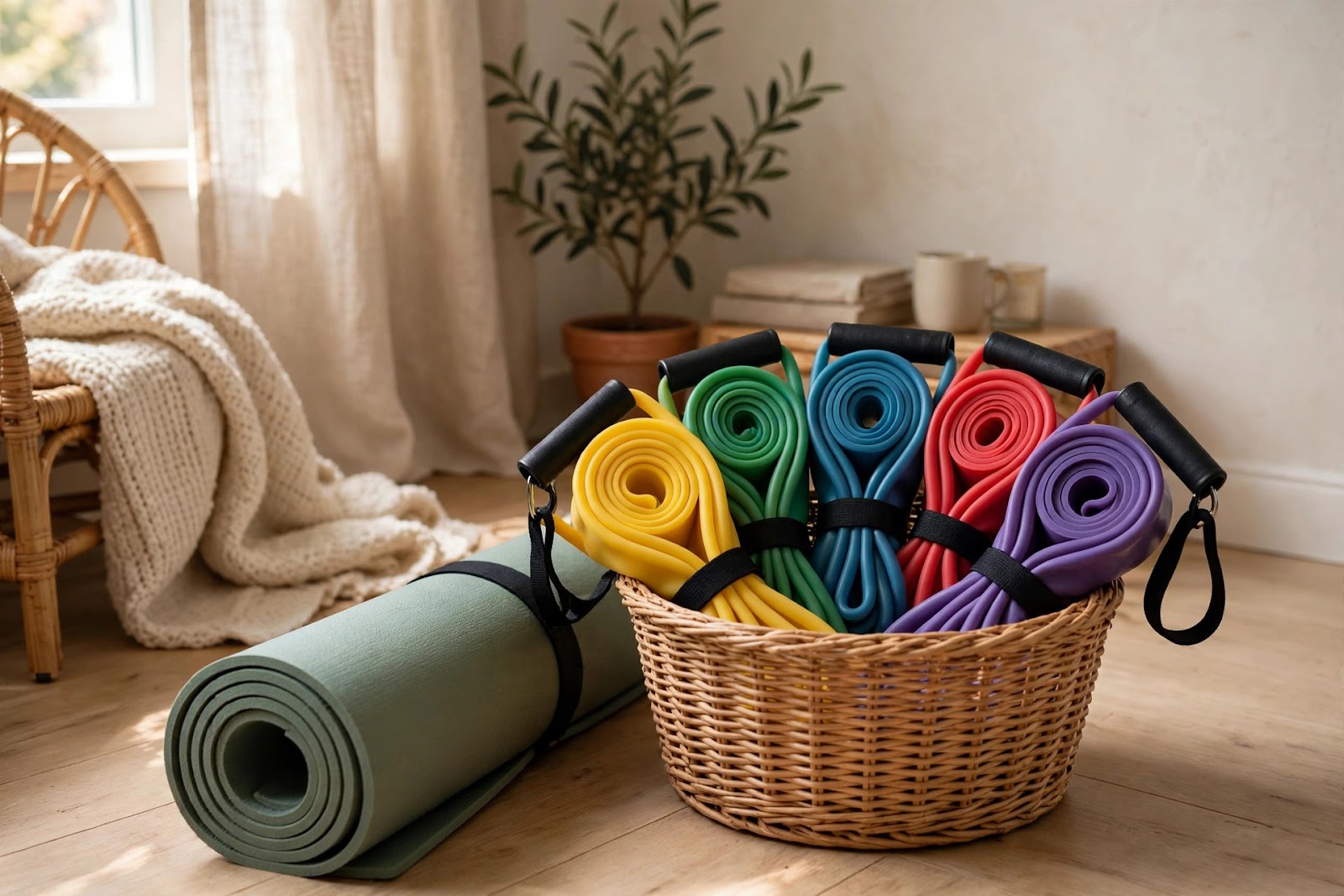
My set has five loop bands, from a thin yellow one to a thick black one, plus two long tube bands with handles. The whole kit cost less than one month at the gym I quit in 2024, and it fits in a shoebox. That matters more than I thought it would, because gear I can see gets used and gear in a cupboard does not.
Now the bands live in a small basket next to the couch, not in a drawer. I can grab one in five seconds. That one change did more for my consistency than any motivational video ever did. If you have to dig for your equipment, you will find a reason not to dig.
I also learned to respect the light bands. On my first retry I grabbed the thickest band for rows, yanked it like I was starting a lawnmower, and felt my lower back complain for two days. The thin band I had dismissed as useless turned out to be perfect for warm-up rows, face pulls, and the kind of slow, controlled work that actually fixes stiff shoulders.
The 25-minute routine I actually do
Three times a week, usually Monday, Wednesday, and Friday after breakfast, I do the same six moves. I warm up for three minutes first: arm circles, leg swings, and ten bodyweight squats, nothing fancy. Then I run through the circuit twice, resting about forty-five seconds between moves.
First, banded squats. I stand on a medium loop band with feet shoulder-width apart, hold the top of the band at my shoulders, and squat like I am sitting into a low chair. Twelve reps. The band pulls hardest at the top, which is the opposite of a dumbbell, and my glutes notice the difference by rep eight.
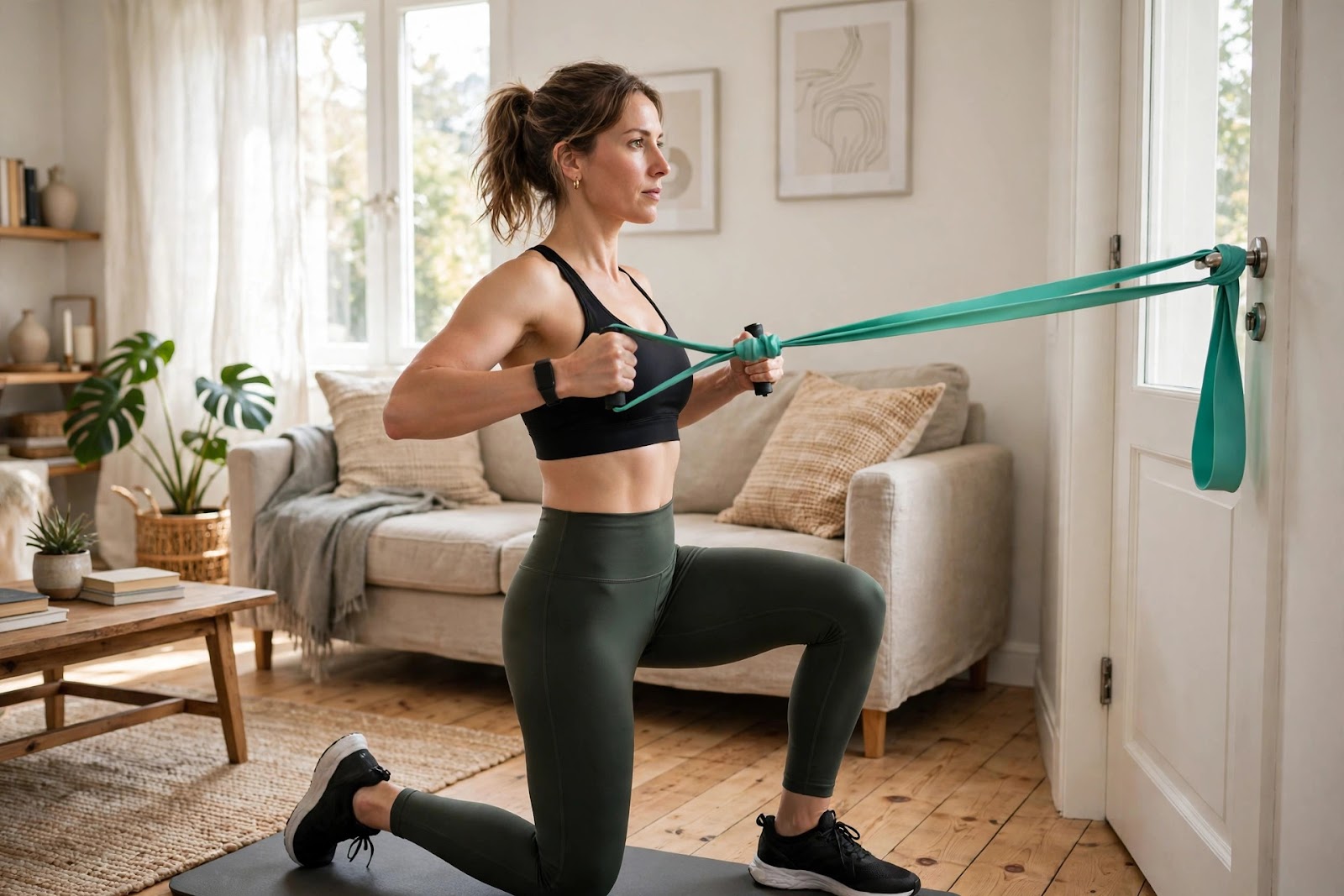
Second, seated rows with a tube band looped around a sturdy door anchor. I sit on the floor, legs straight, and pull the handles to my ribs, squeezing my shoulder blades together for a full second each time. Twelve reps. This is the move that fixed my laptop hunch more than any stretch did.
Third, banded push-ups. I loop a light band across my upper back, hold the ends under my palms, and do push-ups from my knees or toes depending on the day. Ten reps. The band makes the top half harder, which is where I used to coast.
Fourth, overhead presses. I stand on a tube band, handles at shoulder height, and press straight up until my arms are long but my elbows are not locked. Ten reps. I keep my ribs down and my lower back quiet, which took practice, because my body wanted to arch like a banana.
Fifth, Romanian deadlifts with a loop band under my feet. I hinge at the hips, slide my hands down my thighs to just below my knees, and stand back up by driving my hips forward. Twelve reps. Slow on the way down, three full seconds, because rushing this one is how my back complained the first time.
Sixth, pallof presses for my core. I anchor a tube band at chest height, stand sideways to it, and press both hands straight out in front of me, holding for three seconds while the band tries to twist me around. Eight reps each side. It looks boring. It is brutally effective.
What nobody told me about band tension
Bands do not behave like weights, and that threw me off at first. A dumbbell weighs the same at the bottom and the top of a lift. A band gets heavier the more you stretch it. That means the hardest part of a banded squat is standing up tall, and the hardest part of a row is the squeeze at the end.
Once I understood that, I stopped fighting it and started using it. I slow down exactly where the band pulls hardest, instead of rushing through the tough spot. My reps got slower, my sets got shorter, and my muscles got sorer in a good way. Ten good reps beat twenty sloppy ones every single time.
I also check my bands before every session now, which takes about twenty seconds. I stretch each one gently and look for tiny nicks, thin spots, or a white line forming near the edge. A band with a nick goes straight in the bin. I learned that rule after a cheap band snapped during a press and whipped my forearm, leaving a red stripe that lasted a week. No workout is worth that.
The mistakes that cost me two months
My biggest mistake was treating bands like a warm-up toy instead of real training. I would do a few lazy reps, feel nothing, and conclude bands were too easy. The truth was simpler: I was using the wrong band and the wrong tempo. When I moved up one resistance level and slowed each rep to three seconds down and one second up, the same routine left my legs shaking.
My second mistake was anchoring bands to anything that looked solid. A wobbly bookshelf is not an anchor. A closed door with the anchor on the hinge side, or a heavy table leg that does not slide, is. I test every anchor by pulling hard before I start, because discovering a weak anchor mid-rep is a lesson you only need once.
My third mistake was skipping rest days. Bands felt gentle, so I trained five days in a row, then wondered why my elbows ached. Muscles do not care whether the resistance comes from iron or rubber. They need a day off. Three sessions a week, with walking on the other days, has kept me progressing without the aches.
One week with the bands, honestly told
Monday of that first week felt awkward. I kept stepping on the wrong part of the loop, the band rolled up on my legs during squats, and I had to stop twice to reposition it. I almost quit again, right there, because awkward feels a lot like failure when you are out of practice.
By Wednesday it was smoother. I learned to wear longer socks so the band did not pinch my skin, and to step a little wider so the loop stayed flat. Small fixes, but they turned a fiddly workout into a normal one. Friday was the first session that actually felt good from start to finish, and I finished it thinking about the next one instead of dreading it.
The second week taught me something else: bands travel. I took two loop bands on a weekend trip in a jacket pocket, did squats and rows using a hotel door anchor, and kept the habit alive instead of losing a week. That portability is the one thing no dumbbell set can match, and it is why I now pack a band whenever I pack a toothbrush.
One more practical detail: I keep a spare light band in my bag for travel and a door anchor that cost less than a coffee. The anchor is a small strap with a foam stopper that sits on the far side of a closed door, and it has held through hundreds of rows without marking the door frame.
If a move feels too easy, I do not add reps first. I move up one band, or I pause for two seconds at the hardest point, or I slow the lowering phase to four seconds. Those three levers have carried me for months without me ever needing a heavier set.
How I know it is working
I do not weigh myself every day, and I do not take progress photos. I keep one small notebook by the basket and write down the band color, the reps, and one line about how it felt. After six weeks, the pattern was obvious: the medium band for squats became the heavy band, and twelve reps that once felt hard now felt like a warm-up.
More importantly, the everyday stuff got easier. Carrying groceries up two flights of stairs stopped leaving me winded. Sitting at my desk for three hours stopped ending in a stiff neck. Those are not glamorous results, but they are the ones I actually live with, and they are why the bands are still out of the drawer.
That notebook also keeps me honest on bad weeks. If I miss a session, I write that down too, without excuses, and I pick up the next one. A missed week used to end the habit. Now it is just a line in a notebook.
If your bands are sitting in a drawer right now, do not buy a new set. Take yours out, put them in a basket where you can see them, and try the circuit above for ten minutes. Start one band lighter than you think you need, slow every rep down, and write down what you did. The drawer is not where strength training lives. The basket by the couch is, and ten minutes is enough to find out.


