The pull-up bar had been hanging in my doorframe for eight months. Eight months. I walked under it every single day — to the kitchen, to the bathroom, to bed — and I used it for exactly one thing: hanging my resistance bands when I was done with them. It was a very expensive band hook. Then one evening, scrolling past yet another video of someone doing effortless pull-ups, I had a thought that embarrassed me with its simplicity: what if I just hung from it? Not pull-ups. Not anything impressive. Just hung there, like a bat, for thirty seconds a day.
That was four months ago. The thirty-second hang became the single highest-return habit in my entire fitness routine — and I say that as someone who does a lot of training. My grip strength transformed. My shoulders stopped clicking. My posture changed. All from thirty seconds of doing, essentially, nothing. Here's the full story.
Why hanging, and why thirty seconds
Let me explain the logic, because "hang from a bar" sounds like the world's least impressive workout, and I need you to understand why it's secretly one of the best.
A dead hang — just gripping the bar and letting your body hang with straight arms — loads your grip, forearms, shoulders, and the entire chain of connective tissue through your upper back, all at once, using nothing but your bodyweight. There's no skill to learn, no reps to count, no form subtlety to master beyond "hold on." It's the rare exercise where the barrier to entry is literally zero and the stimulus is genuinely significant.
Thirty seconds was the number because it was short enough to be undeniable. I told myself: you cannot talk yourself out of thirty seconds. It's less time than it takes to microwave leftovers. The deal I made with myself was one hang a day, thirty seconds, no excuses, no rest days needed because the volume is so low. If thirty seconds felt easy after a while, I could add time — but I was never allowed to skip because "I don't have time." Nobody doesn't have thirty seconds.
I should mention what kind of bar I have, because it matters for anyone thinking of trying this. Mine is a leverage-style doorframe bar — the kind that wedges into the frame without screws, using your bodyweight to hold itself in place. It cost me very little, took five minutes to install, and has held me without a single slip in four months. But here's the honest safety talk: check your doorframe first. It needs to be solid wood trim, not decorative molding, and the bar needs to be rated well above your weight. Test it by hanging with your feet still touching the floor first, then gradually take weight off. If the trim creaks, flexes, or looks flimsy, do not trust it — find a sturdier doorway or a different solution. A bar ripping out of a doorframe mid-hang is the kind of story that's funny only if nobody gets hurt, and I'd rather you never have that story.
The first hang: thirty seconds is longer than you think
Day one, I grabbed the bar, lifted my feet, and started counting. By second twelve, my forearms were burning. By second twenty, my fingers were having serious doubts about this arrangement. I made it to thirty, dropped down, and stood there shaking my hands out like I'd just touched something hot. Thirty seconds. Half a minute. It had felt like a plank feels at the two-minute mark.
That first hang was genuinely humbling. I considered myself reasonably fit — I could do push-ups, I ran, I did bodyweight circuits. But grip is its own kingdom, and I was a peasant in it. Nothing in my routine had ever asked my hands to support my full bodyweight, and my hands filed an immediate protest.
Here's the anecdote I promised, the one that still makes me laugh. On day three, I was hanging in the doorway between my living room and hallway, counting down the last ten seconds, when my neighbor knocked on the door. I dropped from the bar, opened the door mid-count, and stood there breathing hard with my hands still half-curled into claws. He looked at my hands, looked at the bar, and said, "Were you... exercising? In the doorway?" I said yes with as much dignity as I could muster while my forearms visibly trembled. He nodded slowly, handed me the package he'd come to deliver, and left. We have never spoken of it. The bar is in a doorway, sir. The doorway is where the bar lives. I regret nothing.
What the first month actually felt like
The adaptation curve on daily hangs is one of the most satisfying I've experienced in any training, because the progress is so measurable and so fast. Let me walk you through it honestly.
Week one: thirty seconds was the max, and the last ten seconds of every hang were a genuine fight. My forearms were sore most days — that deep, worked soreness in the meaty part of the forearm. My fingers felt tired for an hour after each hang, like they'd done a day of manual labor. I also noticed my shoulders making little clicking sounds during the first few hangs, which I found alarming until I learned — from reading, not from expertise — that some of that is just stiff joints moving through ranges they haven't visited in a while. The clicking faded within two weeks and never came back. (Standard disclaimer that I will repeat because it matters: if a joint clicks with pain, or swells, or the clicking gets worse instead of better, that's a conversation for a professional, not an article.)
Week two: something clicked — pun intended. The thirty seconds stopped feeling like a fight and started feeling like... a stretch. A really good, deep, satisfying stretch through the lats, the shoulders, the entire side body. I started looking forward to it the way you look forward to a good morning stretch. My grip was still the limiting factor — shoulders and back could have hung longer, but the fingers said thirty and meant it.
Week three: I got greedy and tried forty-five seconds. Made it, barely, on the third attempt. The interesting thing was where I felt it: not just the forearms anymore, but the hands themselves — the muscles in the palm, the base of the fingers. Grip strength isn't just forearms; it's a whole system from fingertip to elbow, and the longer hangs were waking up all of it.
Week four: I did my first full sixty-second hang, and I need you to understand how absurd that felt compared to day one. Day one, thirty seconds nearly broke me. Day twenty-eight, sixty seconds felt controlled. That's the power of daily, consistent, sub-maximal practice — your body adapts to exactly what you ask of it, and I'd asked for hanging.
The grip changes: concrete, checkable, real
Okay, let's talk about what "grip changed everything" actually means in practical terms, because I want this to be concrete, not motivational-poster vague.
Opening jars: I used to hand the stubborn ones to someone else or run them under hot water. About six weeks in, I opened a jar of pickles that had defeated me two months earlier — same brand, same seal — without thinking about it. I stood in the kitchen holding the open jar feeling disproportionately triumphant. It's a small thing. Small things are the point.
Carrying groceries: I live up a flight of stairs, and grocery day used to mean multiple trips because my hands would give out on the heavy bags. Two months into daily hangs, I carried everything in one trip — not because my arms were stronger, but because my grip didn't quit halfway up the stairs. Grip is the bottleneck in more daily tasks than people realize. Your legs can carry the weight; your back can handle it; but if your hands give out, the trip ends.
The farmer's-carry test I invented for myself: I have two dumbbells, and on day one I could hold them at my sides for about forty seconds before my grip failed. At the two-month mark I timed it again: two minutes and ten seconds. Same dumbbells, same weight. The only training difference was the daily hangs. I don't present that as science — it's one person, no controls, take it as an anecdote — but it's my anecdote and the numbers are real.
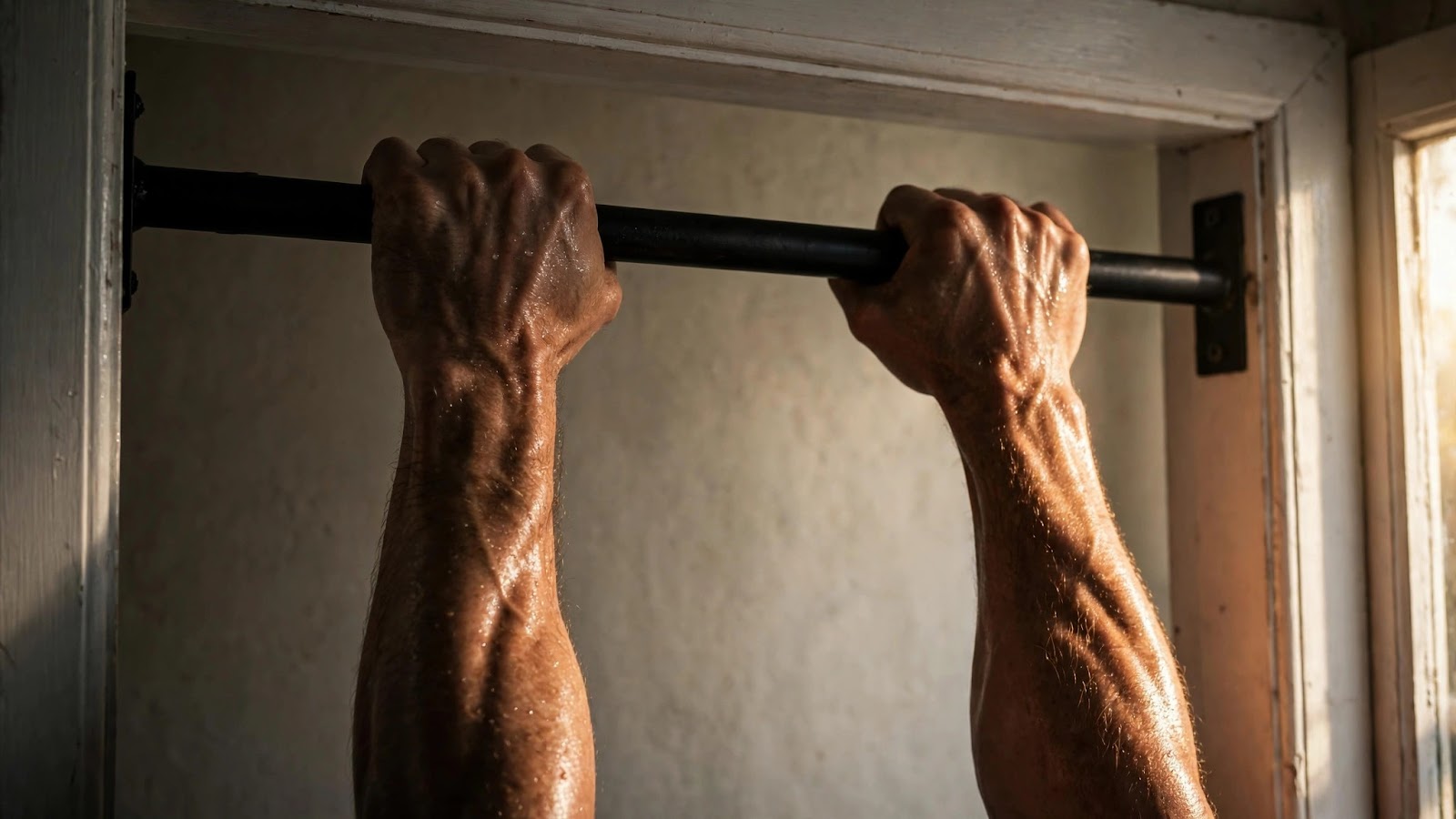
And then there's the thing I didn't expect at all: my hands look different. The muscles at the base of my thumb are more defined. My forearms have actual shape to them now, especially the brachioradialis — that muscle along the top of the forearm that pops when you do a thumbs-up. I didn't set out to change how my arms looked. It was a side effect of the grip work, and honestly, it's a nice one.
The shoulder surprise: decompression is real and it feels amazing
I started hanging for grip. I kept hanging for my shoulders. This was the unexpected dividend, and it's the reason I'd recommend daily hangs even to someone who doesn't care about grip strength at all.
Here's my situation: I work at a desk. Like, a lot. Hours of shoulders-rolled-forward, chin-poking-out, spine-shaped-like-a-question-mark desk work. By evening, my upper back would feel compressed — that tight, achy feeling between the shoulder blades, like my torso had been slowly folding in on itself all day.
The first time I hung after a long desk day, the sensation was immediate and almost startling: my spine lengthened, my shoulders dropped away from my ears, and the space between my vertebrae felt like it opened up. It was the physical opposite of desk posture — instead of compressing downward all day, I was tractioning upward for thirty seconds. That contrast is powerful. Thirty seconds of decompression genuinely undid hours of compression feeling.
Over the months, this added up to a real posture change. I catch myself sitting taller without thinking about it. The evening upper-back ache that used to be a daily event now shows up rarely. And my shoulders — which used to click and feel cranky when I raised my arms overhead — move smoothly. I credit the hangs with keeping my shoulders healthy through months of desk work, and I'm not casual about that claim: it's the most noticeable joint-health improvement I've gotten from any single habit.
There's a name for the relaxed version of this — some people call it just "hanging out," letting the shoulders fully relax and the body go completely dead-weight. I do a mix: some hangs where I keep the shoulders slightly engaged and active (better for building strength), and some where I just let everything go loose (better for the decompression feeling). Both have their place. If you're starting out, the loose dead hang is the easier and more comfortable entry point.
How I progressed past thirty seconds (the actual method)
After the first month, thirty seconds had become easy — almost too easy to feel like training. Here's exactly how I progressed, because "just hang longer" is true but unhelpful without the details.
Month two: I moved to two hangs a day — one in the morning, one in the evening — thirty seconds each. Splitting them kept each hang high-quality instead of one long grind where form falls apart. Total daily hanging time stayed at a minute, but the double dose accelerated the grip gains noticeably.
Month three: I started extending the evening hang. The rule was simple: add five seconds whenever the current target felt comfortable for three days in a row. Thirty-five, forty, forty-five, fifty — slow, boring, effective. No jumps, no ego. The morning hang stayed at thirty seconds as a maintenance dose.
Month four (where I am now): my evening hang is at ninety seconds, and I'm working toward two minutes. The morning thirty-second hang is pure maintenance and decompression — I barely think about it anymore, it's just part of waking up, like stretching.

A few technique details that matter more than people think. Grip the bar with your thumb wrapped around — a full grip, not a false grip with the thumb on the same side as the fingers. The thumb wrap is safer and builds more complete hand strength. Keep your arms straight but not violently locked — think "long arms," not "jammed elbows." Breathe normally; beginners tend to hold their breath during hangs, which makes everything harder and can make you dizzy. And engage your core just slightly — not a full brace, just enough that you're not swinging like a pendulum. A little swing is fine; wild swinging means you're wasting energy.
One more progression option I haven't needed yet but want to mention: if you max out your available time, you can add difficulty instead of duration — towel hangs (draping a towel over the bar and gripping the towel instead, which is brutally hard on grip), or single-arm hangs for short durations once you're advanced. I'm not there yet. Maybe someday. The two-minute double-arm hang is my current mountain.
The pull-up side effect I didn't see coming
Here's the funny epilogue to the story of the world's most neglected pull-up bar: after three months of just hanging, I tried a pull-up on a whim. Not a kipping, swinging mess — a real, strict, chin-over-bar pull-up. I did three. Three clean pull-ups, having never trained pull-ups, never done a single rep of pulling work in my life.
Now, three pull-ups is not impressive in absolute terms. I'm not claiming it is. But going from "cannot do one pull-up" to "three strict pull-ups" with zero pull-up training — just from hanging — tells you something about what dead hangs build. The grip, the shoulder stability, the lat engagement, the core tension: hanging trains all the supporting cast of the pull-up. The pulling muscles themselves still need direct work, obviously, but the foundation was there, built entirely by accident.
I've since added a few pull-up attempts after my evening hang — just two or three reps, nothing structured — and they're improving steadily. The bar has gone from expensive band hook to the most-used piece of equipment I own. It only took eight months of ignoring it and four months of hanging from it.
The honest limitations (because nothing is magic)
Let me balance the enthusiasm, because I don't want this to read like a miracle cure pitch. Dead hangs are a fantastic habit with real benefits, but they're not everything.
They don't build much pulling strength directly — my accidental pull-ups notwithstanding. If you want a strong back in the rowing/pulling sense, you need rows and pull-ups, not just hangs. They don't do much for your legs or your cardiovascular fitness, obviously. They're a supplement to a routine, not a routine.
They can also be hard on the hands in a way that's annoying rather than dangerous: I developed a callus on each palm in month two. Not painful, just there. If you care about soft hands, moisturize and maybe file them down occasionally. If you don't care, they'll just be part of the package — climbers call them badges, and I've decided to agree.
And the bar itself is a real consideration. Not everyone has a suitable doorframe. Renters should check their lease — some prohibit doorframe bars, and a damaged frame costs more than the bar saved. If a doorframe bar won't work for you, the same benefits come from any sturdy overhead bar: a playground bar, a gym bar, a securely mounted wall bar. The doorway is convenient, not mandatory.
Finally, the standard safety line, which I mean sincerely: if you have shoulder issues, wrist problems, or any upper-body injury history, check with a professional before loading your full bodyweight onto those joints daily. Hanging is gentle as loading goes, but it's still loading, and injured tissue has its own rules. I was healthy when I started; your situation is yours to assess honestly.
Thirty seconds, four months later: the verdict
Four months in, the daily hang is the most automatic habit I have. More automatic than coffee. I walk through that doorway a dozen times a day, and at least twice, I stop and hang. It's stitched into the architecture of my day now — literally, into the architecture of my home.
The grip transformation is the headline, and it's real: jars, groceries, the farmer's-carry numbers, all of it. The shoulder decompression is the quiet co-headliner — the benefit I didn't know I needed and now can't imagine living without. The posture improvement, the accidental pull-ups, the forearm definition: all welcome side effects of thirty seconds of daily nothing.
If I could give one piece of fitness advice to someone starting from zero — no equipment, no gym, no routine — it wouldn't be a workout program. It would be this: get a doorframe bar, make sure it's secure, and hang from it for thirty seconds every day. That's it. That's the whole program. It's the smallest possible commitment with the most disproportionate return I've found in years of home training.
Thirty seconds. You have thirty seconds. Your grip — and your shoulders, and your spine, and possibly your neighbor's opinion of you — will thank you.


