For years, my warm-up was walking from the kitchen to the living room rug, dropping my phone on the couch, and jumping straight into squats. That was it. No marching, no arm circles, nothing. I told myself I didn't have time to waste on the easy stuff when the real workout was waiting, and for a while that story held up fine.
Then one Tuesday morning I grabbed a pair of dumbbells cold, went straight into overhead presses, and felt my shoulders complain through the whole first set. Not pain, exactly. Just stiffness, like a door hinge that hasn't been oiled in months. I finished the workout, but everything felt heavier than it should have, and my second set was worse than my first.
The next morning, annoyed at myself, I set a timer for five minutes and did the most basic warm-up I could think of before touching a weight. Marching in place, arm circles, a few easy squats with no weight at all. Nothing fancy, nothing I needed a video for. And the workout that followed felt completely different. My hips opened up faster, my shoulders stopped clicking through the presses, and I actually enjoyed the first ten minutes instead of just surviving them.
I've done that five minutes before every single home workout since, and I don't plan to stop. It's not magic, and it won't turn a bad program into a good one. But it fixed the exact problem I had: starting cold, in a small room, first thing in the morning, when my body was still half asleep.
The five minutes that changed my mornings
Here's the thing nobody told me when I started working out at home: a warm-up isn't a separate event. It's the on-ramp. You wouldn't merge onto a highway at full speed from a dead stop, and your body doesn't love that either. Five minutes is enough to raise your temperature a little, wake up the joints you'll actually use, and remind your brain what a squat feels like before you load it.
I keep mine dead simple on purpose. If a warm-up needs equipment, a tutorial, or a printed sheet on the wall, I won't do it at 6:40 in the morning. Mine needs a rug, about six feet of floor, and a phone timer. That's the whole setup, and it's the reason I've stuck with it for months when fancier routines lasted about a week.
The structure is one minute of gentle movement, two minutes of joint work, one minute of the actual moves I'll do in the workout, and one minute of ramping up. I don't time each piece to the second. I glance at the timer, move on when it feels right, and keep the whole thing under five minutes so it never becomes an excuse to delay the workout itself.
That last part matters more than I expected. A twenty-minute warm-up routine would have killed my habit in a week, because my workouts are only thirty to forty minutes long. Five minutes is short enough that I never talk myself out of it, and long enough that I can actually feel the difference when it's done.

What I actually do, move by move
Minute one is marching in place. Not high knees, not a jog, just marching. I lift my knees to about hip height, swing my arms naturally, and breathe through my nose. Thirty seconds in, I start rolling my shoulders back, big slow circles, ten each way. By the end of that first minute I'm warm enough that my hoodie starts feeling like too much, and I usually peel it off and toss it on the couch.
Minute two is joints, and this is the part I used to skip entirely. I do ten ankle circles each way, standing on one foot and holding the back of a chair if I wobble. Then ten hip circles each way, hands on my hips, feet planted. Then wrist circles, because I do push-ups and dumbbell work most days and my wrists used to ache by the third set. It sounds fussy written out like this. In practice it takes about ninety seconds and it feels like loosening a jar lid before you try to open it.
Minute three is leg swings and arm work. I hold the chair again and swing each leg forward and back ten times, then side to side ten times. Nothing forced, nothing stretched to the limit. The swings get a little bigger on their own as I go, which is the whole point: I'm letting range come to me instead of yanking it out of cold muscles. Then I do ten big arm circles forward and ten back, and ten cross-body arm swings, like I'm hugging myself and then opening up wide.
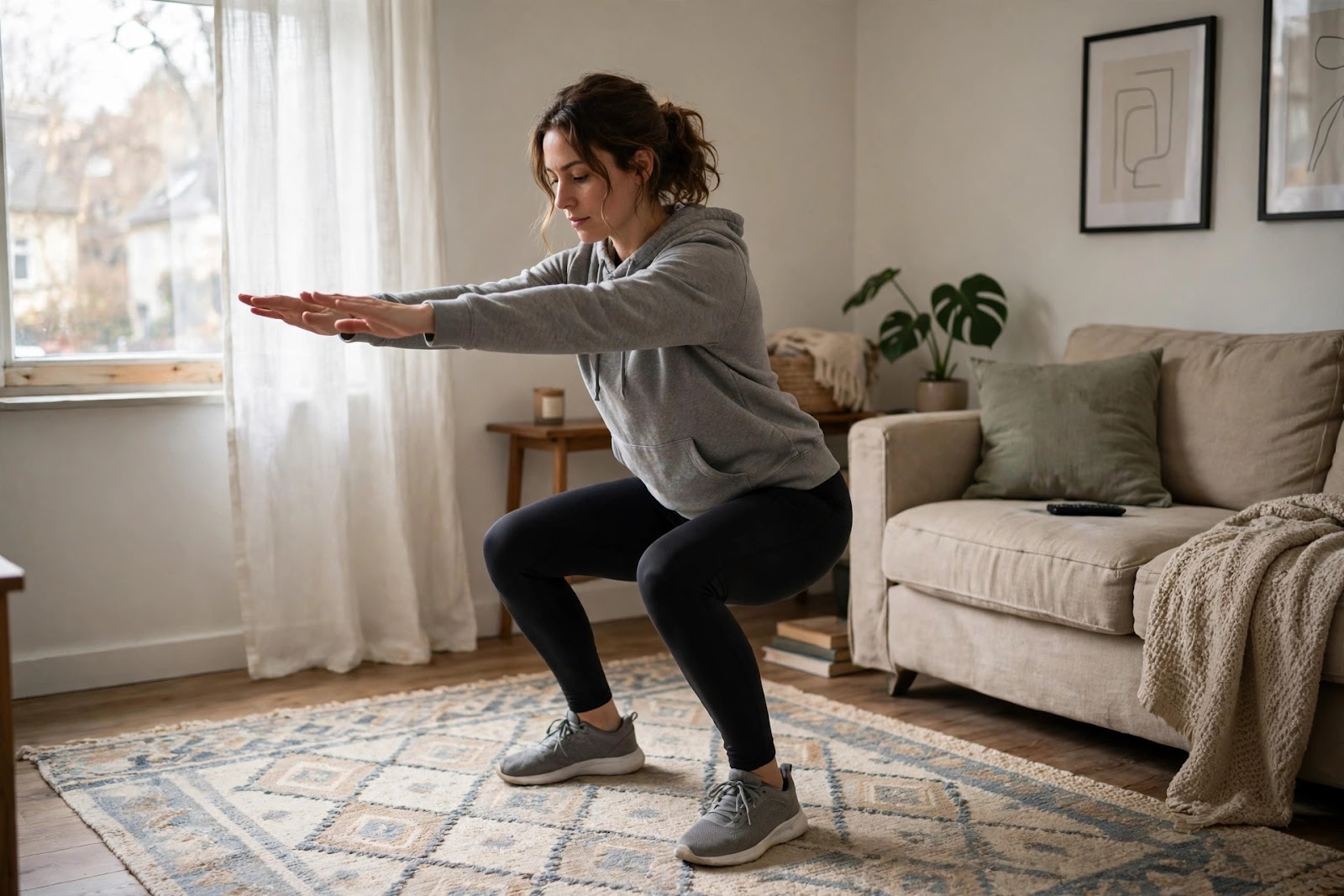
Minute four is rehearsal. I do ten bodyweight squats, slow and easy, sitting back like I'm lowering myself into a chair. Then ten glute bridges on the rug, squeezing at the top for a second. If the workout has push-ups, I do five easy ones from my knees here. If it has lunges, I do five slow lunges per leg. The rule is simple: do the workout's moves at half effort before you do them for real. It sounds obvious now, but I spent two years not doing it.
Minute five is the ramp. I pick the first exercise of the workout and do one easy set of it: light dumbbells, or slow reps, or fewer reps than planned. Then I rest thirty seconds, drink some water, and start the real thing. That easy first set used to be my worst set of the day. Now it's the set that tells me how the workout will go, and most days it tells me good news.
The small-space version that actually fits my flat
My living room is not a gym. It's about twelve feet by ten feet, with a coffee table I shove against the wall and a rug that slides if I don't plant my feet right. Everything in my warm-up fits in that space because it has to. The marching happens on the rug. The leg swings happen holding the chair I already own. The squats happen in the gap between the couch and the TV stand.
On days when my brother is sleeping in the next room and I'm trying to be quiet, I swap the marching for slow step-touches side to side, and I do the squats extra slowly so my feet don't thud. It still works. The warm-up doesn't care whether it's loud or impressive. It cares whether you actually did it.
I've also got a rainy-day, low-energy version for mornings when five minutes feels like a negotiation. Three minutes: thirty seconds of marching, thirty seconds of arm circles, a minute of squats and bridges, thirty seconds of the first exercise done easy. It's not as good as the full five, but it's ten times better than zero, and it keeps the habit alive on days when I'd otherwise skip everything.
What changed after a month of doing it
The first change I noticed was embarrassingly simple: my first working set stopped feeling terrible. Before, I'd spend the first ten minutes of every workout just trying to feel normal, and by the time I did, I was a third of the way through. Now I feel normal by the time the timer goes off, and the workout starts properly from rep one.
The second change was in my shoulders. I do a lot of overhead pressing at home because I only have dumbbells, and my shoulders used to feel pinchy and stiff for the first two sets. After a month of arm circles and cross-body swings before every session, that stiffness mostly went away. I can't promise the same for anyone else, and I'm not pretending a warm-up fixes real problems. But for plain morning stiffness, the difference was obvious enough that my workout log started showing heavier second sets instead of lighter ones.
The third change surprised me most: I started looking forward to workouts more. That sounds like a stretch, but think about it. When your first ten minutes feel awful, you dread starting. When your first five minutes feel easy and rhythmic, starting is the easy part. My warm-up became a little ritual, the same way making coffee is a ritual. Timer on, march, circles, swings, squats, go.
I also stopped getting that weird mid-workout tightness in my calves during lunges. I credit the ankle circles and the easy rehearsal lunges, though honestly it could just be that I'm moving more before I ask my legs to work. Either way, I'll take it.
Mistakes I still catch myself making
The biggest one is rushing when I'm late. If I slept in and I've only got twenty-five minutes, my brain says skip the warm-up and get to the point. Every time I've listened to that voice, the workout felt worse and I regretted it. Now I cut a set from the workout instead. The warm-up stays. Five minutes of preparation beats five minutes of an extra exercise done cold.
The second mistake is turning the warm-up into a workout. Some mornings I feel good during the marching and start adding burpees or fast high knees, and suddenly I'm breathing hard before the workout begins. That's not warming up, that's just starting early and tired. I keep it easy on purpose now. If I'm out of breath during the warm-up, I'm doing it wrong.
The third is static stretching cold, which I did for years because that's what school PE taught us. Sitting on the floor and yanking a hamstring stretch before moving at all never felt good, and it turns out it was the wrong order. Move first, loosen up, and save any long holds for after the workout, when everything's warm. That one change alone made my legs feel better during squats.
Here's my honest takeaway, and it's not complicated. Pick five moves you can do in your living room, in your socks, without thinking too hard. Do them in the same order every time, for five minutes, before every workout, for two weeks. Don't judge it after one session. Judge it after ten, when your first working set starts feeling like your second one used to. That's when I became a believer, and that's when the five minutes stopped feeling like a chore and started feeling like part of the workout itself. If you're skipping it right now, you're not lazy. You're just starting cold. Fix that first, and the rest of the workout gets easier on its own.


