I never thought I would be the person throwing punches at thin air in my own living room. It sounded silly, honestly. Shadow boxing belonged in boxing gyms and movie training montages, not in a flat where my coffee table is two steps from the sofa. Then one wet Tuesday evening, bored out of my mind and too fed up to do another set of squats, I put on an old playlist, stood in the middle of the rug, and threw my first jab. Twenty minutes later I was sweating, grinning, and wondering why I had waited so long.
Cardio had always been my weak spot at home. Running bored me, jumping jacks made my downstairs neighbour's ceiling thump, and the stationary bike I once bought ended up as a very expensive clothes rail. I needed something that raised my heart rate without shaking the whole building, and that did not feel like a punishment. Shadow boxing turned out to be exactly that, mostly because it gives your brain something to do while your body works.
The first session was a mess, and I will not pretend otherwise. I threw punches with my arms only, forgot my legs entirely, and held my breath like I was underwater. My shoulders burned out in about four minutes. My fists flailed. I looked, I am sure, completely ridiculous. But I kept going because the music was good and nobody was watching, which is the great advantage of training at home. Embarrassment only lasts until you realise the cat does not care.
What shadow boxing actually is
Strip away the boxing-movie image and shadow boxing is simply punching, moving, and dodging against an imaginary opponent. No bag, no gloves needed, no partner. You throw jabs, crosses, hooks, and uppercuts in combinations, you step in and out, you slip and duck, and you keep moving for a set time. It is cardio, coordination, and upper-body endurance rolled into one, and you can scale it from gentle to brutal just by changing your speed.
That scaling is what sold me. On a tired day I can move slowly, focus on form, and still finish feeling warmed up and looser. On a restless day I can pick up the pace, throw faster combinations, and finish properly out of breath. The workout bends to the day you are having, instead of demanding the same effort every single time. That flexibility is why I have stuck with it for months when other routines lasted two weeks.
A quick honesty note before we go further. I am not a boxing coach, and this is not fight training. If you have a shoulder, wrist, or back problem, or any condition that makes vigorous exercise risky, talk to a professional first and stop if anything hurts sharply. General fitness advice from a blog is a starting point, not a medical clearance. The rule I follow is simple: muscle burn is fine, joint pain is a stop sign.
The stance that changed everything
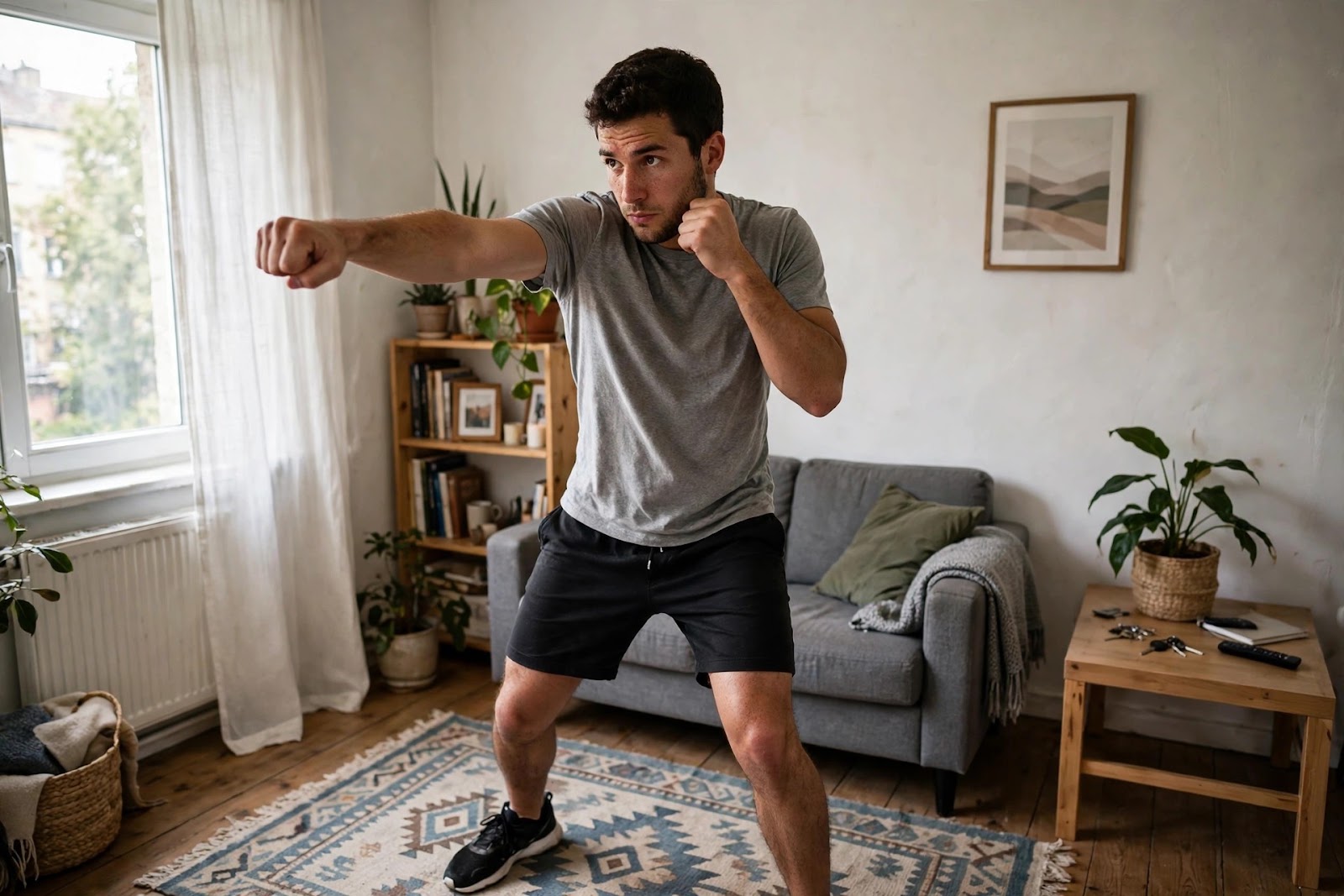
My first fix was my feet, not my fists. I stood square at first, both feet level, like I was waiting for a bus. A friend who boxes casually watched me on a video call and laughed. He told me to step my left foot forward, turn my body slightly sideways, keep my knees soft, and bounce lightly on the balls of my feet. That one change made everything feel connected. Punches started coming from my hips instead of just my shoulders, and my arms stopped tiring so fast.
Keep your hands up near your chin, elbows tucked in, fists relaxed until the moment you punch. I used to clench my fists hard the whole time, which exhausted my forearms in minutes. Now I stay loose, tighten only at the end of each punch, and snap back to guard straight away. Think of it as flicking a towel, not pushing a heavy door. Speed comes from looseness, not tension.
The jab is your home base. It is a quick straight punch with your lead hand, and it sets up everything else. After the jab comes the cross, a straight punch with your rear hand that turns your hips into it. Add a hook, a curved punch that comes around the side, and an uppercut, a short rising punch from below. That is four punches, and honestly, four is plenty for months. I spent my first month on just those, and I still use them most.
My 20-minute session, step by step
I warm up for three minutes before I throw a single punch. I march in place, roll my shoulders ten times each way, circle my wrists, and do ten slow arm swings across my chest. Then I shadow box at half speed for one minute, just jabs, to wake up the pattern. Skipping the warm-up once gave me a stiff shoulder that nagged for three days, so I do not skip it anymore.
Then I work in rounds, because rounds make the time pass. Three minutes of work, one minute of rest, four rounds, and I am done in about twenty minutes including the warm-up. Round one is jabs and crosses only, moving forward and back. Round two adds hooks. Round three adds uppercuts and slips, where I dip my head slightly to one side as if dodging. Round four is freestyle: I mix everything, move around the rug, and throw whatever combination feels natural.
Moving matters as much as punching. I step in with a jab, step out after a combination, and circle to one side between bursts. Standing still and arm-punching is how you end up with sore shoulders and a bored brain. The footwork is also what makes it real cardio. My legs do half the work, my heart rate climbs steadily, and I finish with that pleasant tired feeling instead of just aching arms.
I keep a timer on my phone where I can see it, and I keep water on the side table. I learned to put the water there before starting, because pausing mid-round to walk to the kitchen turns a three-minute round into a six-minute wander. Small preparation, big difference. I also clear the rug properly, because I once clipped the corner of the coffee table mid-slip and hopped around the room holding my toe.
The mistakes I kept making

My biggest mistake was punching too hard. I thought power meant progress, so I locked my elbows at full extension on every cross and wondered why my elbows ached. A coach on a free video I watched later said to stop just short of full lockout, keeping a tiny bend in the elbow. That one tip ended the ache within a week. You are punching air, after all. There is nothing to hit, so there is no reason to snap your joints straight.
My second mistake was holding my breath. I would throw a four-punch combination while basically not breathing, then gasp at the end. Now I breathe out sharply on each punch, a short hiss through my teeth, and breathe in between combinations. It sounds odd at first, and my first week sounded like an angry kettle, but it keeps the rhythm steady and stops that dizzy feeling I used to get in round three.
My third mistake was doing the same round every day until it went stale. Variety fixed that. Some days I do slow, technical rounds where I focus on turning my hips. Other days I do fast thirty-second bursts with thirty seconds of stepping in place. I made a small list of combinations on a card by the sofa: jab-cross, jab-cross-hook, jab-uppercut-hook, and a simple one-two-slip. Picking one card at random keeps the session fresh without any planning.
Why it stuck when other cardio did not
The honest answer is that it feels like play, not exercise. I put on music I actually like, usually something with a strong beat, and the punches land on the beat without me thinking about it. Counting reps never held my attention. Moving to music does. I also track nothing except how many rounds I finished, which removes the pressure of beating yesterday's numbers every single time.
After about six weeks, the changes showed up in ordinary places. Carrying shopping bags up two flights felt easier. My shoulders stopped rounding forward at my desk by late afternoon. I could do a full four-round session without my arms giving out in round two, which was my original ceiling. None of that happened overnight, and none of it required new equipment or a subscription. Just a rug, a playlist, and twenty minutes.
One unexpected benefit was coordination. I am naturally clumsy, the kind of person who trips over flat floors, and learning to step and punch at the same time genuinely improved my balance. I notice it when I catch myself on stairs or turn quickly in the kitchen. It is a small thing, but it makes daily life feel a bit more solid, and I did not get that from any treadmill.
If you try this, start with ten minutes, not twenty. Two rounds, jabs and crosses only, half speed. Do that three times in a week and see how your shoulders feel the next day. If you finish wanting a third round, add it next week. The goal is a routine you still like in a month, not a heroic first session you never repeat. My first heroic session left me sore for four days and nearly put me off entirely. Slow starts win.
Shadow boxing will not make you a boxer, and it will not replace every kind of training. It will give you a quiet, neighbour-friendly cardio session you can do in a small room, in any weather, with no gear at all. Put on a song you love, stand on the rug, hands up, and throw your first jab. Mine felt ridiculous for about thirty seconds. Then it felt like the best part of my evening.


