I used to have a gym membership I never used. I paid for it every month, went for the first two weeks in January, and then watched it become a direct debit for nothing. The gym was a twenty-minute drive away. By the time I had driven there, changed, worked out, showered, and driven back, an hour and a half was gone. I could never find an hour and a half. So I did nothing.
Then, on a Tuesday in February, I was waiting for the kettle to boil and I did ten squats. Not because I had a plan. Because I was bored, standing in the kitchen, waiting for water. Ten squats, kettle clicked, I made the tea, and I forgot about it. The next morning I did it again. And the morning after that. And somewhere along the way, without ever deciding to start exercising, I started exercising.
Three months later I was doing five minutes of movement, several times a day, in the gaps between ordinary tasks. Squats while the pasta cooked. Calf raises while I brushed my teeth. A stretch while I waited for the microwave. None of it looked like a workout. All of it added up.
This is the story of the five-minute habit that stuck, because it was too small to fail.
Why the big plan kept failing
I want to be honest about why I never exercised. It was not laziness, exactly. It was the size of the commitment. Every fitness plan I tried asked me to block out an hour, put on special clothes, travel somewhere, and do a full session. On a good day, that felt doable. On a normal day, with work, cooking, and the thousand small tasks of a life, it felt impossible. So I skipped it, felt guilty, and then skipped it again because the guilt made it worse.
The all-or-nothing thinking was the real problem. I believed that if I could not do a proper workout, there was no point doing anything. A five-minute burst did not count. Ten squats did not count. A stretch while the kettle boiled was not exercise. So I did nothing, and nothing, repeated daily, added up to exactly nothing.
The kitchen squats broke that thinking, because they were so small they did not trigger the resistance. I did not have to change clothes. I did not have to travel. I did not have to find an hour. I just did ten squats while I waited for water. It took forty seconds. There was nothing to talk myself out of.
I think this is the most important thing I have learned about habits. The habit that sticks is the one that is too small to skip. Not the impressive one. Not the ambitious one. The tiny one that you can do on your worst day, when you are tired and busy and the last thing you want to do is exercise. Ten squats while the kettle boils is a habit you can keep on your worst day. An hour at the gym is not.
The kettle rule
The first rule I made, almost by accident, was the kettle rule. Every time I put the kettle on, I do squats until it clicks off. A full kettle takes about two minutes to boil. An almost-empty kettle takes about forty seconds. Either way, I am moving for the whole time the kettle is on.
At first it was ten squats per kettle, with rests. Then it became fifteen, then twenty, then squats without stopping until the kettle clicked. I make tea three or four times a day, so that is three or four sets of squats, spread across the day, without ever scheduling a workout.
The squats themselves are nothing fancy. Feet shoulder-width apart, weight in my heels, knees tracking over my toes, down until my thighs are roughly parallel to the floor, back up. I do not go for depth records. I go for clean, controlled repetitions. If my knees ache, I do shallower squats. If I am feeling strong, I go deeper. The point is movement, not punishment.
What surprised me was how quickly the squats got easier. In the first week, twenty squats left my legs burning. By the third week, I could do thirty without thinking about it. By the second month, I was adding variations: a pause at the bottom, a slow descent, a calf raise at the top. The kettle had become a tiny gym, and I had not noticed the progression happening because it was spread across so many small sessions.
Squats while the pasta cooks

The kettle rule spread to other kitchen tasks. Pasta takes ten to twelve minutes to cook. That is a long time to stand in a kitchen doing nothing. I started using it. While the pasta boiled, I did a circuit: ten squats, ten lunges, ten calf raises, repeat. Three rounds took about eight minutes, and the pasta was done when I was done.
The microwave became another trigger. Three minutes for reheating leftovers. That is a plank. I drop to the floor and hold a plank until the microwave beeps. It is not a long plank, two to three minutes at most, but it is a plank I would never have done if I had to schedule it. The microwave schedules it for me.
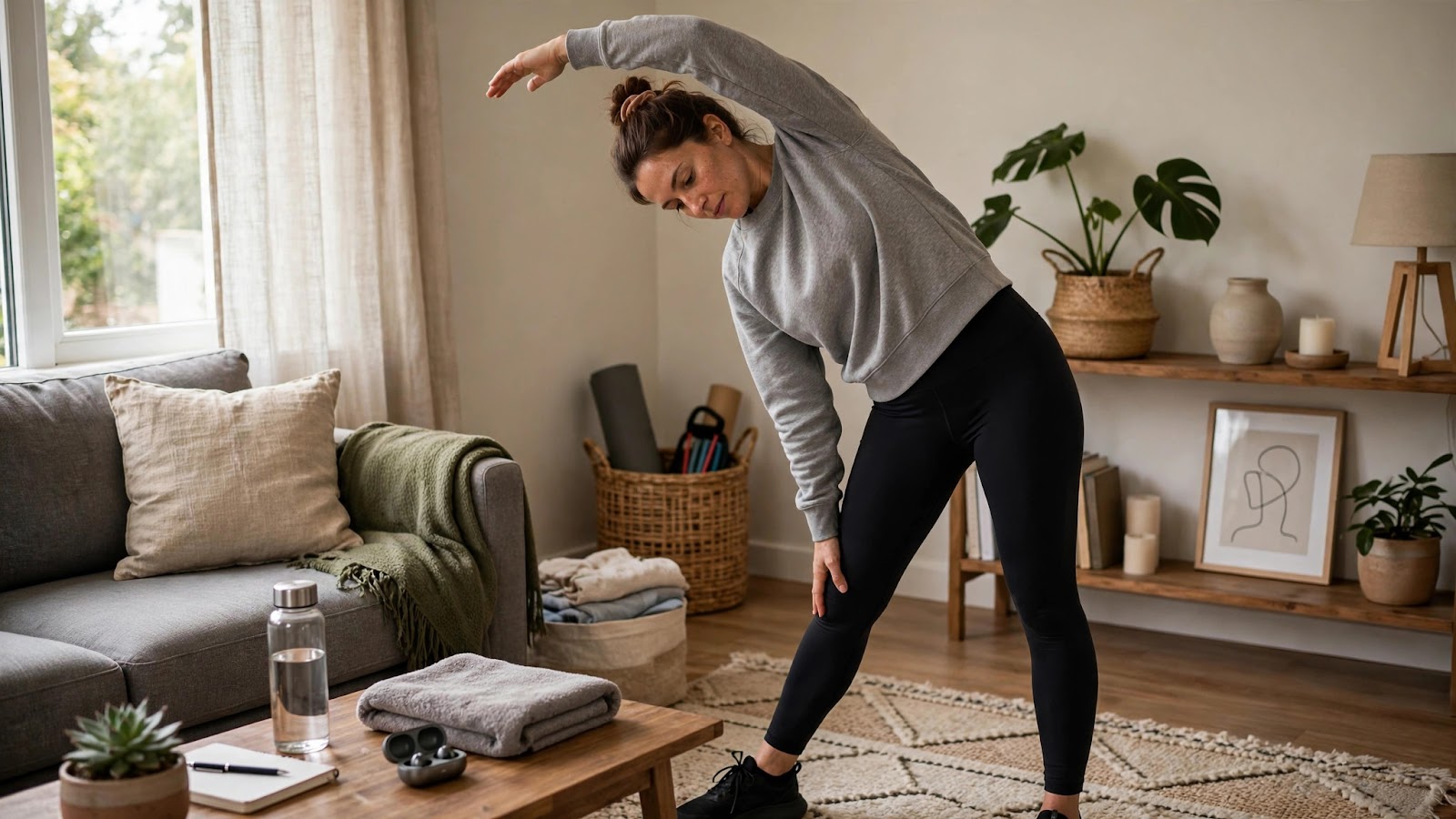
Waiting for the oven to preheat became a stretching window. Ovens take ten to fifteen minutes to reach temperature. I use that time to stretch my back, my shoulders, and my hips. Nothing intense. Just gentle movement, undoing the stiffness of sitting at a desk. By the time the oven beeps, I feel looser than I did ten minutes earlier.
The pattern is always the same. A kitchen task with a built-in wait becomes a movement trigger. The wait is the cue. I do not need willpower or a schedule. The pasta, the kettle, and the microwave do the scheduling for me. All I have to do is show up for the wait, which I was going to do anyway.
The habit that stuck because it was small
Here is what I think actually happened, psychologically. Every time I did squats while the kettle boiled, I got a tiny win. A small, completed action, done without drama. Tiny wins stack up. After a week, I had twenty tiny wins. After a month, I had a hundred. And a person who has a hundred tiny wins starts to think of themselves as someone who exercises. That identity shift matters more than any single workout.
Before the kettle rule, I thought of myself as someone who did not exercise. That identity was self-fulfilling. If you believe you are someone who does not exercise, you do not exercise. The tiny wins broke the identity. I was now someone who did squats while the kettle boiled. That is a small identity, but it is a real one, and it grew.
The smallness also protected the habit from bad days. On days when I was ill, or exhausted, or overwhelmed, I still did ten squats while the kettle boiled. Not because I was disciplined, but because ten squats is nothing. It takes forty seconds. Even on the worst day, I had forty seconds. And doing it on the worst day kept the chain alive. The chain is the habit. Break the chain and you have to restart. Keep the chain going, even with a tiny version, and the habit survives.
I also stopped feeling guilty about exercise, which was an unexpected benefit. The guilt cycle, skip a workout, feel bad, skip another workout because you feel bad, had been running for years. The tiny habit broke it, because there was nothing to skip. I did the squats. I kept the chain. There was nothing to feel guilty about.
What three months added up to
After three months, I did a rough tally of what the tiny habit had added up to, and the numbers surprised me. I was doing roughly five minutes of movement, four to six times a day. That is twenty to thirty minutes a day, every day, without ever scheduling a workout. Over three months, that is somewhere around forty hours of movement. Forty hours, from kettle squats and pasta lunges.
The physical changes were modest but real. My legs got stronger. Stairs stopped winding me. I could get up from a low sofa without using my hands, which sounds trivial until you realise you could not do it before. My balance improved, which I noticed when I stood on one leg to put on socks without wobbling. My back, which used to ache after a day at my desk, ached less, because I was moving it every couple of hours instead of sitting still all day.
My weight barely changed. I want to be honest about that, because the internet will tell you that five-minute bursts will transform your body, and that is an exaggeration. I did not lose a dramatic amount of weight. I did not get visibly muscular. What changed was strength, stamina, and how I felt in my body. I felt capable instead of stiff. That is a smaller claim than a transformation, but it is a true one, and it matters more to me.
The biggest change was not physical at all. It was the fact that I was exercising, after years of not exercising. The tiny habit had done what every gym membership and every fitness app had failed to do. It had made movement a normal part of my day, not a special event that required an hour and a costume change.
The full menu of tiny workouts
Over time, I built up a small menu of movements tied to specific kitchen and household triggers. Here it is, in case you want to steal it. Kettle on: squats until it clicks. Pasta boiling: squats, lunges, and calf raises in a circuit. Microwave running: plank until it beeps. Oven preheating: gentle stretching for back, shoulders, and hips. Brushing teeth: calf raises, one leg at a time for balance. Waiting for the shower to warm up: arm circles and shoulder rolls. Adverts on television: a set of push-ups, or knee push-ups if full ones are too much.
Each one is tiny. Each one is tied to a trigger that happens every day. And each one is easy enough that I do it without thinking. The triggers do the remembering for me. I do not need an app, a reminder, or a schedule. The kettle remembers for me.
I also have a rule about form. Even in a tiny burst, form matters. Ten good squats beat twenty sloppy ones. If I am rushing, I do fewer, slower, cleaner repetitions. Sloppy repetitions train bad patterns and risk injury, and a twisted knee from a rushed lunge would end the habit faster than any amount of laziness. Slow and clean, even when it is only forty seconds.
One more rule: I never do the same movement if it hurts. Discomfort is fine. Muscles burning during squats is fine. Sharp pain in a joint is not fine. If something hurts, I stop, and I do a different movement. I once had a sore knee from a long walk, and I swapped squats for calf raises for three days until it settled. The habit survived because I adapted it, not because I pushed through pain.
What about real workouts?
People sometimes ask me whether the tiny habit replaced proper workouts, and the honest answer is that it replaced nothing, because I was not doing proper workouts. It replaced zero. And zero is the baseline you should compare it to, not a perfect gym routine.
That said, the tiny habit eventually led me to longer workouts. After three months of kettle squats, I started doing a twenty-minute session twice a week, just because I felt like it. The tiny habit had built the identity and the baseline strength, and the longer sessions felt like a natural next step instead of a dreaded obligation. I do not think the longer sessions would have happened without the tiny habit first. They would have been another January gym membership.
If you already exercise regularly, the tiny habit is still useful, as a supplement. It breaks up long periods of sitting, which is good for your back and your circulation regardless of how fit you are. A person who runs for an hour in the morning and then sits for ten hours is still sitting for ten hours. The tiny bursts fill the gaps.
I think the real lesson is that exercise does not have to be an event. It can be a texture, woven through the day in small pieces. The kettle, the pasta, the microwave, the adverts. Those gaps are everywhere, and they are currently filled with standing still and scrolling. Filling them with movement is the easiest fitness upgrade I have ever made.
Starting today, with one kettle
If you want to try this, start with one trigger. Just one. The kettle is the best one, because everyone boils a kettle, and the wait is short enough that it never feels like a workout. Next time you put the kettle on, do ten squats while you wait. That is it. Ten squats. Forty seconds.
Do not add five more triggers on day one. Do not plan a full circuit. Do not buy equipment. Just the kettle, just ten squats. Do it tomorrow too. And the day after. After a week, if the kettle squats feel automatic, add a second trigger. The microwave plank, or the pasta circuit. One at a time, slowly, until movement is just something you do while you wait.
Three months from now, you might look back and realise you have done forty hours of exercise without ever scheduling a workout. Or you might just notice that the stairs feel easier and your back aches less. Either way, you will have started, and starting is the part that defeats most people. Ten squats. One kettle. Go and put it on.


