My home gym has a problem: it's also my living room. There's no space for a pull-up bar — the doorframes are the wrong shape for the leverage kind, and I'm not drilling into a rental wall for the mounted kind. For two years, my back training consisted of dumbbell rows bent over the couch arm, which worked my lats about as effectively as thinking about my lats. My back was, to put it kindly, the forgotten continent of my body. Strong-ish chest from push-ups, decent legs from squats, and a back that looked like it belonged to a different person.
The fix came from the most unglamorous piece of equipment imaginable: a bath towel and a door. A trainer at my old gym — this was years ago, before I moved — showed me door-anchor rows during a session when all the cable machines were taken. I remembered it as a curiosity, a party trick. It took me two years of living-room training to realize it wasn't a trick at all. It was the back exercise I'd been missing. Six months of towel rows, three times a week, and my back finally matches the rest of me. Here's the complete setup, the safety checks I never skip, and how to progress it from "is this doing anything" to "my lats are on fire."
The anchor setup (exactly how I rig it)
You need three things: a sturdy door, a bath towel (or two), and about six feet of clear floor space on the pulling side. That's the whole equipment list. Total cost: zero dollars, assuming you own a towel.
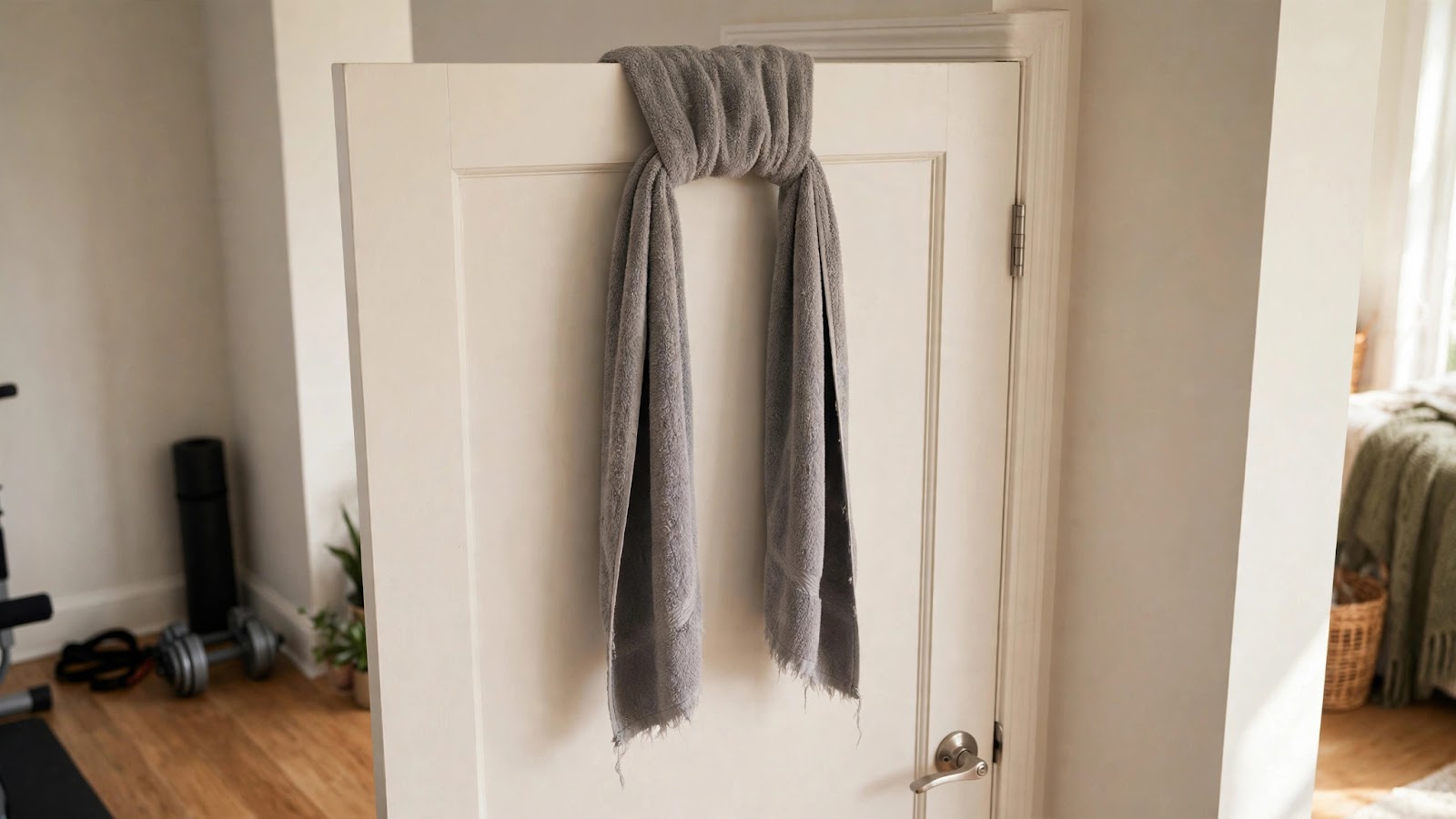
Here's the rigging, step by step. Open the door — a solid interior door, not a hollow closet door, and I'll explain why in the safety section. Fold your bath towel lengthwise into a thick strap, then fold it in half again so you have a loop with two loose ends. Drape the folded towel over the top of the door, with the loop hanging down on your side and the two ends hanging down on the far side. Now close the door firmly. The towel is now pinched between the door and the frame at the top, with the loop hanging on your side at about chest height. That's your anchor.
Before you put any weight on it, test it. Pull the loop toward you with gradually increasing force — lean back a little, then a little more. The towel should hold firm with no slipping. If the towel slides, the fold was too thin; refold it thicker or double up with a second towel. If the door shifts or the latch strains, you've got the wrong door — more on door selection below. When the anchor holds your partial body weight without moving, it's ready.
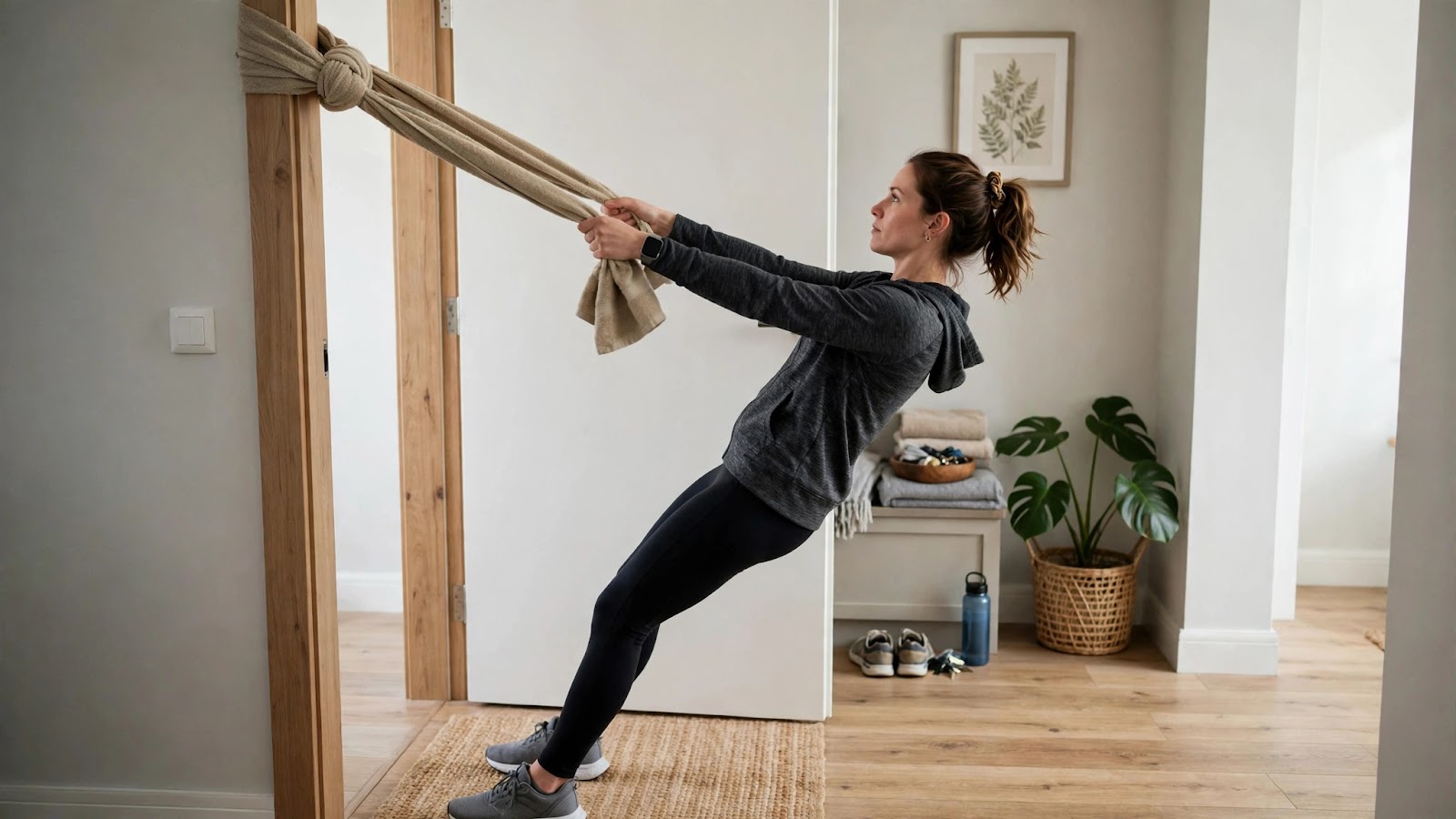
Your body position: stand facing the door, feet about two to three feet back from it, holding the towel loop with both hands. Lean back until your arms are straight and your body forms a diagonal line from heels to head — heels planted, body rigid, like a plank tilted at 45 degrees. This is the start position. Row by pulling your chest toward the door, driving your elbows back and down, squeezing your shoulder blades together at the top. Lower slowly back to straight arms. That's one rep.
The angle is your weight dial. Steeper body angle (more upright) is easier — you're pulling less of your body weight. Shallower angle (closer to horizontal) is harder. I started at about 45 degrees, which felt almost too easy for the first set and then surprisingly real by set three. The beauty of the setup: you adjust difficulty by walking your feet forward or back. No plates, no pins, no excuses.
Safety checks before you lean in (read this twice)
I'm going to be thorough here, because you're hanging your body weight from a towel pinched in a door, and "thorough" is the appropriate speed. I've done thousands of reps on this setup without incident, and it's because I check these things every single session, not just the first time.
Check one: the door itself. Use a solid-core interior door or an exterior door. How do you tell? Knock on it. A solid door sounds dull and heavy; a hollow-core door sounds, well, hollow — like knocking on a drum. Hollow-core doors are common in modern homes for bedrooms and bathrooms, and they are NOT suitable anchors. The thin veneer can crack, the door can flex, and in the worst case the whole thing can fail under load. My house has solid doors on the bedrooms and hollow ones on the closets — I use a bedroom door. If all your doors are hollow-core, this exercise isn't for you; get a suspension trainer that anchors differently or find another row variation. No back exercise is worth a broken door and a faceplant.
Check two: which way the door opens and what's on the other side. The door must open AWAY from you — you should be on the side the door swings toward when opened... no wait, let me get this exactly right, because it matters. You want the door to be pulled CLOSED against the frame by your rowing force. You stand on the side where the door would hit you if it opened toward you — no. Let me think carefully.
Here's the correct geometry: close the door. Stand on the side where the door's hinges are NOT visible... actually, the simplest rule: you want your pulling force to pull the door tighter into its frame, not pull it open. The towel is draped over the top of the closed door. When you lean back and pull, the towel pulls the top of the door toward you. For the door to resist that, the door needs to be braced against its frame on your side — meaning the door opens away from you. If the door opens toward you, your pulling force works WITH the opening direction, and the only thing keeping it closed is the latch — a small metal tongue that is absolutely not rated for your body weight. Test it: with the door closed, push the top of the door from your side. If it feels rock-solid (frame behind it), you're on the correct side. If it gives even slightly (only the latch holding it), switch sides or pick another door. I cannot stress this enough: latch-only is a failure waiting to happen, and the failure mode is you falling backward suddenly with a towel in your hands. Check every time — doors get left ajar, kids open them, life happens.
Check three: the towel. Use a real bath towel, not a hand towel, not a t-shirt, not a bedsheet. It needs to be thick enough that the pinched fold can't pull through the gap between door and frame, and strong enough to hold your weight repeatedly. Inspect it periodically — I retired my first towel after about four months when the fold started looking thin and frayed in the middle. Towels are consumables in this role. A thick beach towel works even better; the extra width distributes the load. Never use anything stretchy — elastic materials store energy and fail unpredictably.
Check four: the floor. You need a non-slip surface under your feet. I row in bare feet on a yoga mat, and the mat has never shifted. Socks on hardwood, on the other hand, turned one of my early sessions into an unplanned trust fall — my feet shot forward, the towel held, and I ended up horizontal, held up entirely by my grip, which was both terrifying and instructive. Bare feet, grippy shoes, or a mat. Never socks on smooth floor. And clear the area behind you — no coffee table corners, no toy trucks, nothing you'll hit if something goes wrong.
Check five: the warm-up rep test. Every session, before my working sets, I do the anchor test pull described above — gradually loading the towel to make sure nothing shifted since last time. Thirty seconds. Non-negotiable. Doors settle, towels compress, frames shift with humidity. The test pull catches all of it.
The rowing form (what "good" looks like)
Once the anchor is verified, the exercise itself is straightforward — but the details separate a back-builder from a arm-pump waste of time. I rowed badly for my first month and wondered why my biceps were sore and my back felt nothing. Here's what fixed it.
Initiate with the shoulder blades, not the arms. Before your elbows bend, pinch your shoulder blades together and down — imagine squeezing a pencil between them. Then drive the elbows back, keeping them at about 45 degrees from the torso (tucked, not flared — flared elbows turn it into a rear-delt party and unload the lats). Pull until the towel loop touches your lower chest or upper abs. Squeeze hard for a full second at the top. I count "one-one-thousand" in my head. That pause is where the growth happens — it's the difference between moving weight and training muscle.
Lower slowly. Three seconds down, every rep. The eccentric — the lowering phase — is where a huge portion of the muscle-building stimulus lives, and it's the phase everyone rushes. I used to drop back to straight arms in half a second. When I forced myself to take three full seconds, the same number of reps became roughly twice as hard, and my back soreness the next day (the good kind) finally showed up. Control the descent like you're resisting someone pulling your hands forward.
Keep the body rigid. Hips shouldn't sag, lower back shouldn't arch, head shouldn't jut forward. One straight line from heels to crown, glutes and abs braced. If your hips sag, you're leaking force and loading the lower back — shorten the lever by stepping closer to the door (more upright) until you can hold the plank. There's no prize for the shallowest angle; there's only the prize of a back that actually got trained.
Breathe: exhale on the pull, inhale on the lower. It sounds basic, but breath-holding during rows spikes blood pressure unnecessarily and makes the sets feel harder than they are. Rhythmic breathing, every rep.
My programming (sets, reps, and progression)
Here's exactly what I do, three times a week — Monday, Wednesday, Friday, after my push-up work (yes, the grease-the-groove habit stuck around in modified form).
Three working sets of 10 to 15 reps, with 90 seconds of rest between sets. When I can do 15 clean reps on all three sets with a given foot position, I move my feet six inches farther from the door next session — a slightly shallower angle, slightly more load. That's the entire progression scheme: same reps, gradually shallower angle. Over six months I went from a 45-degree start to a position where my body is maybe 25 degrees off horizontal, and the difficulty curve has been smooth the whole way. No plateaus, no deloads needed, just the slow walk backward from the door.
Two variations I rotate in. Wide-grip rows: hands at the ends of the towel loop, wider apart — hits the upper back and rear delts more. I do these for one of my three weekly sessions. Single-arm rows: one hand on the loop, other arm behind the back, feet closer to the door to reduce load — brutal on the lats, and the anti-rotation demand lights up the core. I added these in month three, one set per session, and they're now my favorite. The single-arm version exposed a left-right imbalance I didn't know I had — my right lat was noticeably stronger — and six weeks of single-arm work evened it out.
Total back-training time per session: about twelve minutes. Three sets, rest periods, done. It slots into a lunch break or the gap between dinner and the kids' bedtime. The low time cost is why I've stuck with it for six months — the best program is the one you'll actually do, and "twelve minutes with a towel" has a compliance rate that "drive to the gym" never achieved for me.
Rig it carefully, check the door every session, start more upright than your ego wants, and progress by walking your feet back six inches at a time. Initiate with the shoulder blades, pause at the top, lower for three seconds. Do that for six months and your back will look like it belongs to the same person as the rest of you. Mine finally does — and all it took was a bath towel, a bedroom door, and the discipline to check the anchor before every single session. The towel is still the least glamorous thing in my fitness life. It's also the most useful.


