I discovered my balance was terrible in the most ordinary way possible. I was standing on one leg to put on a sock, wobbling like a toddler, when I grabbed the doorframe to stop myself falling sideways into the wardrobe. I laughed it off at the time, but it stuck with me. I could walk, I could squat, I could climb stairs, yet I could not stand still on one foot for ten seconds without windmilling my arms. That seemed worth fixing before a real fall did the convincing for me.
Balance is the quiet fitness skill nobody brags about. Nobody posts about their single-leg stand the way they post about a run or a lift. Yet it shows up everywhere: stepping off a kerb, reaching for a high shelf, carrying a laundry basket while the cat weaves around your ankles. I decided to spend four weeks on it, ten minutes a day, in my hallway and living room, and the results surprised me far more than any strength routine had.
My starting test was simple and slightly humbling. I stood barefoot on the rug, arms by my sides, lifted one foot a few inches off the floor, and timed myself with my phone. Right leg: eleven seconds before I had to put my foot down. Left leg: seven seconds, and not elegant seconds either. I wrote both numbers on a sticky note on the fridge. That note kept me honest, because balance improves quietly, and without a starting number I would never have believed the change.
Why balance fades without practice
Modern life barely asks us to balance. We sit most of the day, we walk on flat pavements, we hold handrails, and our shoes do a lot of the stabilising work for us. The small muscles in our feet and ankles, and the reflexes that catch us when we tip, get lazy through lack of use. It is not age or clumsiness, mostly. It is practice we stopped doing, like a language we stopped speaking.
The good news is that those reflexes come back quickly with short, regular practice. You do not need a wobble board or fancy equipment. You need a clear patch of floor, something sturdy to hold if you need it, and a few minutes most days. I did my routine in the hallway because the walls were close enough to catch me, which mattered in week one when I wobbled a lot. Pride is a poor safety net. A wall is a good one.
One safety note, plainly: if you have a condition that affects balance, dizziness, or your inner ear, or you have fallen before, check with a professional before starting, and always practise near support. Stop if you feel dizzy or sharp pain. Wobbling is normal training. Dizziness is a signal to sit down and get advice, not to push through. My rule was simple: near a wall, barefoot or in flat shoes, never on a slippery floor.
The routine I actually did
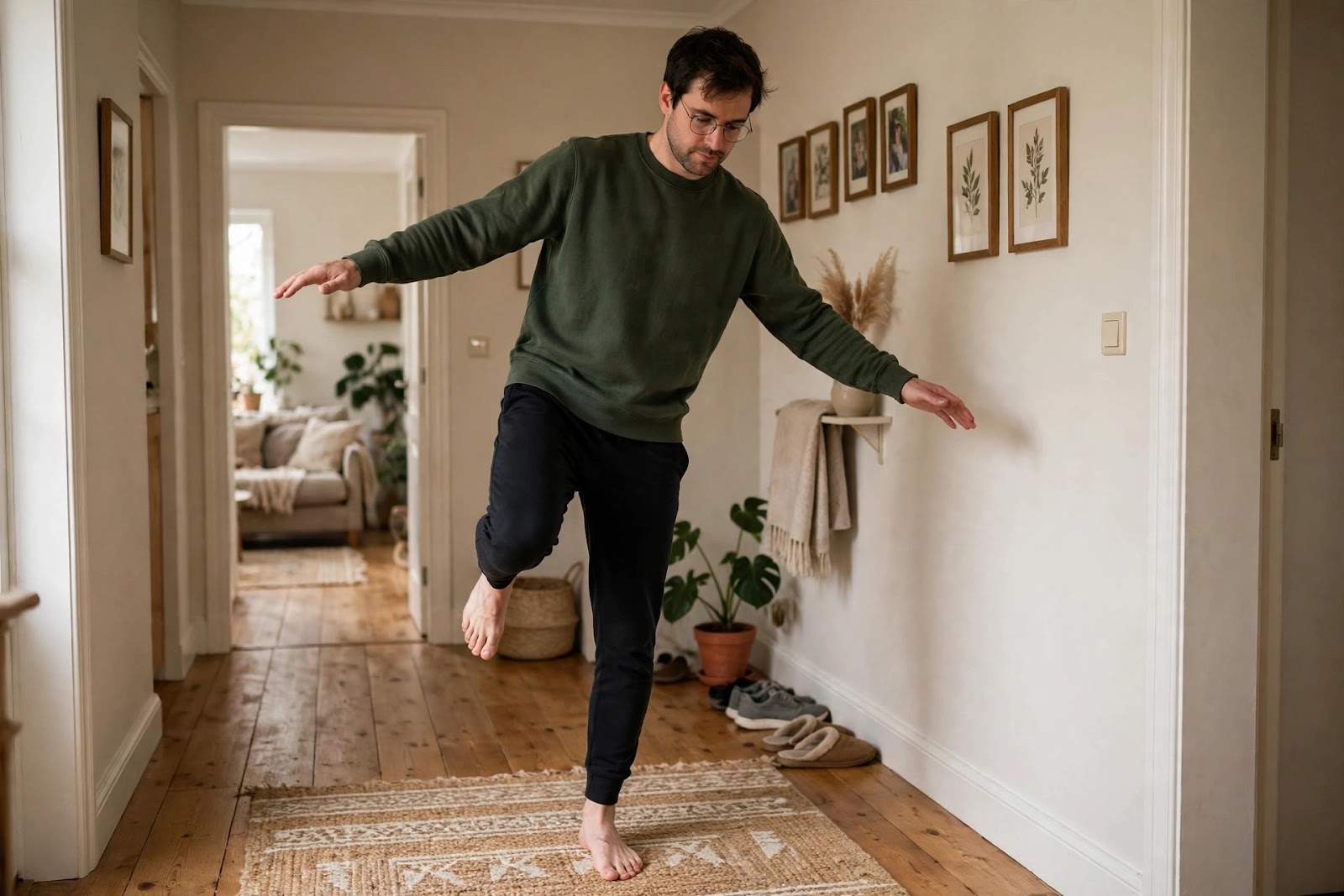
I practised for ten minutes, five days a week, usually while my evening tea cooled. I started every session with two minutes of ankle work, because stiff ankles were half my problem. I did ten slow ankle circles per foot, then ten heel raises holding the wall lightly, then ten toe raises where I lifted my toes and rocked back onto my heels. It sounds trivial. It woke up feet that had spent years inside shoes doing nothing.
Then came the main drill: single-leg stands. Three sets per leg, aiming for thirty seconds each, with a hand hovering near the wall. In week one I held the wall with two fingers, which felt like cheating until I realised it was exactly the right level. By week two I could hover my hand an inch from the wall, touching only when I tipped. By week four I stood free for thirty seconds on my right leg and twenty-two on my left, which was triple my starting number.
The second drill was heel-to-toe walking, the sobriety-test walk, done slowly down my hallway. I placed one foot directly in front of the other, heel touching toe, arms out to the sides like a tightrope walker, and walked ten steps, turned carefully, and walked back. The first time I did it I veered into the wall by step six and had to laugh at myself. By week three I could do the full hallway without touching either wall, which felt like a genuine achievement, hallway or not.
The third drill was the one that made the biggest difference: weight shifts. I stood with feet hip-width apart and slowly shifted all my weight onto my right foot, lifted my left foot just an inch, held for five seconds, then shifted back. Then the other side. Twenty shifts total, slow and controlled. This taught my body to catch small tips early, instead of waiting until I was already falling sideways and flailing. It is boring to watch and brilliant to practise.
The progressions that kept it interesting
Once thirty seconds of single-leg standing felt steady, I added small challenges instead of just standing longer. First I closed my eyes for five seconds during a stand, hand still near the wall. That was shockingly hard. Without vision, my ankles had to do all the work, and they complained loudly for a week. I built up to ten seconds with eyes closed, and that is still my favourite test of real progress.
Next I added head turns. Standing on one leg, I slowly turned my head left and right, then looked up and down. Turning your head while balancing scrambles the signals your body relies on, which is exactly why it is useful training. I did it slowly, near the wall, and stopped the moment I felt genuinely dizzy. Slow head turns, not fast spins. This is training, not a fairground ride.
Then I tried single-leg stands on a folded towel, which gives a slightly soft, uneven surface. I only did this in week three, once the flat floor felt easy, and I kept both hands near the wall. The towel made my ankles work much harder, and I could feel muscles in my feet I had never noticed before. If a towel feels too wobbly, skip it. The flat floor version is already plenty, and rushing to unstable surfaces is how ankles get twisted.

My last progression was the most practical one: balancing while doing something else. I stood on one leg while folding a tea towel, or while reaching slowly to a shelf at shoulder height. Real life never asks you to balance in a vacuum. It asks you to balance while carrying, reaching, and turning. Training with a small task attached made the skill transfer to daily life much faster than pure standing ever did.
What changed in four weeks
The numbers told one story. Right leg: eleven seconds to over forty. Left leg: seven seconds to twenty-eight. Heel-to-toe hallway walk: wall-bouncing mess to clean run. But the daily-life changes mattered more, and they arrived without fanfare. I stopped grabbing furniture when I put on socks. I stepped off kerbs without that little hesitation. I carried a full washing basket downstairs without hugging the wall.
The change I did not expect was confidence. I had started avoiding certain movements without realising it: stepping over the low garden wall, standing on a chair to reach a shelf, walking across a wet pavement. After four weeks I was not fearless, but I was less hesitant, and that hesitation had been quietly shrinking my world. Balance training gave some of it back, ten minutes at a time.
My biggest mistake, honestly, was practising only my good leg at first. My right leg improved fast, my left lagged, and the gap actually felt worse for a while. When I forced myself to start every set on the left, weaker leg, the gap narrowed within two weeks. Always start with the weaker side. Let it set the standard, and let the stronger side match it, not exceed it.
My second mistake was training in thick, cushioned trainers. They muffled all the feedback from my feet, so my ankles learned nothing. Barefoot on the rug, or in thin flat shoes, worked far better. I could feel the floor, feel my toes gripping, and feel a tip starting before it became a fall. If your floors are cold, thin socks are fine. Thick soles are not your friend here.
If you want to try this, start with the test I did. Time each leg, write it down, and practise for ten minutes a day for two weeks before judging anything. Keep a chair or wall within reach, keep it slow, and keep it daily rather than heroic. Balance is a skill, and skills respond to frequency, not intensity. A short daily practice beats one long weekend session every time, and my fridge note proves it.
Four weeks ago I could not put on a sock without grabbing the doorframe. Now I stand on one leg, eyes closed, for ten seconds, and I do it while my tea cools in the kitchen. It is a small, unglamorous victory, and I am oddly proud of it. If your balance feels shakier than it used to, do not wait for a fall to take it seriously. Ten minutes, a hallway, and a wall nearby is all it takes to start.


