I sit for a living. Ten, sometimes twelve hours a day, parked in an office chair, hips folded at ninety degrees like a human pocketknife. For years my body kept the receipt quietly. Then one Saturday I tried to sit cross-legged on the floor to play a board game with my kids, and my hips staged a full revolt — pinching in the front, aching in the back, and a stiffness so profound I had to rock forward to stand up, like a man twice my age. I was 34. That was the moment I admitted my hips were broken.
I'd tried the usual fixes. The pigeon pose from yoga class, which felt like my knee was being interrogated. The couch stretch, which made my lower back scream. Random YouTube hip-openers that left me sore in places I couldn't name. Nothing stuck, because nothing addressed the actual problem: my hips had forgotten how to rotate. They could flex forward and extend back — the sitting and standing motions — but internal and external rotation, the movements that let you squat deep, sit cross-legged, or pivot without your lower back compensating, had basically rusted shut.
Then a physical therapist friend watched me try to sit cross-legged, winced sympathetically, and said: "Ninety-nineties. Ten minutes, twice a day, three weeks. Call me when you can sit on the floor." I was skeptical — one stretch, ten minutes, fixing years of chair damage? But I was also desperate. Three weeks later I sat cross-legged through an entire board game. Here's the routine, exactly as I did it.
What the 90/90 position actually is
The name describes the shape your legs make. Sit on the floor with your front leg bent at 90 degrees — thigh pointing forward, knee bent so the shin runs sideways, both the hip and knee at right angles. Your back leg mirrors it: thigh pointing out to the side, knee bent at 90 degrees, shin running backward. From above, your legs make a kind of boxy Z shape. One hip is in external rotation (the front leg), the other in internal rotation (the back leg). Then you switch sides, and each hip gets both jobs.
That's the whole position. It looks simple. It is not easy, at least not at first. The first time I tried it, my front knee hovered three inches off the floor no matter how hard I pressed, my back hip pinched ominously, and I lasted about forty seconds before flopping over sideways. This is normal. The position exposes exactly what sitting has stolen from you, which is why it works — it's a diagnostic and a treatment in the same shape.
Why this stretch instead of pigeon pose or lunging hip flexor stretches? Because the 90/90 trains rotation, not just length. Most hip stretches pull the muscles longer in one direction. The 90/90 puts each hip through both internal and external rotation under your own body weight, which teaches the joint to actually move in those directions again — not just tolerate being stretched, but actively control the range. My PT friend's line: "Stretching makes you longer. The ninety-ninety makes you capable." After three weeks, I understood exactly what she meant. My hips didn't just feel looser; they felt smarter.
The 10-minute routine (my exact sequence)
I did this twice a day — once mid-morning as a break from the desk, once in the evening while the TV was on. Ten minutes each. Here's the sequence, and the order matters because it goes from gentle assessment to deeper work.
Minutes 0–2: Settle into the 90/90 on your tighter side first. Don't force anything. Just sit in the position, hands on the floor beside you for support, and breathe. Let gravity do the work. Your front knee might float — mine did for the first ten days. That's fine. Don't push it down. The goal of these two minutes is to let your nervous system realize this position isn't a threat. Everything in hip mobility is downstream of convincing your brain to stop guarding. Breathe slowly, in through the nose, out through the mouth, and feel the hips settle a millimeter deeper with each exhale.
Minutes 2–4: Rotations in place. From the 90/90, keeping your feet roughly where they are, lift both knees and rotate them to the other side — like windshield wipers — so your legs flip to the mirrored position. Then rotate back. Slow and controlled, ten rotations total. This is the money movement: you're actively driving the hips through internal and external rotation, not just parking in the stretch. The first week, my rotations were jerky and uneven — one side would flop over while the other lagged. By week two they smoothed out. By week three they were almost graceful. Almost.

Minutes 4–6: Lean work on the front leg. Back in the 90/90, walk your hands forward over the front shin and fold your torso toward the floor, keeping your back flat. You should feel a deep stretch in the outside of the front hip — the glute and the deep rotators. Hold for five slow breaths, come up, repeat twice. Then place your hand on your front knee and gently rotate your torso toward the back leg, opening the chest — this adds a trunk-rotation element that stretches the front of the back hip. Five breaths each side, twice. This was the part that made the biggest day-to-day difference for me; the morning I first felt my front knee actually touch the floor during the forward fold, I texted my PT friend a photo like I'd won something.
Minutes 6–8: Lift-offs. Still in the 90/90, place your hands on the floor for balance and try to lift the front knee an inch off the floor using only the hip muscles — hold for five seconds, lower. Five reps. Then the back knee: lift it an inch, hold five seconds, five reps. This is strength work disguised as stretching, and it's the part most people skip, and it's the part that makes the flexibility stick. A range of motion you can't actively control isn't really yours — your brain won't let you use it. The lift-offs teach control, which is why my new mobility didn't evaporate after a long workday. Fair warning: these are humbling. My first lift-offs moved my knee approximately zero inches. I was contracting muscles that had been on vacation for a decade. They woke up eventually.
Minutes 8–10: Switch sides and repeat the rotations. I always did the full sequence on the tight side, then flipped and did at least the rotations and one forward fold on the other side. Over the three weeks, my "good" side needed less and less work, and I gradually shifted to doing the full ten minutes per side — twenty minutes total — by week three. Start with ten total; expand when it feels right.
Form cues that actually matter
Sit tall before you fold. The most common mistake I see (and made) is rounding the lower back to get deeper into the forward fold. A rounded back dumps the stretch into the lumbar spine instead of the hip — which is exactly the compensation pattern we're trying to fix. Cue: imagine a string pulling the crown of your head toward the ceiling, hinge forward from the hips, and stop the moment your back wants to round. Your depth will be less impressive. Your hips will thank you.
Keep the feet relaxed but active. In the 90/90, your feet should be roughly in line with your knees — not tucked under, not flopping outward. I think of "flexing" the feet gently, like I'm showing the soles to the walls. This keeps the ankles from collapsing, which otherwise lets the knees torque in ways they shouldn't. If your ankles are cranky, this position will tell you — another diagnostic bonus.
Breathe into the stretch, not against it. When you hit the edge of your range, the instinct is to hold your breath and brace. That bracing is your nervous system guarding, and it locks the hip tighter. The exhale is the key that unlocks it: breathe in, and as you breathe out, consciously let the hip sink a fraction deeper. I gained more range from breathing correctly than from any amount of pushing. This sounds like yoga-class mysticism. It is biomechanics — exhaling activates the parasympathetic system and reduces muscular guarding. Whatever the mechanism, it works.
Never stretch into sharp pain. Dull, deep, "intense but tolerable" is the zone. Sharp, pinching, or shooting — especially a pinch in the front of the hip — means stop and adjust. A front-of-hip pinch often means the femoral head is jamming into the socket, and pushing through it is how people injure labrums. If you get that pinch consistently on one side, shift your torso slightly toward the front leg or elevate your hips on a cushion — sitting on a yoga block or a firm pillow reduces the angle and often eliminates the pinch entirely. I sat on a folded towel for the first week. No shame in props; shame is for injuries.
The three-week progression (what changed and when)
Week one was mostly about showing up. Honestly, the physical changes were minimal — my front knee still floated, the rotations were jerky, the lift-offs were theoretical. But something important happened around day five: the position stopped feeling like an attack. My body stopped bracing the moment I sat down into it. That nervous-system adaptation is invisible and unglamorous and it's the foundation everything else builds on. If week one feels pointless, it's not. It's the week your brain decides the floor isn't dangerous.
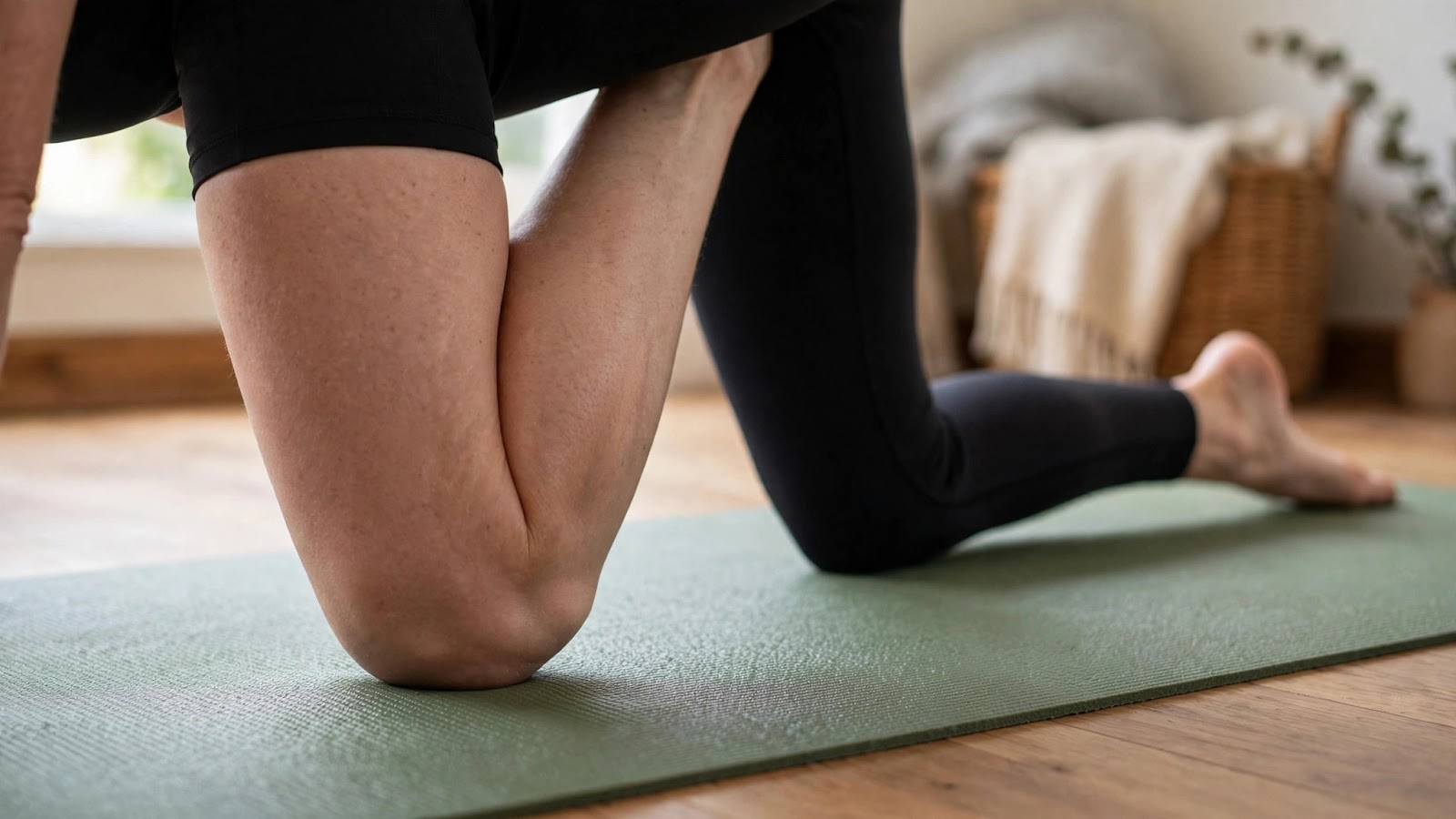
Week two is when the visible changes started. Around day ten, my front knee touched the floor on the right side during the forward fold — not forced, just settled there during an exhale. The rotations smoothed out noticeably; I could do ten continuous windshield-wipers without the clunky reset between each one. The lift-offs started producing actual lift — a real inch of daylight under the knee. And the cross-legged test: I could sit cross-legged for about five minutes before the ache set in, up from about thirty seconds. Progress you can measure in minutes of comfortable floor-sitting is progress that matters in real life.
Week three was the payoff. By day eighteen, both knees rested on the floor in the base position without effort. The lift-offs were strong — five-second holds, controlled lowers, no shaking. I sat through the entire board game cross-legged, then stayed on the floor for another twenty minutes afterward because I could. My morning stiffness — that tin-man first-ten-minutes after getting out of bed — was noticeably reduced. And here's the one I didn't expect: my squat improved. I could drop into a deep bodyweight squat with my heels down for the first time in years. Hip rotation and squat depth are linked — when the hips rotate freely, the femurs can track correctly in the squat — and the 90/90 had quietly fixed both.
What I added (and what I'd skip)
Around week two, I added a couch stretch — the half-kneeling hip flexor stretch with the back foot up on the couch — for two minutes per side after the 90/90 routine. My hip flexors were brutally tight from sitting, and while the 90/90 handles rotation beautifully, it doesn't deeply lengthen the hip flexors. The combination was excellent: rotation from the 90/90, length from the couch stretch. If you sit all day like me, I'd recommend pairing them. If I had to pick only one, though, the 90/90 wins — rotation was my bigger deficit.
What I'd skip: aggressive "hip opening" flows from social media — the ones with deep lunges, frog poses held for five minutes, people hanging off yoga straps. I tried a couple in week one out of impatience, and they left me sore for two days without improving anything. More intensity isn't more mobility. The 90/90 works because it's the right movement done consistently, not because it's extreme. Boring and repeatable beats intense and occasional, every time.
I also tried doing the routine only once a day for a few days in week two (evenings only, skipped mornings when work got busy). The difference was noticeable within 48 hours — the morning stiffness crept back, and the evening session felt like starting over. Twice daily matters, at least in the beginning. The dose makes the medicine. Ten minutes is short enough that "I don't have time" is never true — I did morning sessions between meetings, on the office floor with the door closed, and nobody ever knew.
The honest takeaway
Three weeks, ten minutes, twice a day, one position. That's the whole prescription, and I'm almost annoyed at how well it worked after years of complicated fixes that didn't. My hips went from "can't sit cross-legged for a board game" to "sits on the floor by choice." My squat depth came back. My morning stiffness dropped by more than half. And the maintenance is trivial — I still do the routine most mornings, five minutes now instead of ten, and the mobility has held for months.
My recommendation is simple: if you sit all day and your hips feel like they're made of rust and regret, try the 90/90 for three weeks before you try anything fancier. Tight side first, breathe into it, add the lift-offs even though they're humbling, and don't push through pinches. Film your base position on day one — knees floating, torso wobbling — and again on day twenty-one. That comparison will tell you everything. Mine told me that the most boring stretch in the world, done with ridiculous consistency, beat every exciting fix I'd ever tried. Sometimes the unsexy answer is the answer.


