The treadmill in my building's little gym room lasted exactly eleven days with me. I know the number because I counted the visits on my fingers one evening, slightly annoyed, while the machine sat there humming for someone else. It wasn't that the treadmill was bad. It was fine. It was grey, it worked, it had a cup holder. The problem was that every minute on it felt like a minute I was serving out, watching numbers crawl and waiting for it to be over. I have never been good at exercise that feels like a punishment I scheduled for myself.
Dancing, on the other hand, snuck in through the side door. I wasn't trying to build a cardio routine at all. One rainy Saturday I was cooking, a song I loved came on, and I ended up moving around the kitchen for the full length of it — not performing, not counting reps, just shifting my weight, stepping side to side, turning when the chorus hit. By the third song I was properly warm, a little out of breath, and grinning. My watch said my heart rate was up in the same zone the treadmill used to put me in, and I hadn't watched a single number while it happened. That was the moment I stopped asking how to force myself to do cardio and started asking what kind of movement I would actually miss if I skipped it.
The routine I built from that afternoon is twenty minutes long, uses songs I already loved before any of this started, and has survived eight months now — longer than any treadmill plan, running plan, or app challenge I've ever tried. This isn't a dance class. I am not a dancer, I have no training, and nobody should watch me do this expecting technique. It's a home cardio session that happens to be dancing, built around music that already means something to me, and that's exactly why it stuck.
Why the treadmill lost and the playlist won
Let me be honest about the treadmill first, because I think a lot of home-fitness advice skips the real reason people quit. I didn't quit because I was lazy. I quit because the whole setup gave my brain nothing to hold onto except discomfort and a timer. I would step on, set a speed, and immediately start negotiating: five more minutes, then three, then fine, two, then off. The workout was a countdown, and countdowns make every second feel longer.
Dancing flips that. The song is the timer, and the song is also the reward. A three-and-a-half-minute track doesn't feel like 210 seconds of effort; it feels like one chorus, one bridge, one ending. When the track changes, my body gets a tiny reset — new rhythm, new steps, new mood — without me having to decide anything. Psychologists have fancier words for this, but in my living room it just means I stop checking the clock. Most nights I finish the routine slightly surprised that twenty minutes passed.
There's another difference I didn't expect: I actually look forward to it. Not in a grand, motivational-poster way. In a small, ordinary way — the way you look forward to putting on a favourite album after a long day. On treadmill days, I used to change into workout clothes with a sigh. On dance days, I press play and the first eight bars do the persuading for me. That shift, from willpower to wanting to, is the whole game. Any routine that depends on daily willpower is a routine with an expiry date.
The playlist rule that made it work
The first version of this routine failed, and it's worth saying why, because the fix was simple. I started with a playlist of high-energy workout songs I found online — fast, loud, generic. It felt like a gym soundtrack dropped into my flat, and I hated it within a week. The songs meant nothing to me, so when I got tired I had no reason to stay for the next one.
So I made a rule: every song on the playlist had to be a song I already loved before I started exercising to it. Old favourites, songs from road trips, songs my friends and I used to play too loud in the car. I went through my library and picked tracks that made my foot tap without me thinking about it. That test — does my foot move before my brain votes? — turned out to be a better selector than any beats-per-minute chart.
I ended up with a pool of about twenty-five songs and I rotate five or six of them into each session. The variety matters because a fixed playlist goes stale fast; I learned that the hard way in week three, when I could predict every beat drop and the whole thing started feeling like a chore again. Now I swap two songs out every Sunday night, which takes about four minutes and keeps the routine feeling like mine rather than a recording I'm replaying.
One more thing about song choice: I pick songs in the 110 to 130 beats-per-minute range without measuring precisely, just by feel. Too slow and I'm swaying, not working. Too fast and I'm flailing and out of breath in ninety seconds. The sweet spot is a song that makes me want to move my whole body — shoulders, hips, feet — without making me gasp. If you try this, trust the foot-tap test over any number.
The 20-minute routine, song by song
Here's the shape of the session, which has stayed the same even as the songs change. Twenty minutes, five songs, roughly four minutes each, with the effort rising and falling the way a good setlist does.

Song one is the warm-up, and I treat it seriously even though it looks like nothing much. I pick something mid-tempo and familiar, and for the first minute I just walk in place, roll my shoulders, loosen my neck, and let my knees bend a little on the beat. In the second minute I add side steps — two steps right, two steps left, arms swinging easy. By the third minute I'm doing gentle knee lifts and small turns. Nothing here should leave you breathless. The point is to arrive warm, not to prove anything in the first track.
Songs two and three are the workhorses. This is where I move biggest: step-touches with real energy, grapevine steps across the rug, little hops on the beat if my knees are happy that day, arm movements that actually use my shoulders. I learned to use my arms properly only after filming myself once (a humbling experience, highly recommended). For the first month my arms were doing almost nothing while my legs did all the work, which meant my heart rate stayed lower than it should have. Big arm circles, reaching up on the chorus, punching the air on the beat — it looks silly, it works, and nobody is watching.
Song four is my favourite trick in the whole routine: the "chorus challenge." I pick the song's chorus and give myself one bigger move just for those twenty or thirty seconds — faster feet, a spin, a little jump, whatever fits. Then the verse brings me back down to a steady step-touch. That on-off pattern does for my stamina what interval training claims to do, except I don't need a stopwatch or a chart; the song itself tells me when to push and when to recover. My breathing gets properly hard during the choruses and settles during the verses, and over the weeks I noticed the recovery getting faster. That's the part that made me feel fitter in everyday life — climbing stairs, carrying groceries — not any single number.
Song five is the cool-down, and I refuse to skip it now after skipping it for a month and wondering why my calves felt tight the next morning. I choose something slower, something I like enough to slow down to. I walk it out, stretch my arms overhead, sway side to side, do slow calf raises and a few deep breaths. The last minute is just standing still, breathing, letting my heart rate come down while the song finishes. It sounds small. It changed how I felt the next day more than any of the fast songs did.
Setting up a corner that doesn't fight you
My dance floor is a rug in the living room, about two metres by one and a half, with the coffee table pushed to one side. That's it. I tried clearing a bigger space once and it made the whole thing feel like a production — furniture moving, lamps at risk, a whole ceremony before the first song. The small space is actually a feature: I can't build up much speed, so I move in place, turn, step, and stay controlled, which is kinder to my knees and to the neighbours downstairs.
Footwear matters more than I expected. I dance in socks on the rug most nights, which gives me enough grip without sticking. On hard floor I'd wear light trainers; bare feet on a smooth floor made me slip once, mid-spin, and I spent the rest of that song being careful instead of enjoying it. If your floor is slippery, wear shoes. If your rug slides, put a non-slip mat under it. Five minutes of setup once beats twenty minutes of caution every night.
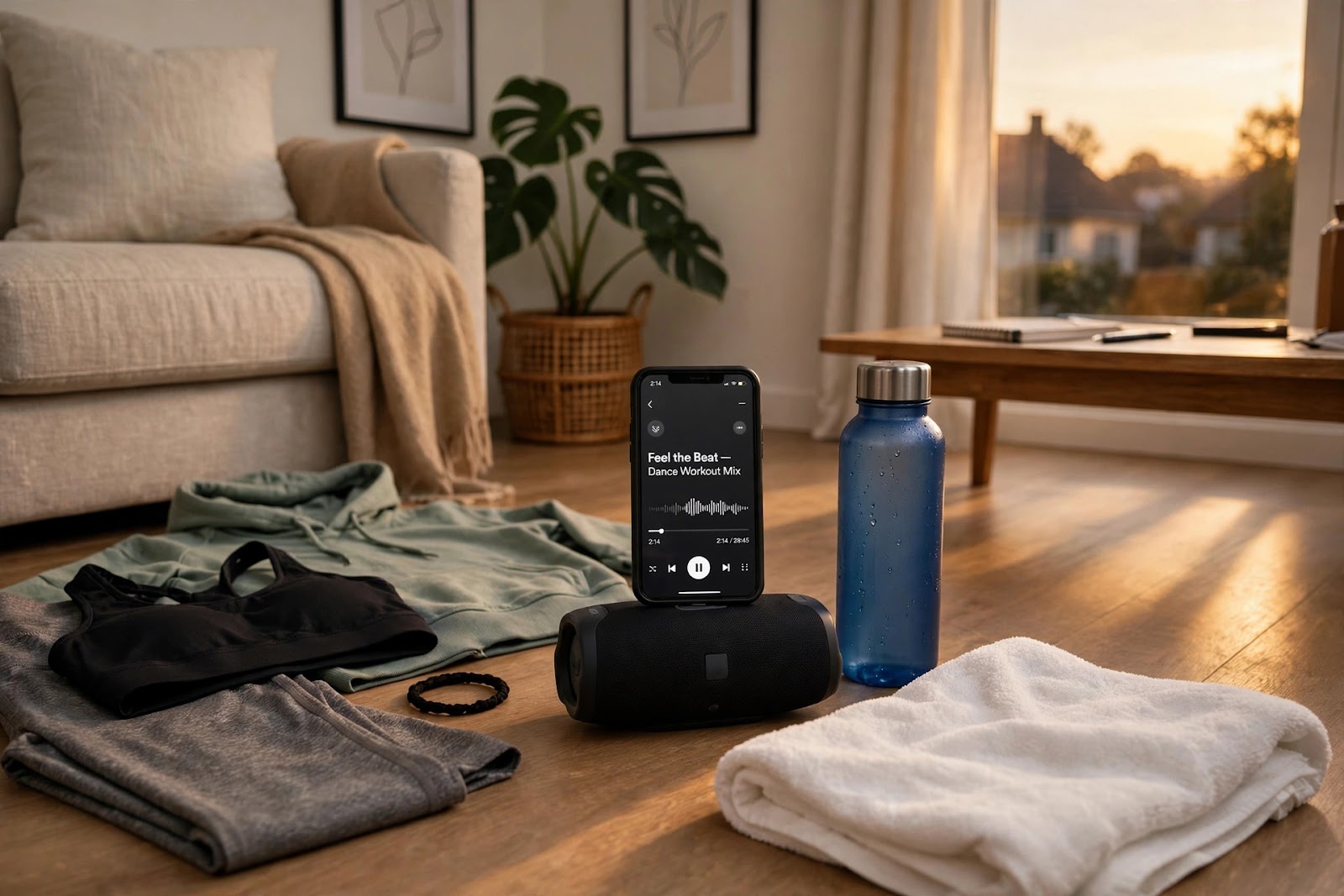
Sound is the other practical piece. I use a small Bluetooth speaker on the bookshelf, loud enough to feel the beat but not loud enough to bother anyone through the walls — I checked with my neighbour early on, and she said she couldn't hear it, which was a relief. Headphones work too, but I prefer the speaker because it makes the room feel like the session, not just my ears. A phone speaker in a quiet flat will do for a first try; don't buy equipment before you know you like the routine.
What went wrong along the way
The honest list of mistakes is longer than I'd like. First, I went too hard in week one, picking the fastest songs I owned and trying to match every beat, and I woke up the next day with sore shins and a grudge against the whole idea. Slowing down felt like failing at the time. It was actually the fix: moderate effort I could repeat beat fast effort I dreaded.
Second, I tried to copy dance routines from videos, and that nearly killed it. The moves were designed for people with coordination I don't have, and spending twenty minutes feeling clumsy is not a workout, it's an embarrassment rehearsal. The day I dropped the videos and just moved the way the music made me move, the routine became mine. If you love following choreography, do that — but if it makes you feel judged, even by yourself, drop it. Your living room is not an audition.
Third, I skipped rest days and paid for it with a dull ache in my left knee that lingered for a week. Now I dance four or five nights a week, never more than two days in a row at full energy, and I walk or stretch on the other days. The routine stuck because it stopped being a daily test and became a regular habit with breathing room.
Fourth — and this one surprised me — I had to stop treating it as a weight-loss tool. For the first month I weighed myself after every session like the scale was grading my dancing. It made a fun thing anxious. When I stopped weighing in and started noticing other markers — I could dance all five songs without stopping, my resting energy in the evening felt better, stairs felt easier — the routine got lighter in every sense. If your goal is weight, dancing helps, but making the scale the judge will spoil the very thing that makes you show up.
How I know it's actually cardio (without obsessing over numbers)
I don't track much, deliberately. But I do check two things, because "fun" alone isn't a fitness measure and I wanted to be honest with myself about whether this counted. The first is the talk test: during songs two to four, I should be able to get out short sentences but not hold a comfortable conversation. If I can chat away easily, I'm swaying, not training, and I need bigger movements. If I can't get a word out, I've gone too far and I ease off until I can. It's a crude gauge, but it's free, it needs no device, and it has never lied to me.
The second is recovery: after the cool-down song, my breathing should feel normal again within two or three minutes. In the early weeks it took five or six. That shrinking recovery time was the clearest sign my fitness was improving, clearer than any app graph. If you try this, note your recovery time once a week in a phone note. One line — "Tuesday: breathing normal after 3 minutes" — is all the tracking this routine needs.
I also keep a tiny weekly tally, nothing more: how many nights I danced. Not minutes, not calories, just nights. Four out of seven is a good week. Three is fine. Two in a row of bad weeks tells me the playlist has gone stale and it's time to swap songs. That tally has kept me honest without turning the routine into bookkeeping.
Making it yours: a first-week plan
If you want to try this, here's the version I'd hand a friend. Night one: pick five songs you already love, clear a rug-sized space, and just move for twenty minutes without any plan beyond "keep moving through each song." Don't film it, don't measure it, don't try to look good. See how it feels.
Night two: notice which song made you move most naturally, and put that one second in the order — that's your workhorse slot. Night three: try the chorus challenge on one song, a bigger move just for the chorus. By the end of the week you'll know whether the music is doing its job. If you finished all five songs and the time passed faster than you expected, you have a routine. If you spent the whole time watching the clock, the songs are wrong, not you — swap them.
A few practical tips from eight months of trial and error. Keep a water bottle in the corner before you press play; stopping to fetch one mid-song breaks the spell. Keep the room cool — I open a window ten minutes before, because a warm room turns twenty minutes into a slog. And give yourself permission to have an off night: some nights my energy is low and I dance gently through all five songs, barely raising a sweat. I still count it. A gentle session beats a skipped session, and skipped sessions are how routines die.
One caution worth stating plainly: if something hurts in a sharp or joint-specific way, stop that move. Soreness in muscles the next day is normal when you start; a sharp pain in a knee or ankle is a signal, not a challenge. I dropped the little jumps entirely during the week my knee complained, kept the stepping and turning, and the routine survived fine. Dancing gives you a hundred ways to move — you don't need the one that hurts.
Why it stuck when nothing else did
Eight months in, I think the reason is embarrassingly simple: the routine is built out of things I already liked. The songs were already on my phone. The living room was already mine. The movement is just what my body does when music I love is playing. Nothing about it feels borrowed from a gym, an app, or someone else's discipline. It's not a program I follow; it's a habit I enjoy, and habits you enjoy don't need pep talks.
The treadmill taught me something useful, too, and I'll give it credit: it taught me what doesn't work for me, which is exercise that asks me to endure boredom for a future reward. Dancing pays me in the present — a good song, a good chorus, twenty minutes that feel like ten. That immediate payoff is why I still press play on nights when I'm tired, busy, or in a bad mood. Especially on those nights, actually. Some of my best sessions started with me thinking I'd only do one song, and then the second song came on and I stayed.
So if cardio has never stuck for you, don't start by shopping for equipment or downloading a plan. Start by opening your music library and asking one question: which five songs make my foot tap before I even think about it? Press play on the first one, move around your living room, and see what happens. You might find, like I did, that the workout you've been avoiding was hiding inside the music you already loved.


