I own no dumbbells. I own no kettlebell, no barbell, no resistance bands that haven't lost their snap. What I do own is a battered grey hiking backpack, three years old, with a sternum strap that actually works and a waist belt I've never once used. For the past eight months, that backpack has been my gym. It's also, briefly, the thing that hurt my shoulder — and the story of how I loaded it wrong is the reason I'm writing this instead of just telling you to stuff books in a bag and start squatting.
Because here's the thing nobody tells you about backpack training: the bag isn't the hard part. The loading is. Where the weight sits, how tight it's packed, which strap takes the load — those tiny details decide whether you get stronger or get injured. I got them all wrong for the first month. My shoulder paid for it. Then I fixed the setup, and the same backpack that hurt me became the best piece of home gym equipment I've ever owned, mostly because it cost me nothing.
If you already have a backpack and a few heavy books, you have everything you need. You just need to load it like it matters, because it does.
How I started: books in a school bag, zero plan
The idea came to me on a Tuesday night, the way bad ideas usually do — I was scrolling through home workout videos and getting annoyed at how much equipment every single one assumed I had. Adjustable dumbbells. A pull-up bar. A bench. I had a living room rug and stubbornness. So I grabbed my old school backpack, threw in four hardbacks, and did squats in my hallway.
It felt brilliant for about a week. The squats were hard in a good way. My legs were sore in the mornings, the honest kind of sore that means you did something. I added a fifth book. Then a sixth, a thick cookbook that weighed almost a kilo on its own. I started doing push-ups with the bag on my back, rows by leaning over the kitchen counter with one strap in my hand, lunges up and down the hallway. I told two friends about it like I'd invented something.
What I didn't notice, because nobody notices this until it bites, was that the books were sliding around. Every squat, the load shifted to one side. Every push-up, the bag sagged toward my left shoulder. The straps were loose because loose felt comfortable. The weight sat low in the bag because that's where gravity put it. I was training with a shifting, lopsided, low-slung load — and I was doing it three times a week, adding weight the whole time.
The shoulder mistake
It happened on a Thursday, during push-ups. Set three, rep nine. I felt something in my left shoulder — not a pop, not a tear, just a sharp, wrong tug right at the front of the joint, like a rubber band pulled past its limit. I dropped to my knees, took the bag off, and sat there on the rug feeling stupid. The shoulder ached for the rest of the day. It ached the next morning. It ached when I reached for the top shelf, when I carried a grocery bag, when I rolled over in bed.
I did what most people do: I ignored it for a week, told myself it was nothing, and then finally went to see a physio when it still hurt to lift my arm past shoulder height. She watched me do one push-up with the bag on, asked me to show her how I loaded it, and then — I will never forget this — she just laughed. Not unkindly. The laugh of someone who has seen this exact mistake a hundred times.
"You've been doing push-ups," she said, "with eight kilos hanging off one shoulder strap, sliding around, while your left arm takes the load. Your shoulder didn't fail. Your setup failed." Then she gave me the three rules that changed everything, and she made me write them down: weight high and tight against the back, straps cinched evenly, and never — never — one strap. One strap is how you turn a strength exercise into a shoulder injury. I was out for three weeks. No upper body work at all. Three weeks of leg-only training and thinking about how a free backpack had cost me a month of progress.

How I load it now
The fix took ten minutes and a couple of old towels. I pack the bag the same way every single time now, and the ritual matters — a consistent setup means a consistent load, which means my body actually adapts instead of compensating for a new wobble every session.
First, the weight goes high. The heaviest books sit at the top of the main compartment, right against the panel that touches my back, not at the bottom where gravity wants them. A low load pulls you backward on every squat and swings on every step of a lunge. A high load sits close to your centre of mass and stays put. This one change made the biggest difference to how stable everything felt.
Second, I fill the gaps. I roll two old hand towels and wedge them around the books so nothing can shift. If I can shake the packed bag and hear or feel movement, it's not ready. The books are the weight; the towels are the packaging. I learned this from the physio, who pointed out that a shifting load is worse than a heavy one — your muscles brace against a surprise every rep instead of working against a predictable weight.
Third, both straps, cinched evenly, sternum strap clipped. This is non-negotiable. I tighten the shoulder straps until the bag sits snug against my upper back with no gap, then clip the sternum strap across my chest. The waist belt stays unused — my bag's belt is flimsy and rides up — but for squats and carries, the sternum strap alone keeps the load from sliding side to side. I check the straps before every set, the way you'd check a seatbelt. Thirty seconds. Worth it.
How much weight? I started back at four books, about five kilos, after the injury. That felt insultingly light, and it was supposed to. I added one book — roughly a kilo — every two weeks, and only if the previous weight felt controlled on every rep. Eight months on, I'm at eleven kilos: seven books and a sealed two-litre bottle of water wedged in the middle for fine-tuning. A bathroom scale and a notebook keep me honest. If you can't weigh your bag, you can't progress it, and guessing is how you end up adding three kilos at once and wondering why your form fell apart.
The four moves I actually do
I keep the program small on purpose. Four moves, three times a week, about thirty minutes. Anything more and I'd start skipping sessions, and a program you skip is worse than a small one you do.
Goblet squat, bag held to the chest. I hold the backpack by its top handle and side straps, hugged tight to my chest, elbows tucked inside my knees at the bottom. Three sets of ten. The bag's weight pulls me forward if I let it, which is why the cue is "chest up, weight in the heels." My knees track over my toes; if they cave inward, the set is over. I learned to stop chasing reps and start chasing clean ones — ten good squats beat fifteen wobbly ones every time.
Backpack push-up. Bag on my back, both straps on, sternum strap clipped — the full setup, every time. Hands under shoulders, body in one straight line from head to heels. Three sets of eight. The bag adds load without changing the movement, which is the whole point. If my hips sag, I stop the set. If the bag shifts, I stop, re-cinch, and start again. My shoulder has been pain-free for six months, and I'm not gambling that on a sloppy set.
One-arm row, bag on the floor. I hold the bag by its top handle, hinge at the hips with a flat back, one hand braced on the kitchen counter, and row the bag to my ribs. Three sets of ten per side. This is the move that taught me my right side was stronger than my left — the left arm always gives out two reps earlier. I do the weak side first and match it on the strong side, never more. Imbalances fix themselves slowly, and only if you stop letting the strong side do the extra work.
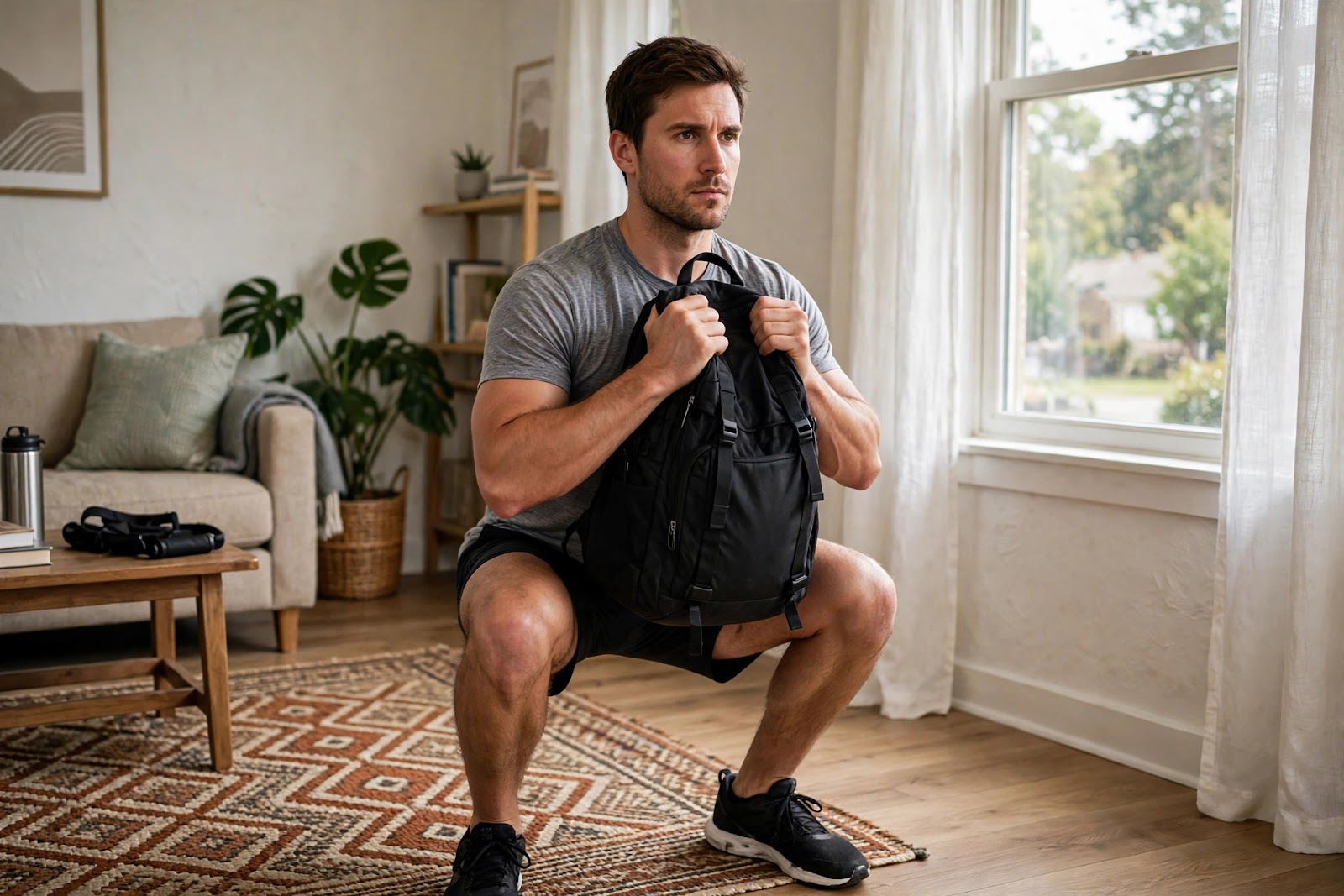
Split squat and farmer's carry. I do these as a pair, because they cover the two things the first three moves miss: single-leg strength and grip. Split squats with the bag on my back, three sets of eight per leg, rear foot on a low step. Then I grab the bag by its top handle in each hand — I use a second, smaller bag for the other hand, loaded with two books — and walk the length of my hallway and back, four trips. My hallway is nine metres. Yours will be different. The distance doesn't matter; the upright posture does. Shoulders back, ribs down, don't lean away from the weight.
The form cues that matter more than weight
People ask me how heavy my bag is, and I always answer with a different number: how clean the reps are. Weight is the least interesting part of this setup. The form cues are the program.
On every move, my ribs stay down. The moment my ribs flare, my lower back takes over, and my lower back is not the muscle I'm training. On squats, my knees follow my toes. On push-ups, my shoulder blades stay controlled — no shrugging toward my ears. On rows, my torso doesn't twist; if it twists, the weight is too heavy. These are small, boring rules. They're also the entire difference between getting stronger and getting hurt, and I say that as someone who learned it by getting hurt.
Breathing matters more than I expected. I exhale on the effort — up from the squat, pushing away from the floor, pulling the bag to my ribs. Holding my breath made me dizzy exactly once, during a heavy set of squats in a warm room, and once was enough. Slow nasal breathing between sets, forty-five seconds of rest, no scrolling. The rest timer is the kitchen clock. Same rule as my mornings: the phone stays out of it.
What I'd tell anyone starting today
Start lighter than you think. Five kilos feels like nothing for the first set, and that's the point — you're learning the setup, not testing your limits. Weigh the bag. Write the number down. Add weight slowly, one book at a time, and only when every rep of every set looks the same as the first one.
Buy nothing. Seriously. The fitness industry will sell you a weighted vest, and a weighted vest is genuinely nice, but it's also a hundred euros or more for something your backpack already does. The only thing I'd spend money on is a bag with a working sternum strap and padded shoulder straps, if yours doesn't have them. My hiking bag cost me nothing because I already owned it. Yours is probably in a closet right now.
And respect the straps. That sounds dramatic for a piece of nylon, but a shifting load is the single most dangerous thing about this setup, and both straps plus a sternum clip are the entire safety system. The day I hurt my shoulder, I was doing a push-up with one strap on because I'd been too lazy to clip the second. Ten seconds of laziness, three weeks of physio. The maths on that is terrible, and I still think about it every time I put the bag on.
My backpack hasn't replaced a gym. It was never going to. But eight months in, my legs are stronger than they were when I had a gym membership, my shoulder is healthy, and my living room is still a living room. The bag hangs on its hook by the door, loaded and ready, towels and all. It cost me nothing, it taught me something, and it only ever hurt me once — when I loaded it like it didn't matter.


