I'd never once thought about my toes until the morning I tripped over my own rug. Not a raised edge, not a wrinkle — just a flat rug in my own hallway, and my left foot didn't quite lift high enough. I caught myself on the doorframe, heart thumping, and stood there thinking: I'm thirty-two, I work out at home four times a week, and I just got beaten by a rug.
That little stumble stuck with me. My legs were strong enough. My balance, on paper, was fine. But something at the very bottom of the chain — the part that actually touches the floor — wasn't doing its job. So I did what I always do when a problem nags at me: I started paying attention to it, and what I found embarrassed me a bit. My feet were lazy. My toes barely moved on their own. My arches collapsed inward every time I stood up from the sofa.
Here's the thing nobody tells you when you start training at home: you can build strong legs and still stand on wobbly foundations. Your feet have dozens of small muscles, and if you never ask them to work, they stop bothering. Shoes do the gripping for you. Flat floors do the balancing for you. And then one day a rug wins.
The toe test that showed me the truth
I tried a simple test that first evening. Standing barefoot in my kitchen, I tried to spread all ten toes wide, like fingers. My little toes refused. They just sat there, glued to their neighbours, completely ignoring me. Then I tried to lift only my big toes while keeping the other four down. My left foot managed it after three attempts. My right foot looked like it was having a small argument with itself.
Next I tried standing on one leg with my eyes open, just to see. Thirty seconds, easy enough — until I noticed my standing foot was doing all the work with my ankle, swaying side to side, while my toes stayed flat and passive. The foot wasn't gripping the floor at all. It was just... parked there.
That was my starting point, and honestly, it was humbling. I'd spent years doing squats and lunges and never once trained the things that connect me to the ground. So I built a tiny routine — ten minutes, barefoot, in my living room — and stuck with it for four weeks. Nothing fancy. No gear except a hand towel and a few marbles from a board game box.
The routine: ten minutes, four moves
I do this most evenings, usually while the kettle boils or while I'm half-watching something on TV. The whole thing takes about ten minutes, and I do it barefoot on the wooden floor because socks make the toe work harder to feel — and not in a good way. Socks slide. Skin grips.
Move one is toe spreads. Sit or stand, doesn't matter. Spread all ten toes as wide as they'll go, hold for five seconds, relax. Ten reps. The first week, my little toes barely twitched. By week three they were actually moving, which sounds like nothing and felt like a genuine victory. If your toes won't spread, don't force them — just send the signal every day and let them figure it out.
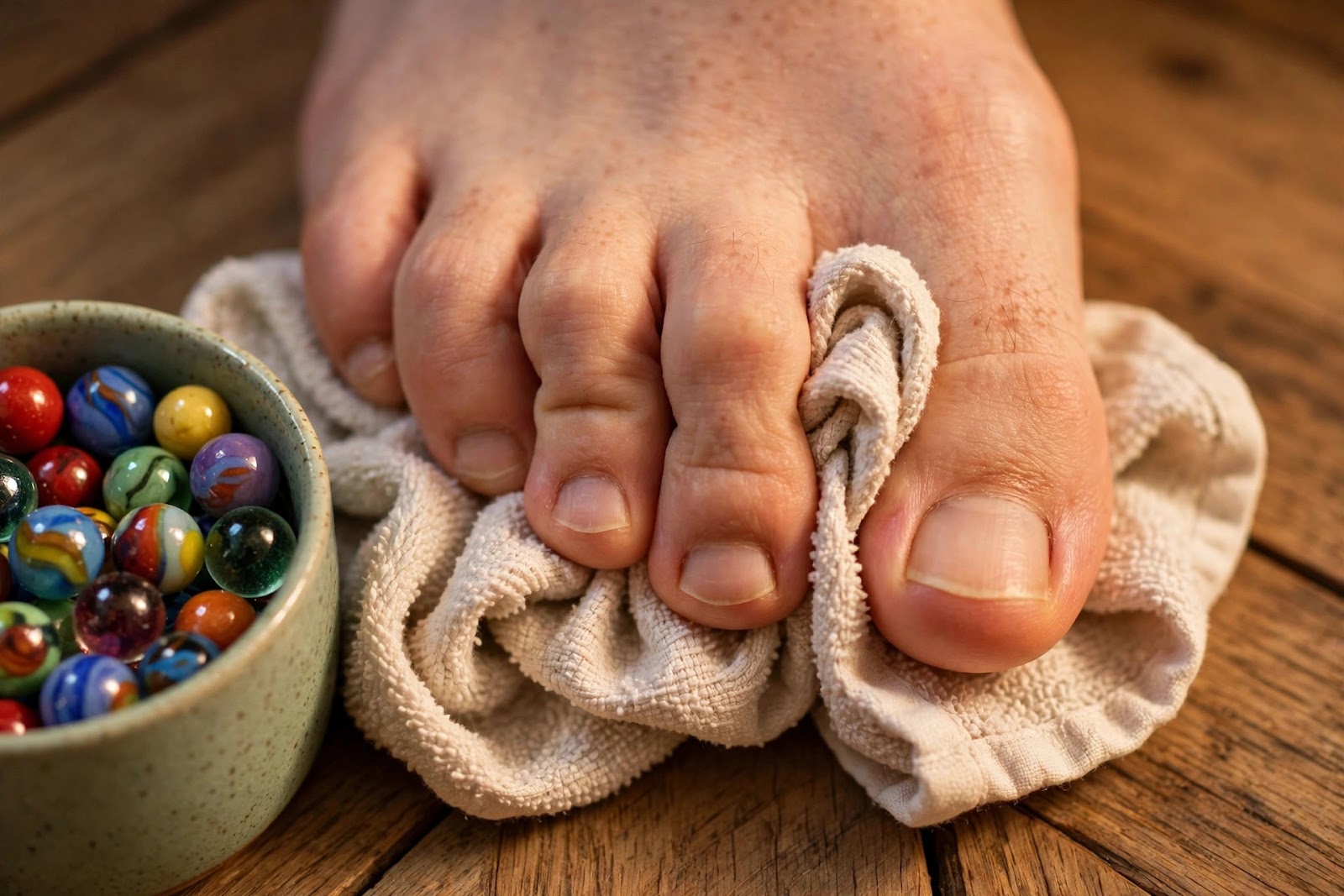
Move two is the towel scrunch. Lay a hand towel flat on the floor, put your heel at one edge, and scrunch the towel toward you using only your toes. Ten slow scrunches per foot. This one burns in a way that surprises you, right under the arch. The trick is to keep your heel planted and your ankle still — the moment your ankle starts helping, your toes clock off. I learned that the hard way after a week of enthusiastic ankle-scrunching that did nothing.
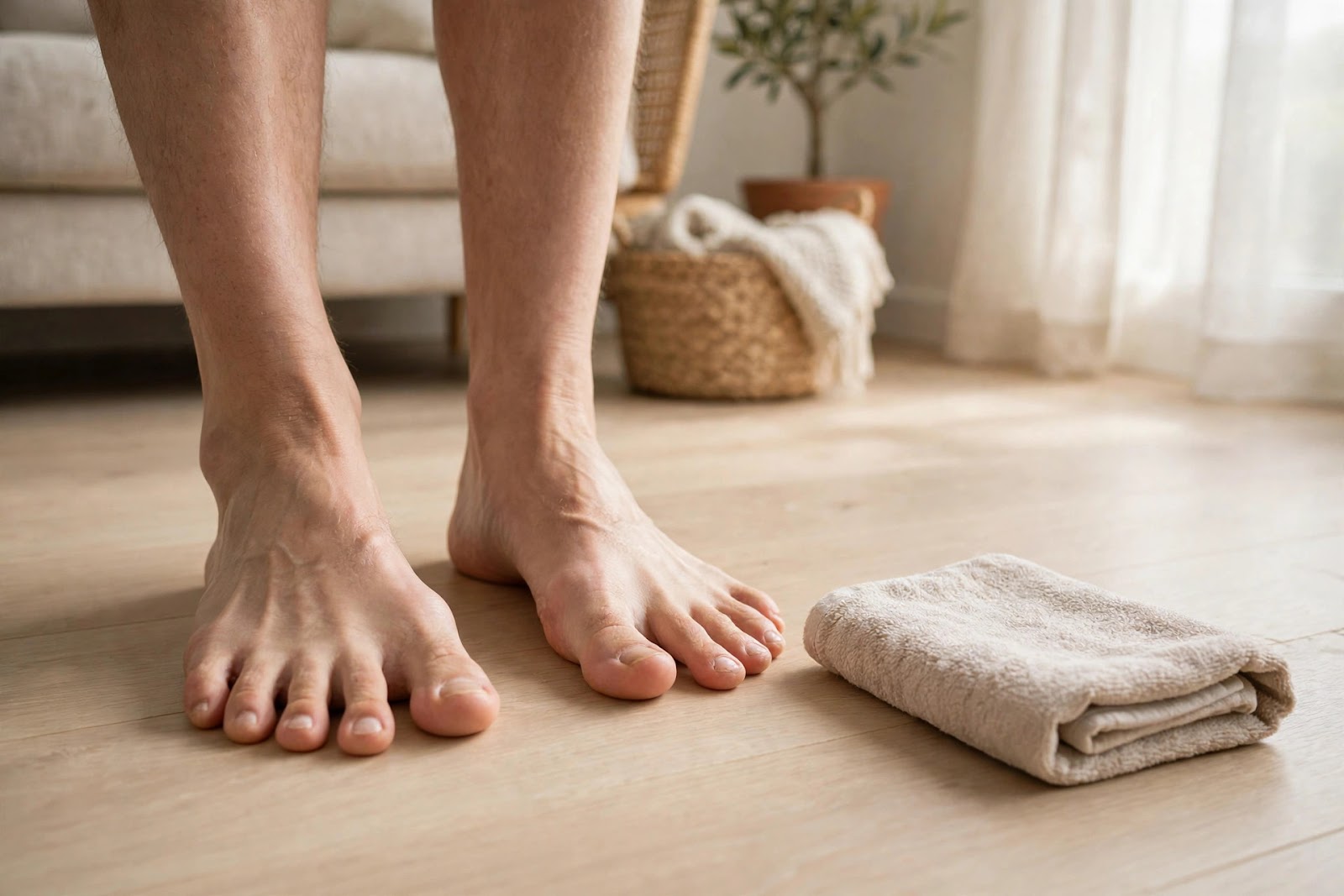
Move three is the short-foot hold, which sounds complicated and isn't. Stand with your feet flat, then try to pull the ball of your foot toward your heel without curling your toes under. Your arch lifts a little, like a small dome forming under your foot. Hold five seconds, ten reps per foot. It took me a full week before I could feel the arch lift at all. For the first few days, all I felt was my toes trying to cheat by curling. Patience, it turns out, is a foot skill too.
Move four is marble pickups. I put ten marbles on the floor and pick them up one at a time with my toes, dropping each into a mug. Five minutes, both feet, and it's weirdly absorbing — the kind of fiddly task that makes you forget you're exercising. My record for ten marbles started at four minutes and forty seconds of fumbling. It's under two minutes now, and yes, I'm slightly proud of that.
The mistakes I made in week one
I went too hard, obviously. The towel scrunch felt easy on day one, so I did three rounds instead of one, and my arches ached the next morning like I'd walked ten miles in new shoes. Small foot muscles get sore just like big ones, and they complain louder because you're not used to hearing from them. One round a day is plenty for the first two weeks. Add a second round only when the first stops leaving any next-day tenderness.
My second mistake was doing the routine in thick socks because the floor was cold. The socks let my toes slide around inside them, so half the work vanished. A cheap pair of thin grip socks fixed the cold-floor problem without stealing the feedback. Or just do it on a rug — the texture actually helps your toes feel the ground.
And the third mistake: I kept holding my breath during the short-foot holds, tensing my whole body like I was lifting something heavy. It's a tiny movement. Breathe normally. If your shoulders are up around your ears while you're training your toes, something has gone wrong.
What changed, week by week
Week one, honestly, not much changed except my awareness. I started noticing how I stood — weight rolled to the inside of my feet, big toe barely involved, little toes doing nothing. Noticing is the boring part nobody posts about, but it mattered, because once I saw it I couldn't unsee it.
Week two, the towel scrunch stopped feeling impossible. My toes started moving as a team instead of as one confused lump. The marble game got faster, and — small thing, but I noticed it — my feet stopped cramping in the middle of the night. I'd get that sharp arch cramp maybe twice a week before, always at 3 a.m., always the left foot. It just... stopped showing up.
Week three was when my balance work changed. I'd been doing single-leg stands for months as part of my normal routine, and they'd always felt wobbly after twenty seconds. Suddenly they felt steadier, like my foot was actually holding the floor instead of balancing on top of it. The heel-to-toe walk down my hallway, which used to feel like a party trick, started feeling ordinary. That's when I knew the toe work was doing something real.
Week four, I re-tested the toe spread from day one. Both little toes moved on the first try. My arches lift when I ask them to, and they stay lifted when I stand, instead of collapsing the moment I stop thinking about it. The rug hasn't beaten me again, for what it's worth — though I'll admit I also straightened the rug.
How I fit it into a normal day
The reason this routine stuck, when fancier plans haven't, is that it hides inside things I already do. Towel scrunches happen while the kettle boils — two minutes, standing at the counter, towel already on the kitchen floor. Marble pickups happen during the first ten minutes of whatever I'm watching in the evening. Toe spreads happen on the sofa, no mat, no changing clothes, no announcement to the household that I'm "working out now."
That's the real secret of it, I think. Feet don't need a workout. They need a few minutes of attention, most days, in the middle of ordinary life. They're like any small habit — brushing your teeth takes two minutes and nobody calls it a fitness programme, but skip it for a month and you'll notice. My feet were skipped for years.
One thing worth saying: if your feet hurt in a sharp or persistent way, or one foot behaves very differently from the other, get it checked by a professional before you start scrunching towels. My feet were just weak and lazy, not hurt, and there's a difference. A routine like this is for the lazy ones.
The bit I didn't expect
The surprise payoff wasn't balance at all — it was my squats. I'd always had a small wobble at the bottom of a bodyweight squat, knees drifting inward on the way up, and I'd blamed my knees for it. Once my arches started holding their shape, the wobble shrank. My feet were the weak link, not my knees. The knees were just where the wobble showed up.
Same with stairs, actually. Going downstairs used to feel slightly rushed, like my feet were slapping the steps instead of placing on them. Now each step lands flatter and quieter. My downstairs neighbour probably appreciates that more than I do, but I'll take the credit anyway.
One last thing I changed: my shoes. I'd been living in soft, cushioned slippers indoors, and they were doing for my feet what a cast does for an arm — everything, so the muscles didn't have to. I switched to thin, flat house shoes and started going barefoot for an hour each evening. The first few days my feet felt oddly tired by bedtime. Then they adjusted, and the evening barefoot hour became the best part of the routine — the floor itself became the training.
And here's a small, silly detail I love: I can pick up a dropped pen with my toes now. Useless skill? Mostly. But the first time I did it without thinking — dropped a pen, scooped it up with my foot, carried on writing — I laughed out loud. That's what four weeks of toe spreads buys you. Party tricks and steadier stairs.
So here's my takeaway, plain and simple: spend ten minutes a day on your feet for a month. Toe spreads, towel scrunches, short-foot holds, marble pickups — one round each, barefoot, while the kettle boils or the TV warms up. Your arches will wake up, your balance will steady, and the rug in your hallway will finally lose. Start tonight, and by the time the month is out, your toes will be doing things you forgot feet could do.


