I noticed the wobble on a wet pavement, not in a gym. I was carrying two grocery bags, stepping off a kerb, and my ankle rolled sideways just enough to make me grab a parked car for support. Nothing tore, nothing swelled, but I stood there feeling embarrassed in a way I hadn't expected. I could squat, I could press, I could walk ten thousand steps around my flat without thinking — yet a simple step down onto an uneven kerb had caught me completely off guard.
That evening I did a little test in my living room, the kind you do when nobody is watching. I stood on one foot, arms out, and counted. Eight seconds on the left. Six on the right, and that was with me flailing like a windmill. Then I tried walking a straight line, heel to toe, the way police dramas make suspects do it on television. I lasted four steps before my foot landed half a foot-width off the line. My legs were strong enough. My sense of where my feet were in space clearly was not.
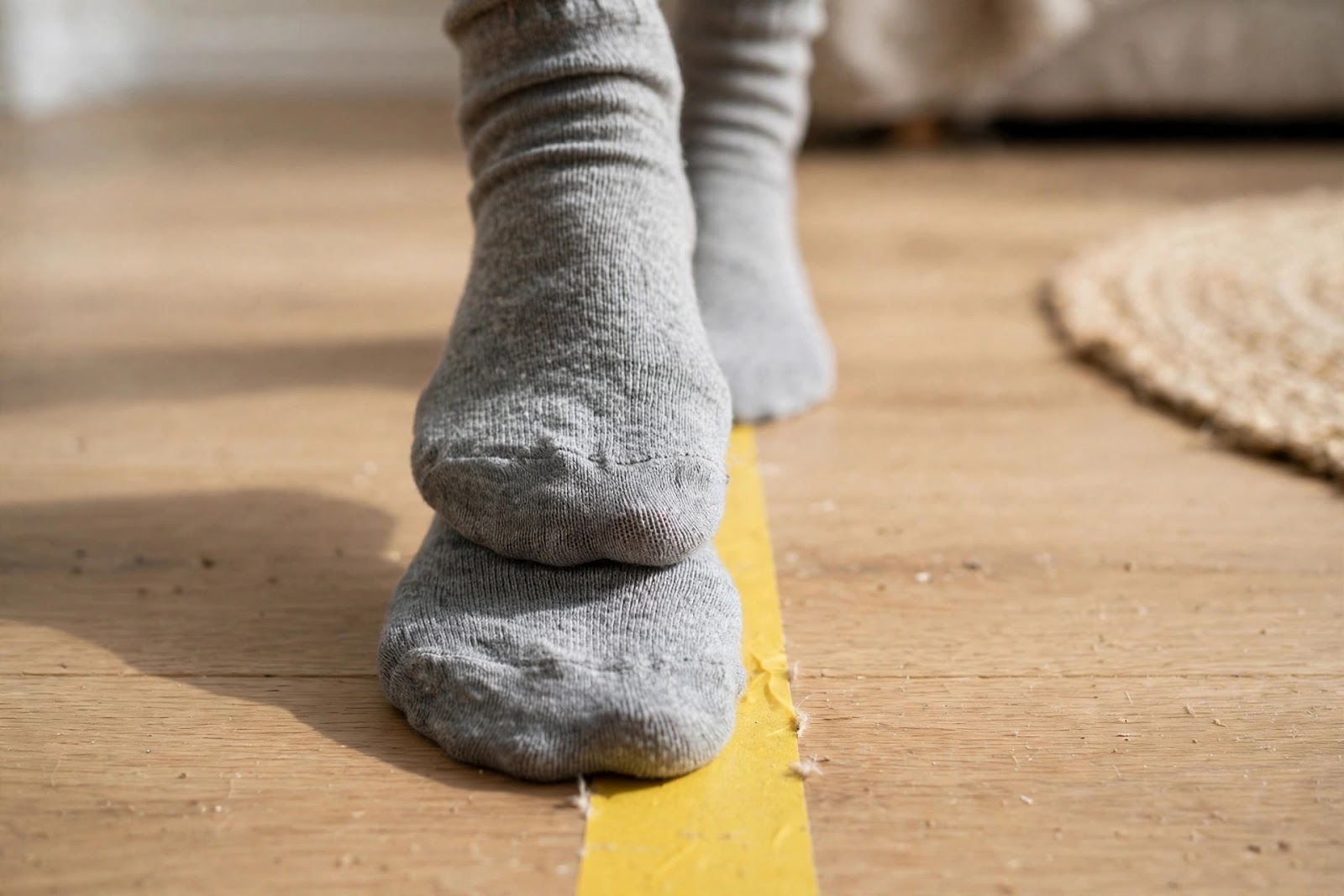
So I taped a line on the floor. A strip of blue painter's tape, about three metres long, running from the sofa to the bookshelf. It cost me nothing — the roll was already in the drawer from the last time I painted a wall — and it looked ridiculous. My first thought was that I'd peel it off within the week. Four weeks later it is still there, slightly scuffed at the edges, and I have no plans to remove it.
What the drill actually is
The drill is embarrassingly simple, which is exactly why I stuck with it. You place the heel of one foot directly in front of the toes of the other, so the two feet touch end to end, and you walk forward along the line. Arms out to the sides at first, like a tightrope walker. Slow. One step, settle, next step. If you step off the line, you stop, step back to where you left it, and carry on.
I started with three slow walks down the tape, once a day, usually in the morning while the kettle boiled. Each walk took maybe twenty seconds. Three walks, a minute of actual work, and then I got on with my day. That was the whole routine in week one, and I am not exaggerating when I say it felt too easy to matter. The wobbling told a different story, though. My arms kept windmilling on step three, always step three, and my right foot kept drifting wide like it had somewhere better to be.
By week two I added a second round in the evening, after dinner, when my legs felt heavier and my focus was worse. That evening round turned out to be the honest one. Mornings I was fresh and careful. Evenings I was tired and sloppy, and the tape showed it immediately. I stepped off the line twice as often after dinner, which taught me something useful: my balance wasn't a fixed thing I either had or didn't have. It changed with fatigue, with attention, with how rushed I was.
The mistakes I kept making
My first mistake was speed. On day three I decided to walk the line at a normal pace, because slow walking felt silly. I stepped off within two steps and nearly tripped over the coffee table. Slow is the point. When you rush, your body cheats — it throws your weight forward and lets momentum carry you, and you learn nothing. When you go slow, every tiny correction is yours. It took me a full week to stop racing the tape.

My second mistake was looking at my feet. Staring down at the line feels natural, but it makes everything worse. Your head tips forward, your weight follows, and suddenly you're chasing your own balance instead of holding it. A friend who does yoga told me to pick a spot on the wall at eye level and keep my eyes there. It felt wrong for the first two days. Then on day three I walked the whole line without a single step-off, eyes on the bookshelf, and I finally understood what she meant.
The third mistake was holding my breath. I didn't even realise I was doing it until I caught myself gasping at the end of a three-metre walk. Three metres! I was bracing like I was lifting something heavy. Once I started breathing normally — in through the nose, out slow — the wobble dropped noticeably. Tension is the enemy of balance. The stiffer I held myself, the harder I fell off the line.
How I made it harder without buying anything
After ten days the basic walk started to feel manageable, so I started changing one thing at a time. First, I lowered my arms. Instead of holding them out wide, I let them hang at my sides, then eventually folded them across my chest. Each change felt like starting over for a day or two, and then it settled. That cycle — wobbly, then steady, then wobbly again with the next change — became the rhythm of the whole month.
Next I tried walking backwards along the line, heel to toe in reverse. That was humbling. My first backwards attempt lasted two steps before I stepped off and had to laugh at myself. Backwards is a completely different skill; you can't see where you're going, so you have to feel it. I kept backwards walks to one slow pass a day, and only after the forward walks. By the end of week three I could do a full backwards pass with one step-off, which felt like a genuine achievement for something so small.
Then I added a turn. At the end of the tape, instead of stopping, I pivoted on the spot — slowly, one foot planted — and walked back the other way. Turns were where my right ankle kept giving way, that same sideways roll from the kerb. So I practised turns deliberately, ten slow pivots a day, until the ankle stopped surprising me. I never forced it. If a pivot felt wrong, I stopped and reset. Patience beat stubbornness every single time.
The four-week check-in
I kept a tiny log on my phone, nothing fancy — just the date and how many step-offs each round had. Week one averaged four step-offs per three walks. Week two averaged three. Week three averaged one. By the last three days of week four, I had two completely clean rounds in a row, arms at my sides, eyes on the bookshelf. I won't pretend the numbers were scientific. Some days I was tired, some days the floor was dusty and my socks slipped. But the trend was obvious, and it matched what I felt in daily life.
The real test came outside the flat. A fortnight into the routine I was walking on a gravel path in the park, the kind of uneven surface that used to make me shorten my steps and tense up. This time my feet just adjusted. I stepped on a loose stone, my ankle tilted, and my body corrected without any drama. I didn't even break stride. That was the moment the tape stopped feeling like a gimmick.
Stairs changed too. I used to grip the handrail every single time, even on the two flights in my own building. Now I still use it when I'm carrying something heavy — that's just sense — but empty-handed I walk up and down without thinking about it. The sit-to-stand work I'd done earlier in the year had built the leg strength. The tape work taught my feet and ankles what to do with it.
What I would tell a friend starting today
Start shorter than you think. Two metres of tape is plenty. If your living room is small, run the tape down a hallway, or even across the kitchen floor between the counter and the table. The length doesn't matter. What matters is that you can see the line, walk it slowly, and repeat it tomorrow.
Wear socks or go barefoot, but pick one and stick with it for the first two weeks. I started in socks on a wooden floor, which is slippery enough to keep you honest. Shoes hide too much — the thick sole does the balancing for you, and you learn nothing. Barefoot is the most honest of all, but my floor is cold in the morning, so socks it was. If your floor is carpet, that works too; the tape sticks fine and the soft surface just changes the feel.
Do it at the same time every day. I tied mine to the kettle, and that was the smartest thing I did. The habit survived because it had a trigger, not because I had willpower. On the two days I skipped — a late night, a lazy Sunday — I noticed the next day's walks were wobblier. Not dramatically, just enough to remind me that this is a use-it-or-lose-it skill.
Don't add challenges too fast. I know the temptation. You get three clean walks and suddenly you want to try it with your eyes closed. I tried that in week three and nearly walked into the bookshelf. Eyes closed is a real progression, but save it for week five or six, when the basic walk is boring. Boring is the signal that you're ready for the next step, not the second clean walk.
And keep the tape down. Seriously. The day I peeled it up to hoover, I forgot to put it back for two days, and those were the two days I skipped. The tape on the floor is the reminder. It sits there, slightly scuffed, daring me to walk it every morning. A roll of painter's tape costs less than a coffee and it doesn't need charging, updating, or an app. Four weeks, one strip of tape, and a floor I already owned — that is the whole trick, and it is still taped down in my living room.


