I Trained My Calves on the Edge of a Step — The Slow Raise Routine That Fixed My Flat-Footed Walk
I found out my calves were weak from a pair of shoes.
Not from a gym test or a fitness tracker. From a pair of trainers I'd worn for about eight months. The soles had worn down unevenly — the inner edge of each heel was chewed away while the outer edge looked almost new. And when I set them on the floor side by side, they leaned inward like two tired old men propping each other up. A friend who runs marathons glanced at them one afternoon and said, "Your feet are collapsing inward when you walk." I laughed it off. Then I watched my own feet the next time I walked to the kitchen, and I saw it. My ankles rolled in with every step. My arches flattened. My whole lower leg looked like it was giving up on the job halfway through each stride.
That was five weeks ago. I didn't buy new shoes. I didn't buy anything, actually. I started doing calf raises on the edge of my stairs, and it turned into one of those small habits that quietly changes how your whole body feels when you move.
Here's the thing nobody tells you about calves: they're the engine of your walk. Every step you take ends with your calf pushing your heel off the ground. If the engine is weak, something else has to pick up the slack — usually your ankles, your knees, or the arches of your feet. My arches had been picking up the slack for years, and the worn-down trainers were the receipt.
The step is the whole secret
I'd done calf raises before, on flat ground, standing in my living room, bouncing up and down while waiting for the kettle. They did nothing. I know why now: on flat ground, you can only rise as high as your ankle allows from a neutral position. There's no stretch at the bottom. The muscle never gets the full range, so it never gets the full workout.
The edge of a step changes everything. You stand with the balls of your feet on the step and your heels hanging off the back, free to drop below the level of the step. That drop is the magic part. When your heel sinks below the step, your calf stretches fully. When you rise up onto your toes, it contracts fully. Full stretch to full contraction, every single rep. On flat ground you're only getting the top half of the movement. On a step, you get all of it.
My staircase has thirteen steps, and I use the second one from the bottom. It's about eighteen centimetres high — low enough that if I lose my balance, I'm stepping down a short distance, not falling down a flight. I hold the handrail lightly with one hand. Not gripping it, just resting my fingers on it, the way you'd rest your hand on a friend's shoulder while you're standing on one leg. The rail is there for balance, not for pulling yourself up. That distinction matters more than you'd think, and I'll come back to it.
I do the raises barefoot. Two reasons. First, shoes hide what your feet are doing, and I wanted to see my toes grip the step. Second, barefoot raises let the small muscles in your feet work too, the ones that hold your arch up. When I tried it in trainers, my feet felt numb and disconnected. Barefoot, I could feel every part of the movement — the stretch in the Achilles, the burn in the calves, the toes spreading on the wood.
The tempo that changed everything
The first week, I did what most people do: fast, bouncy reps. Up, down, up, down, thirty in a row, barely pausing. My calves felt tired afterwards, but nothing changed. Then I read something — a trainer's blog post, not a study, just a person who'd trained a lot of calves — that said the secret is the lowering. The slow, controlled drop. And that made sense to me immediately, because it's the same lesson I'd learned with push-ups years ago: the lowering is where the strength is built.
So I changed the tempo completely. Three seconds up. Two seconds holding at the top, heels high, calves squeezed tight. Three seconds down, lowering my heels slowly below the step until I felt a deep stretch. One second at the bottom. That's nine seconds per rep. A set of ten takes ninety seconds. It feels like a very long time when your calves are burning at rep seven.
The first session with the new tempo, I managed eight reps before my calves started shaking. Eight. I'd been doing thirty bouncy ones the week before, and eight slow ones nearly finished me. That told me everything I needed to know about how little the bouncy version had been doing.
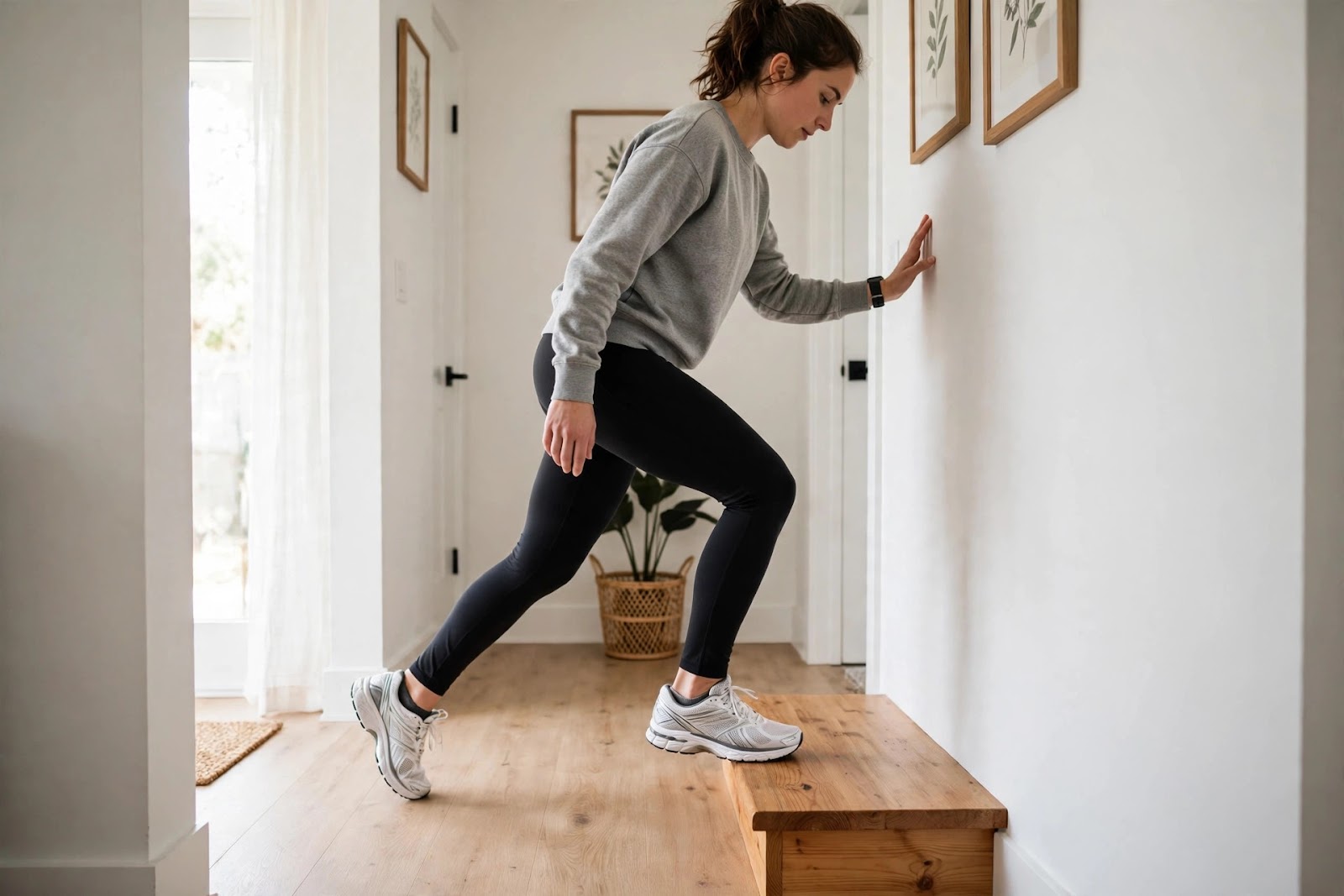
Here's my routine, exactly as I do it now. I train calves four days a week — Monday, Tuesday, Thursday, Saturday — for about eight minutes, at the end of whatever else I'm doing, or on its own after lunch. Three sets of ten slow reps with both feet, resting sixty seconds between sets. Then two sets of eight slow reps on one leg at a time, holding the rail a little more firmly for those. That's it. No weights, no bands, no equipment beyond a staircase and a handrail.
What five weeks actually looked like
Week one was humbling. Both-feet sets of ten left my calves shaking, and the single-leg sets were a mess. My left leg — always the left leg, the weak side — could only manage five slow reps before the heel drop turned into a wobble and I had to grab the rail properly. I wrote the numbers down in a notebook I keep by the stairs: date, sets, reps, how it felt. That notebook is the most useful training tool I own, because it stops me from lying to myself about whether I'm improving.
Week two, something clicked. The both-feet sets got easier, so I added two reps — twelve per set instead of ten. The single-leg sets went from five shaky reps to six steady ones on the left and eight on the right. I noticed the change first on the stairs themselves, in everyday life: walking up to my flat, my feet felt more planted. Less slapping, more pushing. It's hard to describe a feeling like that, but the best word is "springy." My steps had a little spring in them that wasn't there before.
Week three, I hit a plateau, and it annoyed me. The numbers didn't move for four days. Same reps, same burn, same wobble on the left leg. I almost added weight — I had a backpack I could have loaded with books — but I decided to change the pause instead. I held the top of each rep for four seconds instead of two, really squeezing the calf hard at the top. That broke the plateau within two sessions. The left leg went from six reps to eight, and the both-feet sets went to fifteen.
Week four, the single-leg sets evened out. Left leg eight reps, right leg eight reps. That mattered to me more than any other number, because the left side had been lagging my whole life — left shoulder, left hip, left calf, the whole left side of me is the clumsy twin. Evening them out felt like fixing a crooked picture frame.
Week five — last week — I tested myself. I did a set of twenty slow both-feet reps without stopping. Five weeks ago, eight reps made me shake. And I walked to the shops in my new trainers, the ones I bought after the old pair gave up, and I watched my feet. The ankles stayed straighter. The arches held. My feet still roll in a little — I'm not going to pretend five weeks of calf raises rebuilt my entire gait — but the collapse is smaller, and my steps feel like they're coming from my calves now instead of from my feet giving way.
The mistakes that waste your time
I made three mistakes with calf raises, and they're the same three mistakes I see everyone make.
Mistake one: bouncing. Using momentum to throw yourself up and letting gravity drop you down. The bounce feels productive because it's fast and your calves get tired, but the muscle barely works. The tendon does the work instead — it stretches and snaps back like a rubber band. If your reps look like you're jumping, you're not training your calves, you're testing your Achilles. Slow down until the bounce is gone.
Mistake two: bending your knees. When my calves got tired, my knees would bend slightly on each rep, and my thighs would quietly take over the work. I caught myself doing it in week two when I noticed my quads felt tired after a calf session. That's a dead giveaway. The fix: straight legs, soft knees, not locked, not bent. I think the words "tall legs" before each set. It sounds daft, but it keeps my knees honest.
Mistake three: death-gripping the rail. In the first week, I was holding the handrail so hard my knuckles went white, and I was pulling myself up with my arm without realising it. The test is simple: if you can do the set with just one fingertip on the rail, you're doing it right. If you need a full grip, you're cheating. I spent a whole session practising with one fingertip, and my reps dropped by a third — which told me how much my arm had been helping.
One more thing I got wrong at first: I did the raises with my feet parallel, every time. Then I tried turning my toes slightly outward — maybe fifteen degrees, no more — and I felt the inner part of my calves work harder. Then toes slightly inward, and the outer part worked harder. Now I rotate: one set toes straight, one set toes out, one set toes in. It's a small variation, but it stops the routine from becoming one-note.
How to fit it into your week
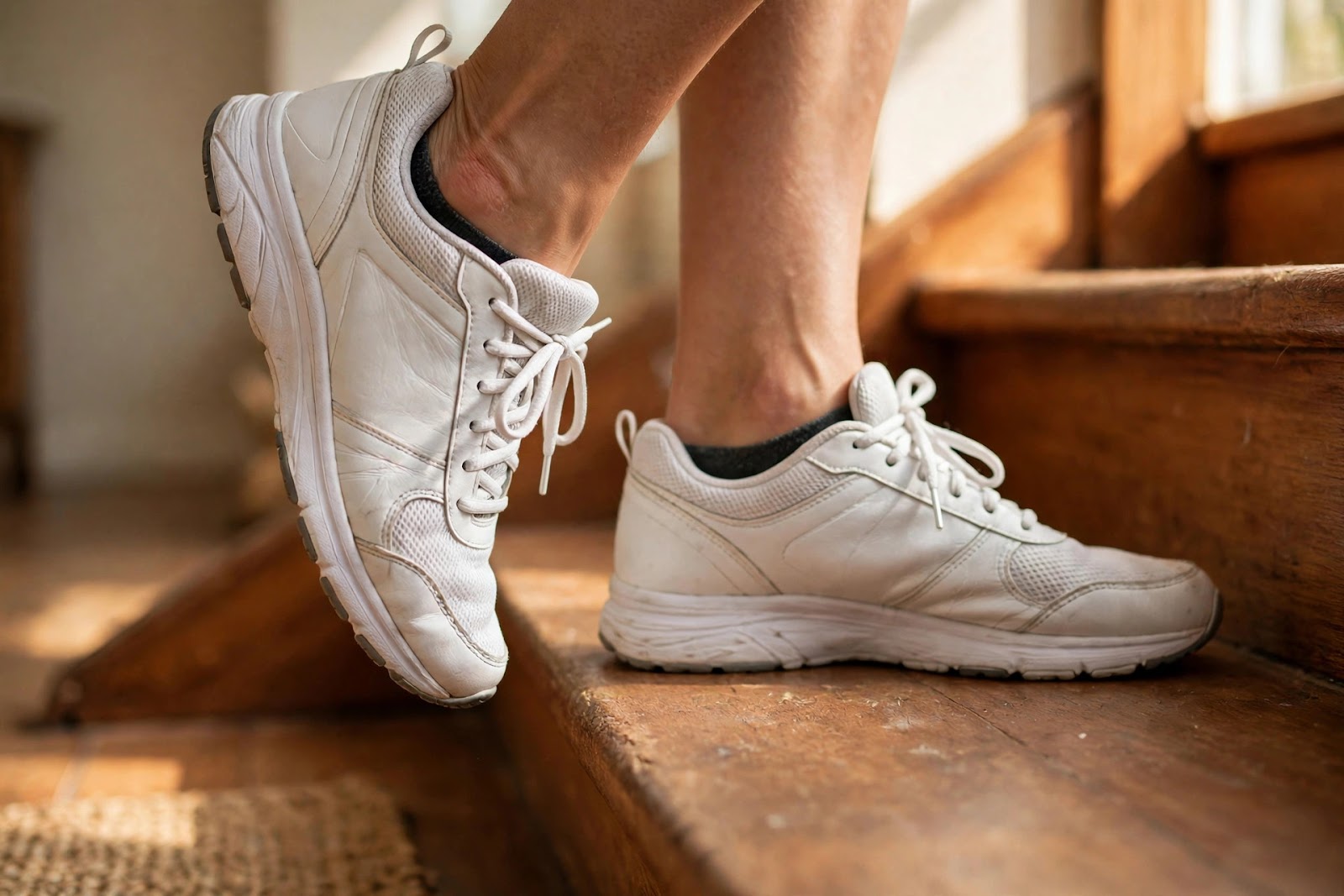
The best thing about this routine is how little it asks of you. Eight minutes, four days a week, on a staircase you already own. I do mine at the end of my regular sessions — after my push-ups and rows — or on rest days, on its own, while I'm waiting for the washing machine to finish. It's the kind of exercise that slots into the gaps in a day instead of demanding a whole new block of time.
If you're starting from scratch, here's the plan I'd actually recommend, based on what worked for me. Week one: two sets of eight slow reps, both feet, three days a week. Don't touch single-leg work yet. Just learn the tempo and the stretch. Week two: three sets of ten, both feet, four days a week. Week three: add one set of six single-leg reps per side at the end. Week four: two single-leg sets per side, eight reps each. Week five: test yourself — how many slow reps can you do in one set? Write it down. Then keep going.
Progress with calf raises is slow and honest. You're adding one or two reps a week, not ten. That's normal. Calves are stubborn muscles — they carry your body weight all day, every day, so they need a real reason to get stronger. The slow tempo and the full stretch are that reason.
One warning from experience: your calves will be sore the first few days, in a way that makes walking downstairs feel funny. That's normal for a new exercise. Don't panic and don't quit. The soreness fades by the second week. If it doesn't, or if anything feels sharp rather than just sore, back off the reps and give it a few days. Listen to the difference between "this is new" and "this is wrong." Your body knows the difference even when your enthusiasm doesn't.
What else changed (the part I didn't expect)
I started this routine to fix my walk and save my shoes. That worked. But three other things changed that I didn't see coming.
First, my balance improved. I stand on one leg while brushing my teeth — it's a habit I picked up from an earlier balance routine — and after three weeks of single-leg calf raises, the wobble was noticeably smaller. Standing on one leg with your heel raised is basically a calf raise in disguise, and the strength carries over directly.
Second, my jump rope sessions got better. I skip rope twice a week in my living room, and the bounce in each jump comes from the calves. After a month of slow raises, my rope sessions felt lighter. I could go longer before my calves gave out. I used to stop at about three minutes because my calves were burning. Now I get to five minutes comfortably. Same rope, same room, same person — just stronger calves.
Third, and this one is the most boring and the most useful: my feet stopped aching at the end of the day. I spend a lot of time on my feet — cooking, cleaning, walking to the shops — and by evening my feet used to feel tired and flat, like they'd been working overtime. Now they feel... normal. Tired in a normal way, not a worn-out way. Stronger calves mean my feet don't have to absorb every step on their own.
There's a lesson in that, I think. The calves are one of those muscles nobody trains because nobody sees them. They're not glamorous. They don't show up in a mirror selfie. But they carry you everywhere you go, every single day, and when they're weak, everything above them — your ankles, your knees, your walk — pays the price. Eight minutes on a staircase, four days a week, is a small price for that.
The shoe test
I still have those old trainers. They're in the back of the cupboard, retired. Every couple of weeks I take them out and look at the soles, because they remind me of the starting point. The inner heels are worn down to the foam. They tell the story of feet that were collapsing inward with every step.
My new pair has been going for three weeks now, and the soles are wearing evenly. That's the result I care about most — not a number in a notebook, not a rep count, but the quiet evidence that my feet are moving differently. Even wear. Straight steps. Calves doing their job.
So here's my honest take. If your shoes wear unevenly, if your ankles roll in, if your feet ache by evening, or if you just want a stronger foundation for everything else you do at home — go and stand on the edge of your stairs. Balls of your feet on the step, heels hanging off. Three seconds up, hold two, three seconds down, one second at the bottom. Ten reps. Rest. Do it again.
It's not exciting. It's not a workout you'll brag about. But five weeks from now, when your steps feel springier and your shoes are wearing straight, you'll understand why the most boring exercise in my routine is the one I'd never give up.


