On the first of October, I made a deal with myself that sounded almost too simple to fail: one plank, every day, for thirty days. No gym, no equipment, no app with a subscription. Just me, the living-room rug, and a timer on my phone. I had done planks before, in workouts, usually as the move I endured while waiting for something better. I had never done one on purpose, alone, as the whole point of the day.
The reason I picked a plank challenge, of all things, is slightly embarrassing. I was watching a video of myself from a family gathering, and I noticed that I stood the way I sit: shoulders rolled forward, stomach soft, lower back doing work it was never designed to do. I didn't want a six-pack. I wanted to stand like someone whose middle actually held them up. A friend had done a thirty-day plank challenge the previous spring and kept talking about it, so I borrowed the idea, wrote "PLANK" on the kitchen calendar in large letters, and started the next morning.
Thirty days later, my longest plank went from 45 seconds to just over three minutes, and I learned more about my own habits than I expected from an exercise that involves lying still on the floor. Here is what actually happened, week by week, including the days I nearly quit and the things I got wrong.
The rules I set (and the one I broke immediately)
Before day one, I wrote down four rules on a sticky note and put it on the fridge. Rule one: one plank session every day, no exceptions, even if it was only twenty seconds. Rule two: the daily plank had to be a single hold, not several short ones added together — I wanted to know how long I could actually hold it, honestly. Rule three: I would add a small amount of time each week, roughly ten seconds, rather than chasing a big number. Rule four: if anything hurt in a sharp or wrong way, I would stop and rest a day, because a challenge is not worth an injury.
I broke rule two on day three. Not out of laziness — out of impatience. My day-one plank was 45 seconds, and it felt harder than I remembered planks feeling. By day three, I wanted a bigger number, so I did two holds of 40 seconds with a break in between and tried to count it as 80. It felt dishonest even as I did it, and the sticky note was right there on the fridge judging me. From day four onward, a plank was one hold, start to finish, and the numbers I recorded were numbers I actually earned. That honesty mattered later, when the numbers started climbing for real.
I also kept a tiny log, which turned out to be the best decision of the whole month. Each evening I wrote the day number, the hold time, and one line about how it felt. "Day 6: 55 seconds, shoulders burned first." "Day 14: 90 seconds, boring, counted the rug pattern twice." That log is the reason I can tell you what actually changed and when, instead of giving you a vague summary about how planks are great. Keep a log if you try this. It takes ten seconds and it turns a blur into a story.
Week one: the humbling part
Days one to seven were humbling in a way I had not prepared for. My starting hold was 45 seconds, and I had expected at least a minute, because I considered myself reasonably fit. I was wrong. At 30 seconds my shoulders started complaining. At 40, my stomach was shaking. At 45, my hips sagged, my form fell apart, and I dropped to the floor feeling annoyed at myself for being annoyed.
The humbling part wasn't the number. It was discovering how much of my old plank "ability" had been borrowed from momentum and distraction. In workouts, planks came after other moves, surrounded by music and a timer I wasn't watching closely. Alone, in silence, with nothing to look at except the rug, every second was accounted for. There was nowhere to hide, and my core knew it.
By day five, something small but important happened: I stopped watching the timer. On days one to four, I had the phone on the floor in front of me, and I watched the seconds crawl. It made every hold feel twice as long. On day five I flipped the phone face-down and set it to beep at my target time instead. The holds immediately felt shorter, even though they were the same length. Attention, it turns out, is a large part of difficulty. If you try this challenge, flip the phone over. It is the single easiest improvement you can make.
Week one ended at 60 seconds, on day seven, and I was quietly pleased. Sixty seconds had been my secret hope for the end of week two, so I was ahead of schedule. That early win mattered, because week two was about to get boring.
Week two: boredom is the real enemy
Days eight to fourteen taught me that the hardest part of a daily plank is not the plank. It is the boredom. A plank is, by design, an exercise where nothing happens. You lie still. You breathe. You wait. There is no movement to enjoy, no scenery, no variety. By day ten, I was negotiating with myself before every hold: "just skip today, do two tomorrow." Tomorrow never wanted two either.
What saved week two was variety, but not the kind I expected. I had planned to do the same forearm plank every day for thirty days, because that felt pure and scientific. It was also mind-numbing. So on day eleven I changed the plan: I would keep one main hold per day, but I would rotate the type of plank through the week. Monday: forearm plank. Tuesday: straight-arm plank. Wednesday: side plank, left side. Thursday: side plank, right side. Friday: forearm plank again, but with slow alternating leg lifts. Saturday: a long slow forearm hold. Sunday: my choice, usually the easiest one, as a reward.
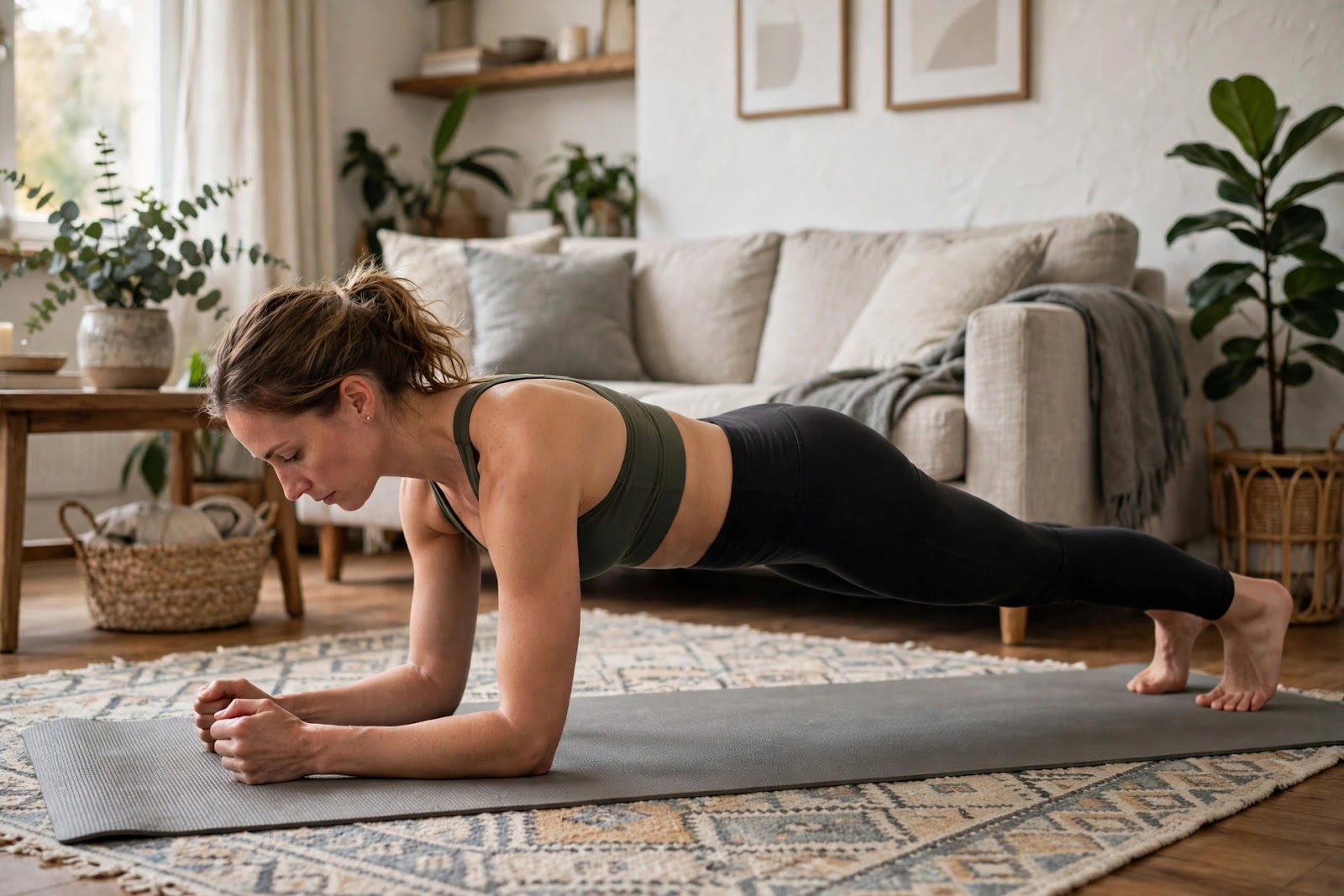
This rotation changed everything, and not just because it was less boring. Each variation taught my core something different. The straight-arm plank lit up my shoulders and upper back in a way the forearm version never did. The side planks exposed a difference between my left and right sides that I had never noticed — my right side held steady for 40 seconds while my left side started wobbling at 25. That imbalance became the most useful discovery of the month, because it explained why my lower back always felt slightly uneven after long sitting days.
Week two ended at 90 seconds on the forearm plank, and I had stopped dreading the daily hold. The rotation gave each day a small question to answer — how does the left side feel today? — and questions are much easier to show up for than a blank stretch of stillness.
Week three: the quiet breakthrough
Days fifteen to twenty-one were the best week of the challenge, and the reason was not a number. It was a feeling. Around day sixteen, during a forearm hold, I noticed that my stomach was no longer the first thing to give up. In week one, my abs had shaken and quit early while my shoulders were still fine. By week three, the order had flipped: my shoulders tired first, and my middle stayed solid longer. My core had stopped being the weak link in its own exercise.
That shift showed up outside the challenge too, in small ways I hadn't been looking for. Carrying a heavy bag of rice up the stairs, I caught myself bracing my stomach without thinking about it, the way you tighten a belt before lifting. Sitting at my desk, I noticed my posture correcting itself once or twice during the afternoon, instead of collapsing by lunchtime. These were not dramatic changes. Nobody would have noticed them except me. But they were the changes I had actually wanted when I started, back when I was staring at that video of myself standing like a question mark.
Week three also brought the first day I genuinely enjoyed a plank, which is a sentence I never expected to write. Day nineteen was a side plank day, and I held the right side for a full minute, steady, breathing slowly, watching dust motes in the afternoon light. It felt less like exercise and more like a pause that happened to be strengthening me. I am not going to pretend every plank felt like that — most of them were still work — but one good one was enough to change my attitude to the rest.
By day twenty-one, my forearm plank reached two minutes, and I allowed myself a small celebration, which consisted of writing "2:00!" in the log with an underline and eating an extra biscuit with my tea. The challenge had stopped feeling like a test and started feeling like a habit, which is a much more durable thing.
Week four: the wall, and what got me past it
Days twenty-two to thirty brought the wall I had been warned about by everyone who has ever done a plank challenge. Around two minutes and fifteen seconds, my body simply did not want to go further. The shaking started earlier, the breathing got ragged, and the last twenty seconds of every hold felt like a negotiation. On day twenty-four, I dropped at 2:10, ten seconds short of my target, and I sat on the rug feeling genuinely irritated.
What got me past the wall was not toughness. It was three small, unglamorous adjustments, and I list them because they are the most practical things in this whole article. First, I moved my plank to the morning, right after breakfast, instead of the evening. Evening planks came after a full day of sitting, when my hips were tight and my patience was thin. Morning planks came when I was fresh, and the same hold felt easier by fifteen or twenty seconds. Timing, I learned, is a training variable, not just a scheduling detail.
Second, I started doing a sixty-second warm-up before the hold: ten cat-cow stretches on all fours, ten slow dead bugs, and a thirty-second glute bridge. Warming up the exact muscles the plank uses, instead of dropping cold into the hardest position, added real seconds to my hold. I had skipped warm-ups all month out of laziness, telling myself a plank was too short to need one. It wasn't.
Third, I changed my breathing. In week one I had been holding my breath without realising it, especially in the last third of each hold, and breath-holding makes everything shake faster. I started a simple pattern: breathe in for three counts through the nose, out for three through the mouth, and keep the pattern going no matter what the timer said. The shaking didn't vanish, but it arrived later and stayed manageable. Breathing is not a side detail in a plank. It is half the exercise.
With those three changes, day twenty-eight reached 2:50, and day thirty — the final day — reached 3:05. I did the final hold in the morning, on the rug, with the phone face-down and the log open beside me. When the timer beeped, I dropped to the floor, lay there for a minute staring at the ceiling, and felt something I hadn't expected: not triumph, exactly, but relief mixed with a strange reluctance for it to be over.
What my core actually learned

So, what did thirty days of planking actually teach my core? The honest answer has three parts, and none of them is "I got abs." I did not get abs. My stomach looks the same as it did on the first of October, and if you are doing a plank challenge for visible abs, I should tell you now that planks alone will not deliver them. That is a diet and overall-training conversation, not a plank conversation, and anyone selling you a thirty-day plank-to-abs story is selling you something else.
What did change, first, is endurance. My core can now hold a steady, honest position for three minutes, where it used to fall apart at forty-five seconds. That endurance shows up in other moves: my squats are steadier, my push-ups don't sag in the middle anymore, and carrying heavy things feels more controlled. A core that can hold still for three minutes is a core that helps with everything else.
Second, my core learned to switch on. Before the challenge, my stomach muscles were passengers — present, but not participating unless I consciously told them to. After thirty days of daily practice, they engage almost automatically when I lift, carry, or stand up from a chair. That automatic bracing is probably the single most useful thing the challenge gave me, because it protects my back dozens of times a day without me having to think about it.
Third, and most unexpectedly, my core taught me about my own consistency. Thirty days is long enough to have bad days, boring days, and days when you genuinely don't want to do it. Getting through all three kinds taught me that I can keep a daily promise to myself even when it isn't fun. That lesson has already outlived the challenge: I have kept the daily plank going, shorter now, three or four times a week, not because a calendar tells me to but because I like the person who does it.
Mistakes worth skipping
Mistake one: counting two holds as one, which I did on day three and regretted. A challenge only works if the numbers are honest. If you need to stop, stop, write down the real number, and try again tomorrow. A real 50 seconds beats a fake 80 every time, because the real number is the one your body actually learns from.
Mistake two: doing it cold, in the evening, while tired, which is how I did most of week one and all of my worst holds. Warm up for sixty seconds. Do it in the morning if you can. These two changes together were worth more than any amount of extra effort during the hold itself.
Mistake three: watching the timer. I have said this already and I will say it again, because it was the biggest psychological difference in the whole month. Phone face-down, beep at the target, eyes on the rug. Time passes faster when you aren't auditing it.
Mistake four: expecting visible results. If your goal is a visible six-pack, a plank challenge alone will disappoint you, and disappointment is how people quit. Set the goal on endurance and steadiness — a longer hold, a steadier hold, a core that switches on when you lift — and the challenge will deliver exactly what it promises.
Should you try it? My honest answer
If you have a rug, a timer, and thirty days, yes — with two conditions. First, talk to a professional first if you have any back trouble, wrist trouble, or a health condition that makes holding a plank risky. A daily challenge is a lot of load on the same position, and a quick check is worth more than a month of guessing. Second, keep the promise small: one hold a day, even if it is only twenty seconds on a bad day. The streak is the point, not any single number.
Start where I started, not where I finished. Day one, one honest hold, phone face-down, write the number in a notebook. Add about ten seconds a week, rotate the variation when boredom arrives, and move it to the morning if evenings keep defeating you. By day thirty, you will not be a different person. You will be the same person, standing slightly taller, carrying things slightly steadier, and knowing — because you have thirty little log entries proving it — that you can keep a promise to yourself for a whole month. That, it turns out, was the real prize, and it had very little to do with my abs.
My log's last entry reads: "Day 30: 3:05. Kept going after the beep for five extra seconds because I could. Same time tomorrow? Probably, yes." And so far, it has been.


