It started with a spice jar. Top shelf, left side, the smoked paprika I use twice a year and keep forgetting I own. I reached up and twisted to grab it, and my mid-back — that band of spine right between my shoulder blades — sent back a sharp little protest, like a door hinge that hasn't been oiled in years. I got the jar. I also spent the rest of the afternoon moving like a mannequin.
That's the thing about the middle of your back: you don't notice it until it refuses to cooperate. My shoulders get all the attention — stretches, wall slides, the lot. My lower back gets blamed for everything. But the thoracic spine, the twelve vertebrae in the middle, just sits there quietly getting stiffer, one desk day at a time, until a spice jar exposes it.
I sit a lot. Most of us do. Hours at a laptop, shoulders rounded forward, arms reaching for a keyboard, and the mid-back slowly locks into that one curved shape. It's not dramatic. There's no single moment it goes wrong. It's just Tuesday, and then it's six months of Tuesdays, and then twisting to look over your shoulder feels like turning a rusted bolt.
So I gave my mid-back two weeks. One move, mainly — the open-book stretch — plus a couple of supporting habits, five minutes a day, on the living-room floor. The change was quicker than I expected, and honestly a bit embarrassing: I'd been ignoring the stiffest part of my own spine for years.
What the open-book stretch actually is
Picture lying on your side on the floor, knees bent up toward your chest, arms stretched out in front of you, palms together. That's the starting position — like a book lying flat. Now you take the top arm and open it away from you, sweeping it across your body until your chest opens to the ceiling, following your hand with your eyes. Your bottom arm stays put. Your knees stay stacked. Only the top half of you rotates.
Hold the open position for five slow breaths, then close the book again. That's one rep. Five reps per side, once or twice a day. The whole thing takes about five minutes, and the first time I did it, I got about halfway open on my left side before everything stopped. My right side opened much further. I'd been twisting to the right for years — reaching for the mouse, turning to the window — and my left side had quietly given up.
The key detail, the one I got wrong for the first three days: your knees must stay stacked and still. The moment your top knee rolls backward, your lower back takes over the twist, and your mid-back — the part you're actually trying to wake up — does nothing at all. If your knees won't stay put, put a cushion between them, or rest your top knee on a rolled-up towel. I used a cushion for the first week. No shame in it. The cushion is doing a job.
The morning I finally felt it work
Day one felt like nothing. Day two felt like slightly more nothing. I almost quit on day three, which is my usual pattern with anything that doesn't give instant feedback. But on the morning of day four, I did my five reps before breakfast, stood up, and twisted to grab my phone from the bedside table — and the twist went further than usual, smoothly, without that little catch halfway through. I actually stopped and did it again, just to check. Same smooth twist.
That tiny moment kept me going, because it was the first proof the stretch was reaching the right spot. Here's what I'd been missing: the mid-back doesn't respond to force. You can't shove it open. You breathe into it, hold the position, and let it loosen on its own schedule. The five slow breaths aren't a countdown — they're the actual work. Each breath out lets the ribs drop a fraction further. Rush the breaths and you rush past the whole point.

By the end of week one, the left-right difference had shrunk. My stiff side wasn't matching my good side yet, but it had stopped feeling like a locked door. I could feel the ribs on that side moving when I breathed, which sounds strange until you've spent months breathing only into the front of your chest.
The two habits that helped it along
The stretch alone would have done most of the job, but two small changes sped things up. The first was how I sit. I moved my laptop up — a stack of books, about ten centimetres — so the top of the screen sits at eye level instead of chest level. When the screen is low, your head drifts forward and your mid-back rounds to follow it. Raising the screen didn't fix my posture (nothing fixes posture, it's a habit, not a switch), but it stopped me folding forward quite so far, quite so often.
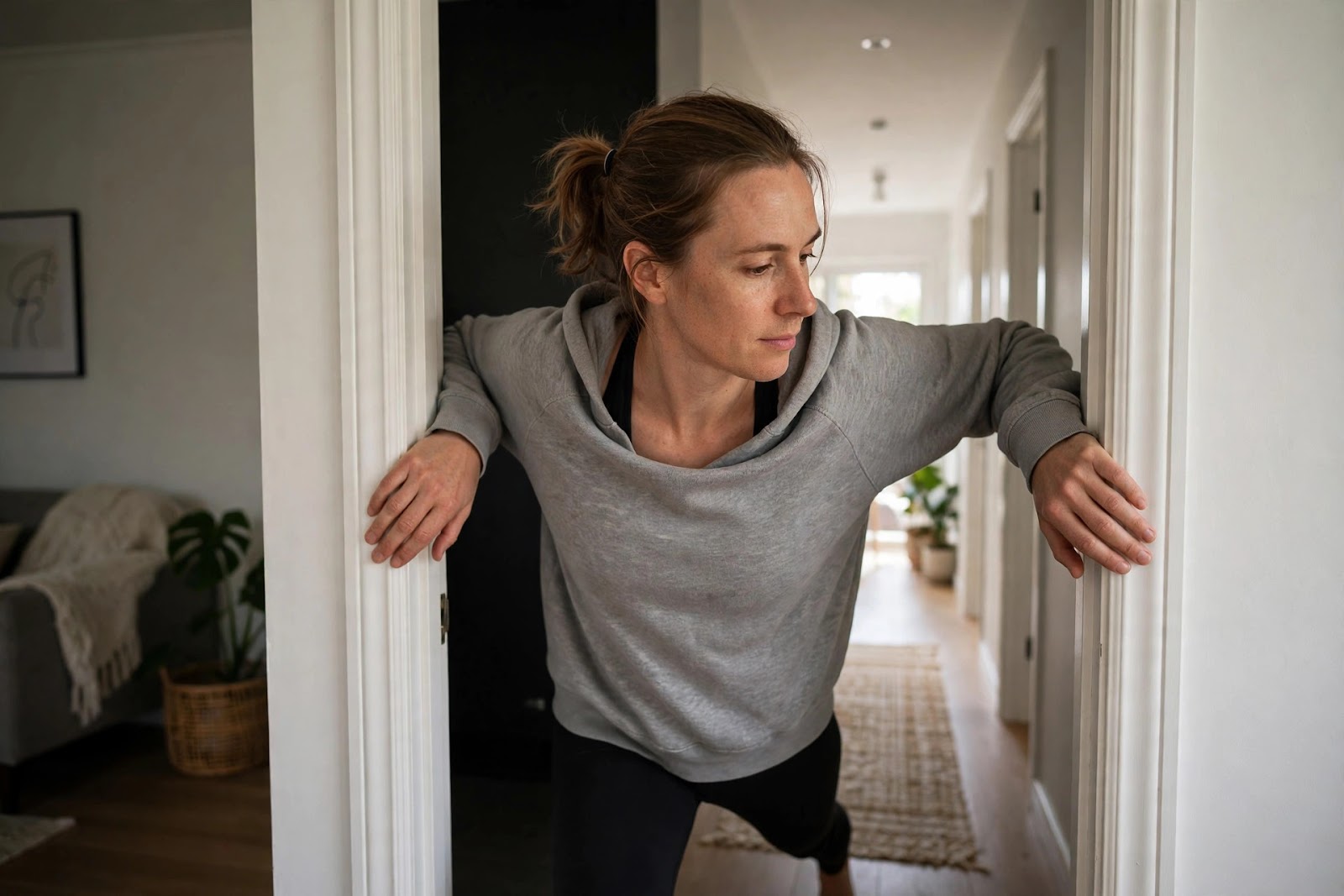
The second change was a doorway chest opener, thirty seconds, twice a day. Stand in a doorway, forearms on the frame, step gently through until you feel a stretch across the front of your chest, breathe, step back. Tight chest muscles pull your shoulders forward all day, and your mid-back rounds to compensate. Loosen the front, and the back gets room to straighten up. It's a pair — you can't fix one side of the hinge without the other.
I also started doing the open-book stretch on the floor instead of the bed. The bed is softer and more forgiving, which sounds nice and actually lets you cheat — the mattress absorbs the rotation. The floor gives you honest feedback. If your knees lift, you feel it. If your ribs flare, you feel it. Five minutes on the wooden floor, a folded blanket under my head, that's the setup. Simple beats comfortable here.
What I got wrong at first
My first mistake was forcing the range. On day one, I tried to push my top arm all the way to the floor behind me, because that's what the pictures show. My shoulder complained, my lower back took over, and I got nothing in my mid-back except a vague ache. The pictures lie, or at least they show the end of a long process, not the start. Open as far as your ribs allow, no further, and let the range grow over weeks. My arm still doesn't touch the floor on the left side. It doesn't need to.
My second mistake was speed. I treated it like a rep — open, close, open, close, one-two-three, done. The stretch only works slowly. Five breaths per hold, minimum. I count them out loud sometimes, which feels ridiculous and keeps me honest. If you finish five reps in under a minute, you didn't stretch, you waved.
Third mistake: I skipped days when I felt fine. The mid-back is a use-it-or-lose-it joint if ever there was one — one day off and the stiffness creeps back like it never left. Daily matters more than long. Five minutes every day beats twenty minutes on Sunday, and I say that as someone who tried the Sunday version first.
Two weeks in, what actually changed
After two weeks, the spice-jar test passed. I reached up and twisted for the paprika — same jar, same shelf — and there was no protest at all. My shoulders turned, my ribs turned, everything moved together like it was supposed to. Small victory, but it was the exact movement that had caught me out, so it counted double.
Reversing the car got easier too, which I hadn't expected. That over-the-shoulder look used to be a two-part movement: turn the shoulders, then crank the neck the rest of the way. Now the shoulders do more of the work and the neck does less. My neck, I should add, has not sent a thank-you note, but it seems happier.
And sitting feels different. Not perfect — I still catch myself slumped at 4 p.m. like everyone else — but the slump doesn't feel like my only option anymore. When I straighten up now, my mid-back actually straightens, instead of my lower back doing all the work while the middle stays folded. It's a small thing, the difference between sitting up and sitting up properly, but my evenings feel less creaky for it.
One more small habit helped, and it's almost too simple to mention: I started taking three slow breaths into my ribs before each set. Hands on the sides of my ribcage, breathe in and feel the ribs widen sideways, breathe out and let them settle. It takes twenty seconds and it tells your mid-back that movement is safe before you ask it to twist. On rushed mornings when I skip the breathing, the first rep always feels stiffer. The breath is the warm-up.
One honest note: two weeks didn't fix everything. My left side is still tighter than my right, and first thing in the morning I'm still stiff for ten minutes. What changed is the ceiling — the stiffness has a limit now, and it lifts once I move. Before, it just sat there all day. That's real progress, even if it's not a before-and-after photo.
How to start, if your mid-back feels locked too
Start on the floor, on your side, knees bent, cushion between them if they wander. Five slow breaths per side, five reps, once a day — morning works best, before the desk gets its hooks into you. Don't chase the floor with your top arm. Chase the feeling of your ribs turning, one small degree at a time.
Add the doorway chest opener when you remember — morning, lunchtime, whenever you walk past a doorway, which in most flats is about forty times a day. Thirty seconds, breathe, step back. And if your screen is too low, raise it. Books work. A shoebox works. Anything that stops your head drifting forward for eight hours straight.
One caution worth repeating: if twisting hurts sharply, or the stiffness came on suddenly with no obvious reason, or you get tingling down an arm, skip the home routine and get it checked by a professional first. My mid-back was stiff from sitting, which is a boring, common problem. Sharp or sudden is a different story, and a stretch won't sort it out.
So here's my takeaway, and it's a short one: five minutes a day, on the floor, open the book, breathe, close it. Do it for two weeks and your mid-back will start moving like it remembers how. The spice jar on my top shelf is still there, and I reach for it now without thinking twice — which, after years of moving like a mannequin, feels like a small, daily win worth keeping.


