My Upper Back Felt Glued Shut — Fifteen Band Pull-Aparts a Day Pried It Open
The photograph that told the truth
A friend took a photograph of me at a family lunch in October, sitting at the table, reaching for the salad bowl. I looked at that photo later and barely recognised my own posture. My shoulders were rolled so far forward that my upper back had gone round, my head was poking out in front of my body, and my arms hung in front of me like they belonged to someone else. I had spent the whole afternoon feeling fine. The photograph said otherwise.
It was not a mystery how I got there. I work at a desk. I eat at a table. I relax on a sofa, phone in hand, scrolling. Nearly everything I do pulls my arms forward and lets my upper back round, and I do it for hours at a stretch. My upper back muscles, the ones between and around my shoulder blades, had basically gone quiet. They were not weak in a dramatic way. They were asleep, and my shoulders had crept forward into the space they left behind.
I had tried stretches for this before. Doorway chest stretches, arm circles, shoulder rolls. They felt nice for ten minutes and then everything slid back to normal, because stretching a tight chest does not wake up a sleepy upper back. What I needed was something that made those back muscles actually work, every day, in a way so small I would not skip it. That something turned out to be a red resistance band hanging on my door handle, and fifteen pull-aparts a day.
What a pull-apart actually is
A band pull-apart is almost embarrassingly simple. You hold a resistance band in front of you with both hands, arms straight, and you pull it apart until the band touches your chest, squeezing your shoulder blades together as you do. Then you return slowly to the start. That is one rep. It takes about three seconds. Fifteen reps takes less than a minute.
I use a red medium resistance band, the loop kind, about a metre long when flat, that I bought in a set of three from a sports shop for twelve dollars. The set had a yellow light one, the red medium, and a green heavy one. The yellow one felt like pulling a piece of string. The green one made my arms shake by rep six and my shoulders shrug up toward my ears, which defeated the whole point. The red one was right: enough resistance that my upper back had to work, light enough that I could keep my shoulders down and my form clean for fifteen reps.
If you only have one band, use it. If you have a long band, hold it with your hands closer together to make it harder, or wider apart to make it easier. The exact band matters far less than doing it every day with a band that lets you keep good form. I know people who do this with a pair of tights, a scarf, or a towel held between their hands. It works. The band is just a tool for resistance, and any resistance that you can control slowly will do the job.
The door handle trick
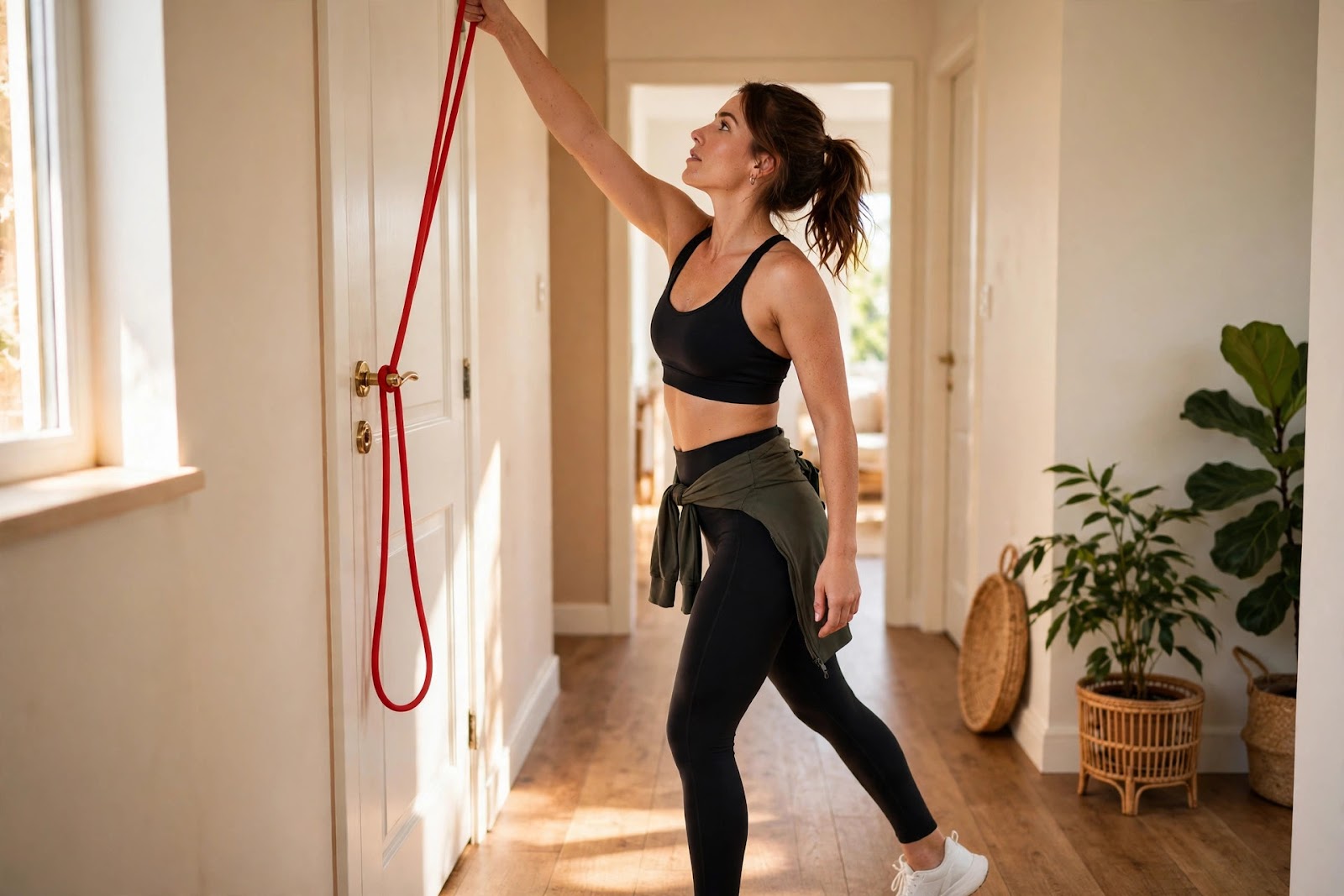
Here is the part that actually made the habit stick. I hung the red band on the handle of my kitchen door, folded in half, so it was the first thing I saw every morning when I went in to make coffee. Not in a drawer. Not in a cupboard. On the door handle, in plain sight, impossible to miss.
The rule I set for myself was simple. Fifteen pull-aparts, once a day, in the kitchen, while the kettle boiled. The kettle takes about two minutes to boil. The pull-aparts take less than one. I do them standing in the kitchen doorway, band in hand, kettle humming behind me, and by the time the water is ready, the exercise is done. No changing clothes, no mat, no timer, no app. Just a band and a kettle.
I tried keeping the band in my bedroom drawer first, for a week. I forgot it existed. Out of sight was out of mind, completely. The door handle changed everything. A habit that lives where you can see it is a habit you actually do. A habit that lives in a drawer is a habit you meant to do.
How I actually do one rep
I stand in the kitchen doorway, feet hip-width apart, knees soft, not locked. I hold the band in front of me at chest height, hands about shoulder-width apart, palms facing down, arms straight but not stiff. My shoulders are down, away from my ears, and my ribs are stacked over my hips, not flared out. That starting position matters. If I start with my shoulders up around my ears, the whole exercise goes into my neck, and my neck does not need more work.
Then I pull. I draw my hands apart slowly, about two seconds, squeezing my shoulder blades together as the band comes toward my chest. I think about trying to hold a coin between my shoulder blades, which is a silly image, but it works. My elbows stay soft, not locked, and my hands end up out to the sides, band touching the middle of my chest.
I pause there for one second. That pause is where the work happens. Without it, I found myself bouncing through the reps, using momentum instead of muscle, and my upper back stayed asleep. With the pause, I can feel the muscles between my shoulder blades switching on, properly, for the first time all day.
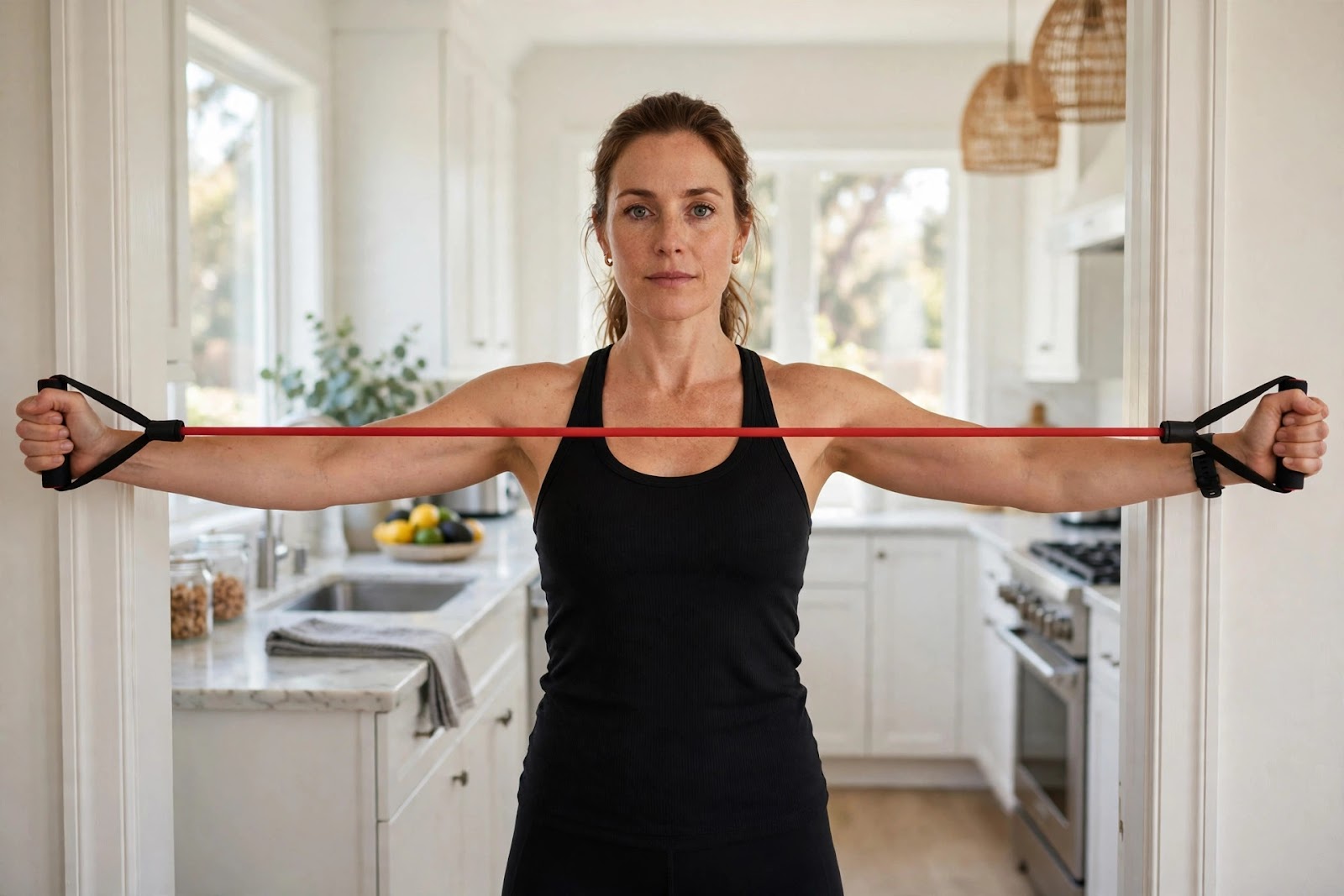
Then I return, slowly, three seconds back to the start, resisting the band the whole way. The return is half the exercise. Letting the band snap my hands back together teaches my shoulders nothing. Fighting it back, inch by inch, is what builds the control.
That is one rep. Fifteen of those, once a day, while the kettle boils.
The first week: finding muscles I had forgotten
Week one was strange, because the exercise felt too easy and too hard at the same time. Too easy, because fifteen reps of a light band is not exactly a workout. Too hard, because by rep ten my upper back was burning in a spot I had never really felt before, right between my shoulder blades, and by rep fifteen my arms were shaking slightly and my shoulders wanted to creep up toward my ears.
The shaking told me something important. Those muscles were not just weak. They were uncoordinated, like they had forgotten how to fire together. The first few days, one shoulder blade would squeeze before the other, and the band would come back uneven, one hand higher than the other. I watched myself in the kitchen window reflection and saw it plainly. Left side lagging, right side doing the work.
I fixed it by slowing down even more, to three seconds out and three seconds back, and by thinking about both hands moving at the same speed, like they were tied together with a string. By day five the movement was even, and the burn was spread across my whole upper back instead of sitting on one side.
My breathing needed work too. I was holding my breath through the squeeze, same as I used to do with squats, and getting dizzy by rep twelve. Now I breathe out as I pull apart and breathe in as I return. Out on the effort, in on the return. It keeps me calm and it stops the breath-holding completely.
The mistakes that nearly killed the habit
I made four mistakes in the first three weeks, and each one nearly cost me the habit, because a habit that hurts or annoys you is a habit you quietly stop doing.
Mistake one was using the green heavy band. I got impatient in week two and switched up, thinking more resistance would mean faster results. It meant my shoulders shrugged, my neck took over, and I woke up the next morning with a stiff neck that lasted two days. I went straight back to the red band. Resistance you can control with clean form beats resistance that wrecks your form, every time.
Mistake two was pulling the band behind my back. I saw a video of someone doing pull-aparts all the way behind their body, and I tried it. My shoulders clicked, my elbows flared, and it felt wrong in a way I did not need a second opinion about. The band touches my chest, no further. That is the range my shoulders are happy with, and I stay inside it.
Mistake three was doing fifty reps in one go. I read somewhere that more is better, and I tried three sets of twenty on a Sunday. My upper back was sore for three days, not in a good way, and I skipped the next two days entirely because it hurt to lift my arms. Fifteen reps, once a day, done consistently, beats fifty reps done once and then abandoned. I know that now because I lived it.
Week by week: what actually changed
Week one was about waking up. My upper back felt used after each session, in a good way, like a muscle that had been reminded it existed. My posture in the mirror had not changed at all, and I did not expect it to. One week is nothing. But I could feel the muscles between my shoulder blades for the first time in years, and that feeling alone was enough to keep me going.
Week two, the movement got even. Both shoulder blades squeezed together, the band came back level, and the shaking stopped. I also noticed something small at my desk. I caught myself sitting up straight without thinking about it, twice in one afternoon. Not a dramatic correction. Just a quiet moment where my body chose the upright position on its own, because the muscles that hold it there were finally awake enough to do their job.
Week three was when other people started noticing. My sister said I looked taller in a photograph, which made me laugh, because I am exactly the same height. What she meant was that my shoulders were sitting further back, and my head was over my body instead of in front of it. I looked at the photograph next to the one from the family lunch, and she was right. The roundness was still there, a little, but it was less. My upper back looked like it was holding me up, not hanging off me.
Week five is where I am now. Fifteen pull-aparts, every morning, kettle boiling, band on the door handle. My shoulders sit back without me policing them. My upper back feels like a part of my body that works, not a part that just holds my head up and complains about it. I will not oversell it. I am not a different person. I am a person whose upper back is awake, and that has made ordinary days noticeably easier.
The progressions that kept it interesting
Once fifteen reps felt comfortable, which took about three weeks, I needed ways to make it slightly harder without buying anything new or turning a one-minute habit into a workout. Three progressions worked, and I use them one at a time.
The first progression was a longer pause. I hold the squeeze for three seconds instead of one, really feeling both shoulder blades meet, before returning. That extra two seconds makes fifteen reps feel like a proper set, and my upper back burns in a way it did not before. I use the long pause on weekdays, when I am in a hurry, because it makes the short session count more.
The second progression was a second set, in the evening, while dinner cooks. Fifteen reps in the morning, fifteen in the evening. That is thirty a day, split across the day, and it never feels like a chore because each set is under a minute. I only do the second set on days when my upper back feels stiff, not every day. On the days I do it, the evening set loosens the stiffness that built up at my desk, and I sleep better for it.
The third progression was moving my hands closer together on the band, which makes each rep harder. I moved my grip in by about five centimetres on each side, which does not sound like much, and it changed the whole feel of the exercise. The last three reps got genuinely hard, and I had to focus to keep my shoulders down. I only use the closer grip on my morning set, and I keep the wider grip for the evening set, so one set is hard and one is easy.
Where the band lives, and why that matters
My kitchen is not a gym, and the band living on the door handle is the whole secret. I have tried keeping exercise equipment in a drawer, in a bag, under the bed, and every one of those places is where good intentions go to die. The door handle is different. I see the band every morning, I touch it every morning, and the kettle gives me a two-minute window that is already built into my day.
If you do not have a door handle that works, hang the band on a hook by the kettle, or drape it over the back of your kitchen chair, or loop it around the tap. Anywhere you stand every morning, waiting for something. The coffee machine, the toaster, the bathroom mirror. The spot matters less than the visibility. It has to be in your path, not in a drawer.
What it did not change
Honesty matters here, so let me say what five weeks of pull-aparts did not do. It did not fix my neck, which still gets tight when I spend too long looking down at my phone, and that is a phone habit, not a band problem. It did not make me strong in the way lifting weights does. My arms are not bigger, my back is not thicker, and nobody looking at me would know I had been doing pull-aparts. It did not replace my walks, and on the days I skip my walk my whole body notices, pull-aparts or no pull-aparts. The pull-apart is an upper-back wake-up call, not a whole fitness plan, and I do not want to pretend otherwise.
It also did not fix my posture overnight. Week one, I looked exactly the same in the mirror. Week two, the same. The change was slow, quiet, and it showed up in how I felt before it showed up in how I looked. That is normal for this kind of work, and it is worth knowing before you start, so you do not quit in week two thinking nothing is happening. Something is happening. It is just happening underneath, where you cannot see it yet.
How to start tomorrow morning
If you want to try this, here is the version I would hand you. Get a light or medium resistance band, the kind that costs about ten to fifteen dollars in a set of three. Hang it on a door handle you pass every morning. Stand with your feet hip-width apart, hold the band at chest height with straight arms, and pull it apart until it touches your chest, squeezing your shoulder blades together. Pause for one second, then return slowly over three seconds. That is one rep.
Start with fifteen reps, once a day, while the kettle boils or the coffee brews. Keep your shoulders down, your ribs in, your grip light, and your breathing steady: out as you pull, in as you return. If fifteen is too many, start with ten. If it is too easy, move your hands closer together, but keep the form clean. No shrugging, no arching, no rushing the return.
Give it three weeks before you judge it. Week one is about finding the muscles. Week two is about making the movement even. Week three is when the change starts showing up, in how you sit, how you carry things, how your upper back feels at the end of a desk day. Keep a little note on your phone: how many reps, how your upper back felt, one line a day. That note is what turns a vague feeling into a story you can actually see.
And if a rep ever hurts, in the sharp way rather than the burning-muscle way, stop. Rest, and if it keeps happening, talk to a professional before you carry on. Burning between the shoulder blades is the point. Sharp pain is not, and no exercise habit is worth pushing through that.
My upper back is not glued shut anymore. My shoulders sit where they belong, my head sits over my body, and the photograph from the next family lunch will tell a different story. Fifteen pulls a day, on a door handle, while the kettle boils. That is all it took.


