Let me be straight with you: I bought resistance bands because I was embarrassed. Not by the bands themselves, but by how many times I had paid for a gym membership and then quietly stopped going. The last one lasted eleven days. Eleven. I kept the card in my wallet for months afterward like some kind of receipt for good intentions.
So one evening, after yet another week of telling myself I would start on Monday, I ordered a set of loop bands and a set of tube bands with handles. The whole thing cost less than a single month at the gym near my house. When the box arrived, I remember thinking this looked too simple to work. A few colorful rubber loops and some handles? That was supposed to replace actual weights?
Eight weeks later, I have a much clearer answer. And it is not the one I expected.
Why I Actually Stuck With Bands This Time
The first reason is boring, and that is exactly why it worked. The bands lived in a drawer in my living room, about ten steps from my couch. There was no bag to pack, no drive across town, no hunting for parking, and no changing room small talk. I could start a workout in the clothes I was already wearing, which, more often than I would like to admit, meant a T-shirt and shorts I had slept in.
I set one rule for myself: three sessions a week, thirty minutes each, no exceptions for being busy but full permission to do an easier session. That second half mattered. On the days I felt tired, I still showed up and did a lighter version instead of skipping entirely. Skipping, I have learned, is the real enemy. One skipped day turns into a skipped week without much effort at all.
My other rule was to keep a notebook on the coffee table. After every session I wrote down what I did, how many reps, and one honest line about how it felt. That notebook is the reason I can tell you what actually happened over those eight weeks instead of guessing.
What My Eight Weeks Actually Looked Like
Here is the routine I settled into after the first messy week. I trained on Mondays, Wednesdays, and Fridays, usually in the evening after work. Each session started with five minutes of easy movement: marching in place, arm circles, and some gentle band pull-aparts to wake my shoulders up. Then I did four moves, three sets of each.
For legs, I did band squats with a loop band just above my knees, three sets of twelve to fifteen reps. I also did glute bridges with the same band, three sets of fifteen, holding the top for a slow count of two. For my upper body, I did band rows by looping a tube band around a sturdy door anchor, three sets of twelve, and overhead presses standing on a tube band, three sets of ten to twelve. I finished with a dead bug core exercise, three sets of eight per side, no band needed.
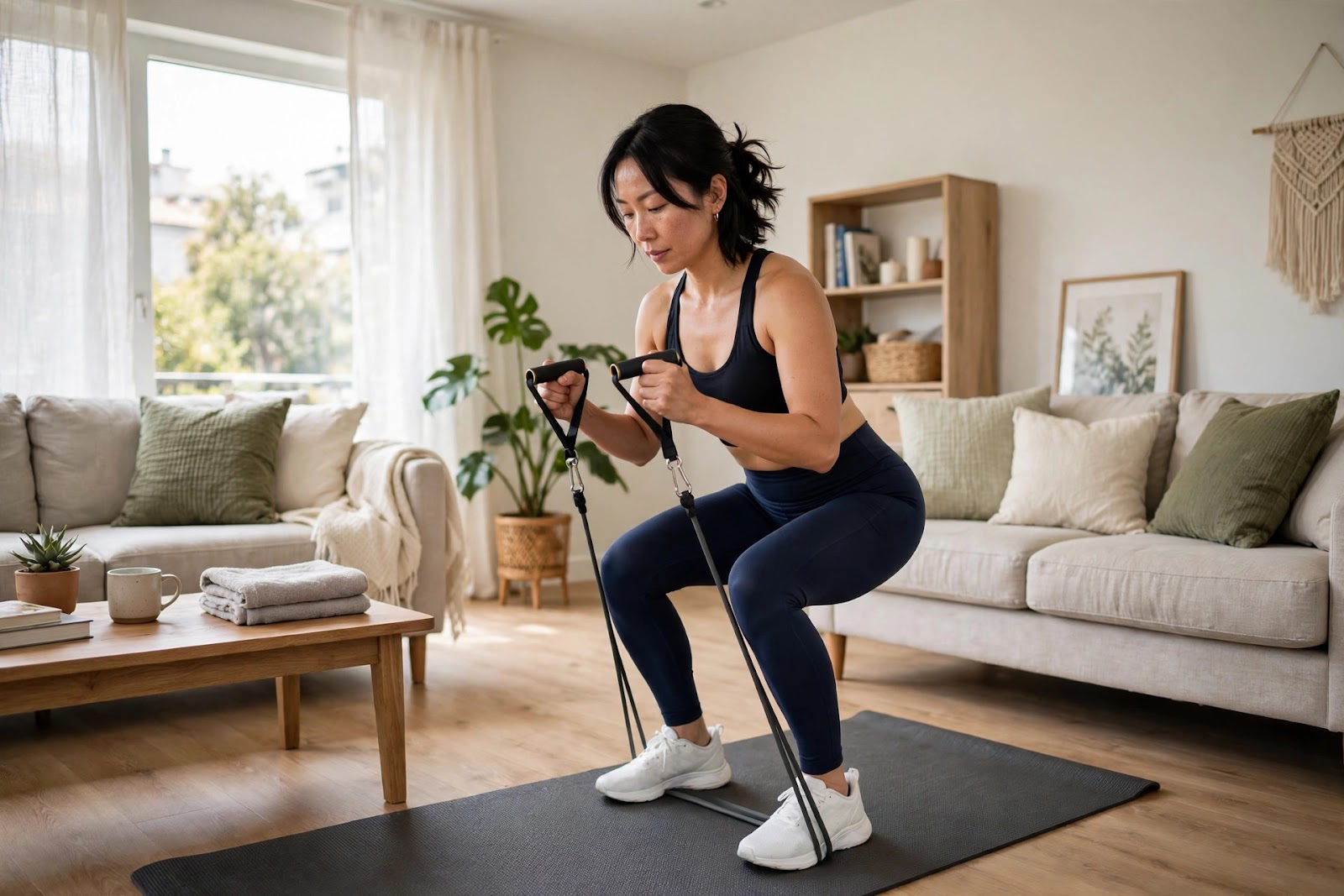
That was it. No fancy programming, no twenty-move circuit I found on the internet. Just four moves I could remember without checking my phone.
In week one, the light green loop band felt hard enough for squats. By week four, I had moved to the blue one, and by week six I was doubling up, using the green and blue together for glute bridges because a single band had stopped feeling like much. That progression felt surprisingly good. It was the first time in years that getting stronger was something I could see week to week, written in my own handwriting.
The Week I Almost Quit
Week three nearly ended the whole experiment. I had a bad few days at work, slept terribly, and woke up on Friday with zero interest in exercising. I did the session anyway, grumpily, and halfway through my band row I felt a sharp twinge in my shoulder. Nothing dramatic, but enough to scare me.
I stopped right there. I did not push through it, and I am glad I did not, because the next day my shoulder was just mildly sore rather than genuinely painful. When I looked back at my notebook, I spotted my mistake immediately. I had jumped from the light tube band to the heavy one for rows in a single week because I was impatient. I had skipped the middle band entirely, and my form had fallen apart as I yanked the band instead of pulling it steadily.
So I dropped back down a level, slowed every rep to about three seconds on the way back, and kept my shoulders down and away from my ears. The twinge never came back. That week taught me the most useful lesson of the whole eight weeks: bands punish sloppy, rushed reps just like weights do. The resistance feels easy at the start of a rep and hardest at the end, which means cheating the last few inches is tempting and also pointless.
I should also say this plainly. This is my personal experience, not medical advice. If something hurts in a sharp or lasting way, or you have an existing injury or condition, check with a doctor or physiotherapist before copying anything I did. I am just a person who worked out in his living room, not a professional.
What Bands Do Well, and Where They Fall Short
Let me tell you what genuinely impressed me. Bands are kind to small spaces and kind to joints, at least in my experience. The tension builds gradually through each rep, so there is no heavy weight crashing down on you at the bottom of a squat. My knees, which used to complain after barbell squats years ago, stayed quiet through all eight weeks. I also loved how easy it was to change exercises. Moving from rows to presses took about thirty seconds of re-anchoring a band, not a trip across a gym floor.

Travel was another surprise win. In week seven I visited family for four days and packed two loop bands in my bag. They weighed almost nothing. I did two short sessions in a spare bedroom and came home without feeling like I had lost a week of progress. A dumbbell set could never have done that.
But honesty cuts both ways, so here are the real limits I ran into. First, it gets harder to keep progressing. With weights you just add a small plate. With bands, the jump between levels can feel big, and doubling bands up gets awkward. By week eight, my glute bridges needed a stronger band than I owned, and I had to slow the reps down and add pauses to keep them challenging.
Second, bands are not great for every goal. If you dream of lifting very heavy weights someday, bands alone will probably not get you there. They are a tool, not a complete replacement for a barbell. And third, cheap bands snap. One of my oldest loop bands, a thin one I had bought years earlier and dug out of a drawer, broke mid-rep in week two. It stung my leg, left a red mark, and taught me to inspect bands before every session and replace any that look nicked, faded, or cracked.
The results, for what they are worth: after eight weeks I could do more reps with heavier bands than when I started, my jeans fit a little better around the waist, and climbing the stairs to my flat stopped leaving me winded. I did not transform into a different person. I did not take dramatic before-and-after photos. I just got noticeably stronger and more consistent, which, at this point in my life, counts as a win.
The Routine I Would Hand a Friend
If a friend asked me where to start, I would tell them to buy a set with at least four loop levels and a tube set with handles and a door anchor, and to spend the first week learning form with the lightest bands. I would tell them to pick four or five moves they actually like, write every session down, and train three times a week for a month before judging anything.
I would also tell them to set the bands up the night before. Mine live in a small basket by the mat now, not in a drawer. That tiny change removed my last excuse. When the equipment is already out, starting feels like less of a decision.
Would I still use bands now that the eight weeks are over? Yes, and I do. They are my weekday training now, and I go to a gym once in a while when I want heavier weights. The bands did something no gym membership ever managed: they got me to show up three times a week, eight weeks in a row. That consistency is worth more than any perfect program I never actually did.
If you are standing where I was, staring at a gym membership you are not using, a set of bands is a cheap, honest place to start. Just respect the progression, watch your form, and give it the full eight weeks before you decide.


