For two years I finished every home workout the same way: I stopped. Last rep done, dumbbells on the floor, straight to the sofa. Sometimes I'd grab a glass of water on the way. Sometimes I wouldn't even do that. The workout was over, so in my head the job was done.
Then came the morning after a leg day in late September. I woke up, swung my legs out of bed, and my quads refused to cooperate. I had to hold the bannister with both hands to get downstairs, one step at a time, like someone twice my age. My calves felt like they'd been shrink-wrapped overnight. And the worst part? I'd done a perfectly good workout the day before. The training wasn't the problem. The five minutes after the training were.
I'd always treated the warm-up as sacred — five minutes of leg swings and marching before I touched a dumbbell — but the cool-down got nothing. Zero minutes. It seemed like a luxury for people with spare time, and I never had spare time. What I had, apparently, was spare stiffness.
So I made a deal with myself: five minutes, after every workout, no exceptions, for three weeks. Not a twenty-minute yoga flow. Not a foam-rolling ceremony. Five minutes, four stretches and some slow breathing, done on the same mat I'd just trained on. Three weeks later the bannister mornings were gone. Here's exactly what I do, minute by minute, and the three mistakes that kept ruining it before I got it right.
The five minutes, minute by minute
Minute one is just walking. Not stretching, not sitting — walking. I walk slow laps around my flat, from the kitchen to the front door and back, about eight slow laps. My heart rate comes down gradually instead of crashing, and my breathing settles on its own. This is the part I used to skip entirely, and it's the part that makes everything after it work better. Stretching a muscle that's still buzzing from a hard set feels like pulling on a rope that's already taut. Give it sixty seconds to slacken first.
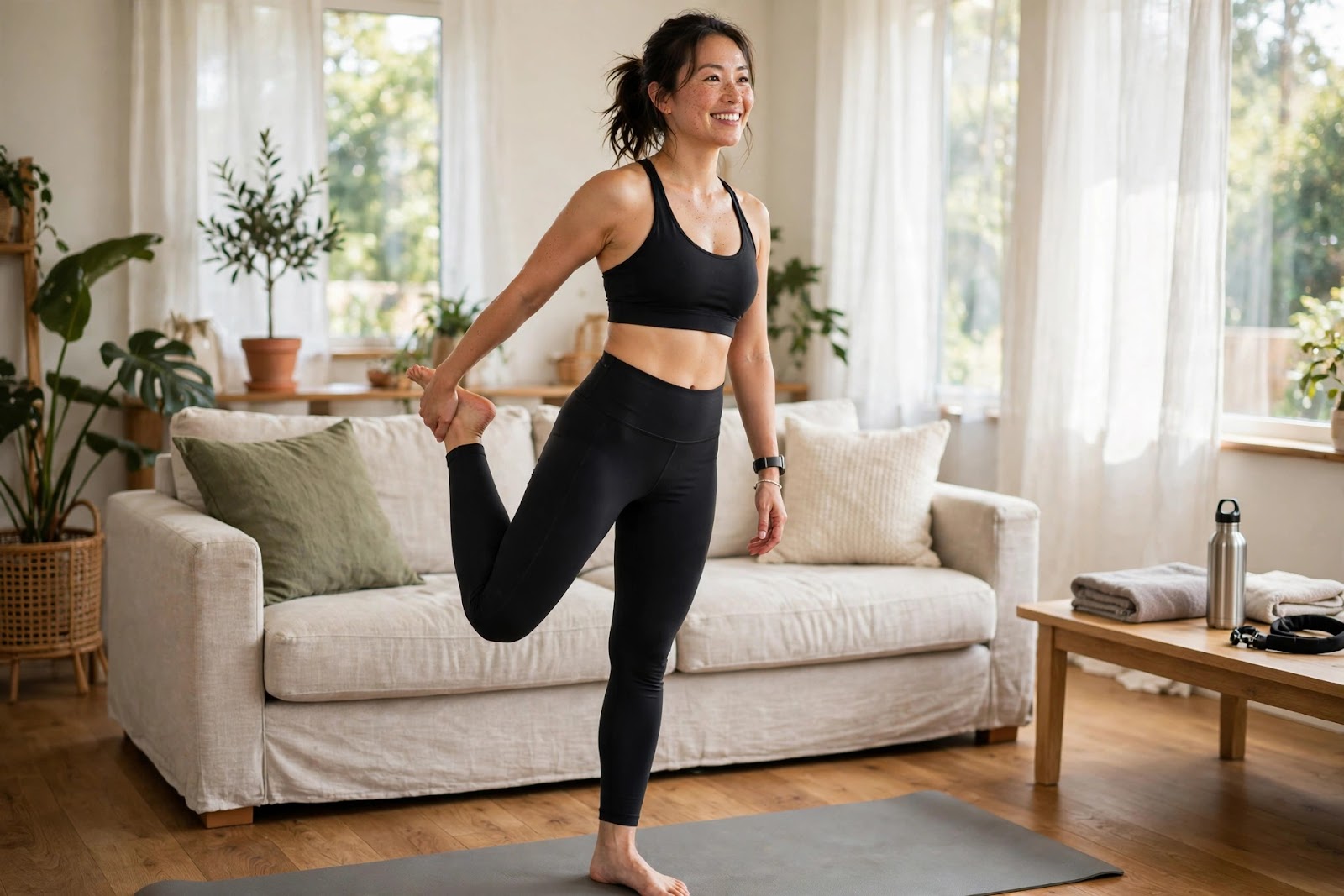
Minute two is legs. I stand next to the sofa for balance and do a standing quad stretch — pull one foot up behind me, hold it with the same-side hand, knees close together, thirty seconds per leg. Then I face the wall, hands flat against it, and stretch my calves: one foot back, heel pressed into the floor, knee straight, thirty seconds per leg. The calf stretch is the one that changed my mornings the most. I'd been ignoring my calves for years because they never hurt during workouts. They only ever complained the next day, quietly, on the stairs.
Minute three is the hips and hamstrings. I put one foot up on the sofa seat — it's about knee height, which is perfect — and lean forward gently from the hips until I feel a stretch down the back of that leg. Thirty seconds each side. Then I do a standing figure-four: cross one ankle over the opposite knee, sit back like I'm lowering into an invisible chair, hands on the sofa arm for balance. This one loosened something in my hips that no amount of leg swings ever had. My hips are the first thing to tighten up after a day at my desk, and they were the last thing I ever stretched.
Minute four is the upper body, which I used to skip because "I only trained legs today". Bad logic. My shoulders carry tension from the desk all day, workout or not. I clasp my hands behind my back and lift them gently until my chest opens up, holding for thirty seconds. Then I bring one arm across my chest and hug it in with the other hand, thirty seconds per side. It takes ninety seconds total and it undoes eight hours of hunching over a keyboard. That alone would be worth the five minutes.
Minute five is the floor. I lie on my back on the mat, knees bent, feet flat, and just breathe. In through the nose for four counts, out through the mouth for six. Five slow breaths. Sometimes I let my knees drop gently to one side for a slow spinal twist, thirty seconds each way, but honestly the breathing is the main event. It tells my body the work is finished. I used to walk straight from a workout into emails with my heart still pounding, and then I'd wonder why I felt wired and exhausted at the same time. Five slow breaths fixed that too.
Why slow beats hard here
The first version of my cool-down failed because I treated it like another workout. I bounced into stretches, pushed into the deepest position I could reach, and held my breath while I did it. My hamstrings would protest, I'd push harder, and the next morning I'd be stiffer than if I'd done nothing at all. Bouncing and forcing is the opposite of what a cool-down is for.
Now I follow one rule: stretch to the point where I feel a gentle pull, then back off about ten percent. The stretch should feel like a relief, not a fight. If I'm wincing, I've gone too far. If I'm holding my breath, I've gone too far. The whole point is to let the muscles relax, and a muscle that's being yanked into a position it doesn't trust won't relax — it'll guard harder.
I also stopped counting in my head and started counting breaths instead. Four slow breaths per stretch, roughly thirty seconds. Counting breaths keeps me honest about the time — my old habit was to hold a stretch for what felt like thirty seconds and actually hold it for eight. Breaths don't lie the way my internal clock does.
The three-week test I actually ran
I'm the kind of person who needs proof before I'll keep doing something boring, so I ran a little test on myself. For three weeks I rated my morning stiffness every day on a scale of one to ten — one being loose as a goose, ten being the bannister morning. I wrote the number on a sticky note on the fridge. Nothing fancy, just a daily number.
Week one, the average was a six. That's with the cool-down done after every single session, three sessions a week. Not impressive. I nearly quit on day five, convinced it wasn't working. But the numbers were already moving: the worst day of week one was an eight, and by the end of the week the worst day was a six.
Week two, the average dropped to a four. The change I noticed first wasn't in my legs at all — it was my shoulders. I stopped waking up with that tight band across the top of my back, the one that used to need a hot shower to loosen. The chest-opener stretch in minute four was doing more than I gave it credit for.
Week three, the average was a three, and the bannister mornings were gone completely. I could walk downstairs normally the morning after leg day. Not pain-free — my quads still felt worked, still felt like they'd done something — but normal. The stiffness had stopped being the story of my morning. Three weeks, fifteen minutes of cool-down total per week, and the single most annoying part of my training routine just... went away.
What it didn't fix (being honest)

A cool-down is not magic, and I don't want to oversell it. The first time I tried a brand-new exercise — Bulgarian split squats, which humbled me completely — I was sore for three days no matter what I did afterwards. New movements make you sore. That's your body adapting, and no amount of gentle stretching will cancel it. What the cool-down did was take the everyday stiffness down a notch, not eliminate soreness entirely.
It also didn't fix my sleep, my energy, or anything else I secretly hoped it might. It's five minutes of stretching and breathing. It does what five minutes of stretching and breathing can do: it helps me feel looser the next morning and calmer in the evening. That's genuinely useful. It just isn't a miracle, and anyone selling it as one is selling something.
The three mistakes that kept ruining it
Mistake one: doing it on the sofa. For the first week I'd flop onto the sofa and stretch from there — one leg up on the coffee table, half-watching TV. It never worked. The sofa is where my body goes to switch off, and it switched off too well; I'd do two lazy stretches and call it done. The mat is the rule now. Cool-down happens on the mat, in the same spot as the workout, before I sit down anywhere. Location is the whole trick.
Mistake two: skipping it on "easy" days. I'd do a full cool-down after leg day but skip it after a short upper-body session, because that felt like it didn't count. Then I'd wake up with tight shoulders and wonder why. The truth is my shoulders need the cool-down more after upper-body work, not less. The rule is now every session, no matter how short. A ten-minute workout still gets a five-minute cool-down. It sounds disproportionate until you remember the cool-down is what lets you train again tomorrow.
Mistake three: turning it into a flexibility contest. I caught myself trying to reach further every single day, as if the stretch were a lift I had to progress. One evening I pushed a hamstring stretch so far I felt a sharp pull and spent the next two days walking carefully. Flexibility work has its place, but the cool-down isn't it. The cool-down is maintenance, not training. Gentle pull, breathe, move on.
Try it after your next session
You don't need my three-week test to start. After your next workout, before you sit down, walk one slow lap around your flat. Then do the quad stretch and the calf stretch, thirty seconds each side. That's two minutes. If you stop there, you've still done more than I did for two years.
But if you've got the full five minutes, add the hip stretch, the chest opener, and the five slow breaths on the floor. Do it after every session for two weeks and pay attention to your mornings. That's the only metric that matters — not how deep you can stretch, not how flexible you look, just whether the stairs feel normal the day after leg day. Mine do now, and the only thing I changed was five minutes I used to think I didn't have. The bannister mornings are over, and honestly, I should have started this two years ago.


